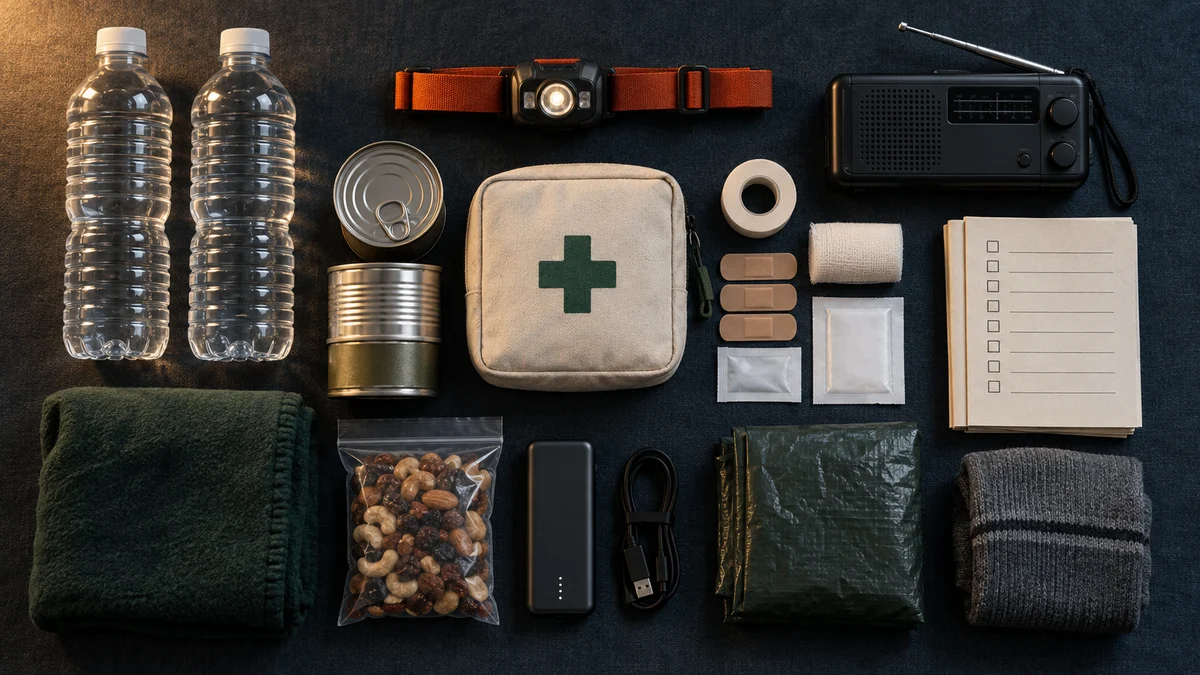
Hurricane Helene came ashore in Florida’s Big Bend late on September 26, 2024, then did what hurricanes are not supposed to: it kept going, inland and uphill. By the next midnight the National Weather Service was measuring 12 to 20 inches of rain across western North Carolina, with winds of only 40 to 60 mph that, it notes dryly, “led to extensive and long-lasting power outages.” Hundreds of miles inland, in towns where nobody owns a hurricane shutter, the water and the lights went out together. That is the week a 72 hour emergency kit is built for.
A year later, FEMA was still counting: eight states affected, more than 107 million cubic yards of debris cleared, 1,026 families still in disaster housing. That last number is the premise of this whole page. When a disaster is wide, help does not arrive on a schedule; it arrives in the order the system can manage, and for the first stretch you run on whatever is already inside your house.
Not the end of the world, then. Three days in which the things that normally just happen — water at the tap, light at the switch, news on a phone, a card reader that works — stop happening. Ready.gov has asked American households to prepare for exactly this for years, and it publishes a list. What it does not publish is how many gallons, how many meals, or where any of it goes in a one-bedroom apartment with no basement. That part is this guide.
Why 72 hours, and who actually decided it
The number is not folklore. It comes from the federal preparedness guidance, and the reasoning behind it is logistical rather than dramatic.
Ready.gov’s basic disaster supplies kit opens with a single sentence that contains the whole arithmetic: “Water (one gallon per person per day for several days, for drinking and sanitation).” Then food, “at least a several-day supply of non-perishable food.” Then a battery-powered or hand crank radio and a NOAA Weather Radio with tone alert, a flashlight, a first aid kit, extra batteries, moist towelettes and garbage bags, a “wrench or pliers (to turn off utilities),” a manual can opener, local maps, and a phone with chargers and a backup battery.
Read it closely and you notice what it is not. No knife on that list, no fire steel, no shelter. It is not a wilderness list. It describes a house that has stopped working, written by people whose job is reaching a lot of houses at once.
Why three days rather than one? Because one day is a bad outage and three days is a regional event, and the two behave nothing alike. In a bad outage the utility has crews on your street by morning. In a regional event those crews are triaged across six counties, the grocery store cannot take a delivery because the interstate is closed, and the shelter that opens on day two is forty minutes away.
Why not two weeks? Because fourteen days is a different discipline — calories counted, fuel stored, a rotation schedule — and telling a household that owns nothing to start there is how you get a household that still owns nothing a year later. Three days is two weekends and one grocery run. Long-term emergency preparedness picks up at two weeks and a month, where the math changes shape.
So 72 hours is a floor, not a ceiling — the line under which no household should ever need anyone. Where the number came from, what it is really measuring, and the American disasters that have run straight past it are the subject of why 72 hours, which is worth reading before you decide the floor is high enough for where you live.
The seven posts of a 72 hour emergency kit
Ready.gov gives you a shopping list, and a shopping list is hard to audit: you cannot tell by reading one whether you are fifteen percent ready or eighty. So this guide regroups the same contents into seven posts, and each post either works or it does not.
Water. Food. Light and power. Information. First aid and sanitation. Documents and cash. The family plan.
The grouping matters because a kit does not fail on its average. It fails on its weakest post. A household with four headlamps, a beautiful first aid kit and no water is not eighty percent prepared; it has a water problem, and every other item is a rounding error beside it. The order below is the order of collapse — water first because you cannot improvise it, the plan last because it costs nothing and decides whether the rest gets used.
Water: the post you cannot improvise
Everything else on this page is arguable. Water is not.
What happens when the tap stops
People assume a power outage leaves the water alone. In a single-family home on municipal supply it often does, for a while. In an apartment building it usually does not, because the booster pump that lifts water above the third floor runs on the same electricity as everything else. On a private well it certainly does not: no power, no pump, no water.
Contamination is the more common version. Flooding pushes a system into a boil-water notice that outlasts the outage by days; a main break during a freeze does the same. The tap runs, and the water is not safe. In every case the reflex is the same — drive to the store — and the water aisle emptied two hours after the first alert.
How much, and in what form
Ready.gov is unambiguous: “Store at least one gallon of water per person per day for several days, for drinking and sanitation.” It adds three qualifiers most people skip. Children, nursing mothers and sick people may need more. In a warm climate more is necessary, and “in very hot temperatures, water needs can double.” A medical emergency might require additional water.
Three gallons per person covers 72 hours. For four people, twelve gallons — about four cases of bottles, lying flat in roughly two feet square. Less than people picture.
But twelve gallons of bottled water is an awkward way to flush a toilet, so split the post. Bottled water in its sealed original container, in a cool dark place, is the drinking supply; that is Ready.gov’s own instruction, and it carries the useful footnote that water which has not been commercially bottled “should be replaced every six months.” A separate refillable container handles washing, dishes, and the bucket you pour into the toilet tank. A five-gallon water jug with a spigotaff. is the best first purchase on this page: it refills at the kitchen sink, it pours without anyone lifting forty pounds, and it goes camping the rest of the year.
The water you already have and have not counted
The moment an alert goes out — a hurricane watch, a winter storm warning, a scheduled outage notice — fill the bathtub and two stockpots. That is not drinking water. It is flush-and-wash water, and it protects the bottled supply.
Your water heater holds thirty to fifty gallons in a tank with a drain valve at the bottom, usable for washing once the power or gas to it is off — find that valve on a calm Saturday, not during the event. Ice in the freezer melts into another gallon or two. None of this replaces stored water; it explains why the drinking supply can sit at the federal minimum without the household running short.
Treatment is the last line, not the first. Water purification tabletsaff. belong in the bin, and they matter only once the stored supply is gone and the tap is questionable. Follow the label: dose and contact time are the whole product. The full method — containers, rotation, boiling, filtering, chemical treatment, and how each fails — is the subject of the emergency water storage article.
Three days of food with no refrigerator and no stove
The second post is where store-bought kits do the most damage, because ration bars photograph beautifully and nobody eats them.
What breaks
Hour four, the refrigerator is still cold and everyone is smug. The CDC puts the refrigerator’s safe window at four hours, a full freezer at 48 and a half-full freezer at 24, with anything thawed or above 40°F thrown out. So the first evening is a good dinner: you cook what would spoil anyway. The second morning is the problem. The pasta wants twelve minutes of boiling water and the cooktop is dead. By day three people are eating crackers and getting irritable, its own hazard when decisions still need making.
Nine meals a person, and none of them wait on anything
Three meals a day for three days. For a household of four, thirty-six. The rule for that shelf is boring on purpose: it has to be something this household already eats. Canned chili, soup, tuna, beans, ravioli. Peanut butter. Shelf-stable milk. Crackers, dried fruit. Applesauce pouches for the kids, which need no bowl, no spoon and no water. Buy shelf-stable canned meals with easy-open lidsaff. and the post is solved in one cart, with the side effect that it rotates itself through normal dinners.
A manual can opener. It sounds like a joke until it is not: it is on Ready.gov’s list by name, and the most reliably missing object in American kitchens otherwise full of cans.
For hot water, a portable butane camp stoveaff. covers three days of coffee, noodles and warmed bottles. Outside or by an open window, never under a dead range hood, and never — this is not negotiable — as a heat source for a room. That distinction is the whole subject of the guide on heating a house without power, which opens by ruling out the three improvisations that send people to the emergency room every winter.
Three days of food is a cabinet. Two weeks is an inventory with dates on it, and that belongs to long-term food storage.
Light and power: what fails at hour four
At 8 p.m. everyone turns on their phone’s flashlight. At 11 p.m. every phone is at twelve percent, there is no light and no way to receive an alert. It happens in essentially every outage, and it is the cheapest problem on this page to fix permanently.
One light per person, not one per house. A single shared flashlight means one person moves and everyone else sits still in the dark, and it means the light goes into a kid’s bedroom and never comes back. A LED headlamp with a red modeaff. beats a flashlight for the same money: it leaves both hands free to work a can opener, carry a toddler down a stairwell or find the breaker panel, and the red setting keeps night vision intact instead of blinding the person across the table.
For the room everyone ends up in, add a battery-powered LED lanternaff.. Set in the middle of the table it lights a meal without anyone holding it, and it cannot fall onto a tablecloth, which candles can and do during precisely the days when fire response times are longest. Candles come out of the kit.
Batteries deserve one sentence of opinion: buy lithium AAA batteriesaff. and nothing else for this bin. Alkalines leak, and a leaking cell takes the headlamp with it.
Then the phone. A charged 20,000 mAh power bankaff. with its own cable, living in the bin, keeps the household receiving alerts and sending “we’re fine” texts on day two. One bank per two phones covers three days. Anything larger — a power station, a folding solar panel, a generator — is a two-week question, argued out in portable power station vs generator. What fails at which hour, what to throw out when the power returns, and how to run a house cold for days is the ground of the extended power outage guide.
Information when the cell towers go quiet
Helene is instructive here too. Cell sites carry battery backup measured in hours, and generators at the bigger ones measured in days if the fuel truck can reach them. In western North Carolina it could not: the roads were gone. For a stretch, whole counties ran on word of mouth.
That is the argument for a receiver that depends on nothing local. NOAA Weather Radio All Hazards is, in the National Weather Service’s own words, “a nationwide network of radio stations broadcasting continuous weather information directly from the nearest National Weather Service office,” running “more than 1000 transmitters, covering all 50 states, adjacent coastal waters, Puerto Rico, the U.S. Virgin Islands, and the U.S. Pacific Territories.” Not only weather, either: chemical releases, AMBER alerts and 911 outages travel on it too. It wants a receiver tuned to one of seven VHF channels between 162.400 and 162.550 MHz.
A hand-crank NOAA weather radio with a solar panelaff. solves all three failure modes at once: no grid, no fresh batteries, no signal from anything else. Get one with tone alert, which wakes the radio when a warning is issued for your county instead of asking you to listen continuously. Then write your channel number and two AM stations on an index card and tape it to the back. Nobody recalls a frequency at eleven at night.
The phone still matters. Wireless Emergency Alerts are “short emergency alerts authorities can send to any WEA-enabled mobile device in a locally targeted area,” sent by state, local, tribal and territorial officials and the National Weather Service among others. You are not charged, and there is nothing to subscribe to — so the only thing required of you is not switching them off, which a surprising number of people have. Check that setting tonight. Which receiver wins in which situation, and why a car radio is a better backup than people think, is compared channel by channel in the emergency weather radio guide.
First aid, sanitation, and the part that is not mine to size
A first aid kit is not a pharmacy. It exists to clean and cover a wound, immobilize a wrist, pull a splinter, cool a minor burn — while you wait for a professional, or because none is reachable.
Gauze, tape, adhesive bandages in several sizes, antiseptic, nitrile gloves, shears, tweezers, a mylar blanket, a thermometer, and a laminated instruction card, because under stress nobody remembers anything. A stocked family first aid kitaff. saves an hour of shopping; open it the day it arrives and check that it really contains sterile gauze pads in quantity, the line every cheap kit thins out.
Then sanitation, the post everyone skips and nobody should. Ready.gov puts “moist towelettes, garbage bags and plastic ties” in the basic supplies, not the nice-to-haves. Three days without a flushing toilet, with kids in the house, breaks a household that is otherwise well lit and well fed. For an apartment above the pump line, emergency toilet bags with gelling powderaff. and a five-gallon bucket are twenty unglamorous minutes people are glad to have spent.
One more line belongs here rather than in the warmth section: a carbon monoxide alarm on every sleeping level. Generators, charcoal, camp stoves and gas ovens pressed into service as heaters all produce carbon monoxide, it has no smell, and the pattern repeats in every major winter event. A battery-operated carbon monoxide alarmaff. is the cheapest thing in this bin that is genuinely about not dying. The rule never changes: detector, ventilation, and if it sounds, everyone outside and call 911.
What does not go on a shopping list
Ongoing prescriptions. A household where someone takes a daily medication — heart, thyroid, diabetes, asthma — needs a few days of it within reach, with the prescription list. How many days, how to store it without refrigeration, whether an early refill is possible on your plan: none of that is a question this site can answer.
Documents and cash you cannot re-print in a week
A flood or a house fire destroys paperwork in an hour. Replacing it takes months, at exactly the moment you are being asked to prove your identity, your address and your insurance coverage in order to get help.
Into a waterproof, fire-resistant document pouchaff.: copies of every driver license and ID, birth certificates, the homeowners or renters policy with its claims number, the flood policy if you carry one, current prescriptions, vehicle titles, the lease or deed, pet vaccination records, a handwritten page of phone numbers, and an encrypted USB drive with the scans. Then cash in small bills, because card readers and ATMs sit downstream of the same grid as everything else.
Why paper, in 2026? Because the desk at a disaster recovery center runs on paper, because your phone may be the thing that got wet, and because a borrowed phone does not have your password manager on it. The full inventory, plus the uncomfortable test of what you could still prove if your phone died right now, is in important documents in an emergency.
The family plan: the page the bin does not hold
It is a Tuesday at three in the afternoon. A household of four is in four buildings: an office, a job site, an elementary school, a daycare. The kit is in the apartment, and it is worth nothing until somebody knows what to do.
Ready.gov frames the plan as questions rather than a form: how will I receive emergency alerts and warnings, what is my shelter plan, what is my evacuation route, what is my household communication plan. Answer them on one sheet of paper.
A meeting point on foot near the house, for a fire or a building evacuation. A second outside the neighborhood, for the day you cannot get back to the first. An out-of-state contact everyone can text, because a short message to a distant number often gets through when local calls are jammed. Where the water, gas and electrical shutoffs are. Medications and allergies. The school’s release policy and who is authorized to pick up. The animals.
Print it. One copy in the bin, one in each go bag, one with the out-of-state contact. Then read it out loud once at the dinner table — a plan nobody has heard does not exist — and make sure the kids know the contact’s number and the first meeting point by heart.
Doing the arithmetic for your own household
The word “kit” implies a standard object, and that is the most expensive misunderstanding on this page. A kit for one graduate student in a studio and a kit for two adults, an infant, a grandmother on daily medication and a dog have exactly one item in common, and it is the radio.
The builder below does that multiplication for the household you actually have — adults, children, infants, dogs, cats, and whether there is a daily prescription in the house — and hands back the seven posts with quantities and a print button.
The builder — your household, three days
The federal list, with your numbers in it
Ready.gov gives the list. You give the household. The builder does the multiplication and hands back a printable kit, post by post, in gallons and meals.
A kit is a twice-a-year habit. Want the reminder?
Water dates, canned goods, batteries, the charged power bank, the family plan sheet: half an hour, twice a year. Leave your email and we send the reminder in spring and in fall — nothing else.
Infants, kids, older adults, animals
An infant moves the proportions more than any other variable. Ready-to-feed formula rather than powder, because powder needs safe water you may not have. Diapers at roughly eight a day. Extra warm layers, because small bodies lose heat fast in a house with no furnace.
Children need something to do, and that is a supply, not a luxury — Ready.gov lists children’s activities among its additional supplies for a reason. A deck of cards or a small travel gameaff. holds an evening under a lantern with no screen and no battery, which no dead tablet will do.
An older adult, or anyone with mobility needs, adds medications, spare glasses, hearing aid batteries and any device that plugs in — which changes the power arithmetic and may push the household toward long-term emergency preparedness.
Animals add water — about half a gallon a day for a medium dog — three days of their usual food, a leash or carrier within reach, and their vaccination record in the pouch. Worth knowing in advance: a shelter that takes people does not always take pets.
Starting from zero, in the right order
Three passes, not one.
The first weekend buys water and light: the cases, the jug, one headlamp per person, lithium batteries. That is the floor, and it already carries a household through a night-long outage without anyone hunting through drawers. The second buys food and information: nine meals per person from aisles you already shop, the can opener, the stove and fuel, the weather radio. The third handles what needs an appointment rather than a cart — the doctor, the photocopying, the USB drive, the cash, the plan sheet filled in at the table.
That order runs from the post you cannot improvise to the one you can defer a week, and it front-loads the purchases while the motivation is fresh. The line-by-line version, with per-person quantities in the same sequence, is the 72-hour kit checklist.
What is useless in a pre-made kit
Said once, plainly: most “survival kits” sold online are assembled for a product photograph, not for a household.
| What is in the boxed kit | What it is actually worth at home |
|---|---|
| Folding knife, wire saw, fire starter | You have a kitchen. These prepare a forest, not an apartment with no power. |
| Candles and “storm matches” | An ignition source during the exact days when fire response is slowest. A lantern does the job with none of the risk. |
| Compressed ration bars | Expensive, unpleasant, never eaten, therefore expired. Nine meals of food you already buy beats them outright. |
| Whistle, signal mirror | Genuinely useful in a backcountry rescue. In a building, you knock on a door. |
| A single sachet of purification tablets | Useful, but in the buyer’s mind it substitutes for a water supply. It supplements one. |
| The backpack itself | A 72-hour kit at home lives in a bin. The bag is for leaving — a different object entirely. |
What those kits almost never contain: water in any real quantity, a prescription advance, copies of your documents, a written plan, a can opener, a radio that receives the National Weather Service. The parts that matter. They sell the visible half.
There are honest exceptions — kits sold explicitly as a starting point, with the maker listing what you must add. Buy that kind, and treat its “add your own” list as the real homework. The bag you take when you leave is a separate build with its own weight rules and its own guide: the go bag.
Where it lives, including in an apartment with no basement
A kit is only useful if it sits somewhere everyone can name without thinking, reachable in the dark, not behind the summer luggage.
A bin, not a bag
A rigid plastic bin with a latching lid, roughly fifteen to twenty gallons, labeled in marker. It keeps out damp and mice, it stacks, one adult can carry it. It holds everything except the water, which stays beside it on the floor in cases.
In a house
The garage or the utility room, as long as neither freezes in January — water expands, cans split — and neither bakes in August. Never a flood-prone basement: a kit meant for a flood cannot be underwater. The entry closet is often the best answer, since it sits on the way out and lives at house temperature.
In an apartment
The common case, and not harder — only more compact. The bin goes at the back of the entry closet, or becomes a nightstand with a board on top; if the only free volume in the place is under the bed, a shallow under-bed storage container with a latching lidaff. holds the whole kit at six inches of height and rolls out without moving furniture. The water distributes: two cases under the sink, one in the coat closet, one behind the couch. Twelve gallons does not need to be in one place; it needs to be counted. The radio and one headlamp live in the kitchen drawer, because at eleven at night that drawer is where a hand goes first.
If there is a car, four things in the trunk cover the outage that catches you away from home: a headlamp, a gallon of water, a charged power bank, and a wool-blend emergency blanketaff., which stays useful in a cold vehicle in a way the foil sheets do not.
Rotation: half an hour, twice a year
A kit is not a purchase. It is a subscription to thirty minutes, twice a year. Skip those and in four years you own a bin of dead batteries.
Two easy anchors: the fall time change, before winter storm season, and the spring one, ahead of heat and severe weather. Everything comes out onto the table. Check dates, eat what is close to expiring and replace it, recharge the power bank, test the radio and every lamp. Empty and refill the jug — Ready.gov’s six-month replacement rule for water that was not commercially bottled is exactly this cadence. Reread the plan sheet and fix it, because a school changed a rule and a phone number stopped working.
Then write the next date on the lid in marker. More reliable than a reminder you will snooze.
Before any of that, it helps to see where you stand. The gauge below is not another questionnaire: tick what is already in the house and the bars redraw, one per post, so the short one shows up before you read a word of text.
The gauge — seven posts, one chart
Where does this household actually stand?
Tick what is already in the house. The bars redraw as you go. A kit does not fail on its average — it fails on its shortest bar, and that is the one this names.
Coverage by post
0 / 28 in the house
Drawing it rather than scoring it is the point, because an average hides the failure. Eighty-five percent overall with water at zero is not a good kit. It is a water problem wearing one. Fix the short bar, then come back.
Where household preparedness stops
Three days covers the likely scenario: an outage, a storm, a boil notice. Three situations run past it, and each has its own guide because each changes the reasoning rather than the quantities.
The first is leaving. The bin stays home; what you carry is a go bag, with its own weight limits and contents, and the decision to evacuate belongs to local officials, not to the bag.
The second is the hazard that comes with where you live — hurricane coast, tornado corridor, wildland-urban interface, floodplain. Natural disaster preparedness starts from your geography and works out which risks are actually yours.
The third is duration: repeated outages, supply disruptions, a month rather than a weekend. That is long-term emergency preparedness, where backup power stops being optional.
And the fourth, which is not a scenario: the health line. Prescriptions, wound care past a bandage, wiring a generator into a panel, anything involving gas. Those belong to a physician, a pharmacist or a licensed electrician, and this site says so rather than guessing.
My verdict, after doing the arithmetic on every post above: the two purchases that matter are water and a headlamp per person. Everything else is refinement. I would rather a household bought those two things this weekend and nothing else than read this page twice and order a boxed kit with a fire steel in it. Two years from now the bin will have been opened four times for a check and perhaps once for real — a February evening when the lights went at eight and somebody took the headlamp out of the drawer, switched on the radio, and finished dinner. You will have forgotten what the lamp cost. You will not have forgotten the line at the store you did not stand in.
Start with the water. The rest follows, and there is more of it in the blog — or, if you want to know who is doing this arithmetic and why, about this site.
Frequently asked questions
- What should a 72 hour emergency kit contain for a family of four?
- Seven posts, sized for four people over three days. Water: twelve gallons, roughly four cases of bottled water, plus a refillable jug for washing and flushing. Food: thirty-six meals that can be eaten cold or with hot water, a camp stove for outdoor use, and a manual can opener. Light: four headlamps, one lantern, lithium spare batteries and a charged power bank. Information: a NOAA weather radio that works without the grid. First aid: a stocked kit, sanitation supplies, a carbon monoxide alarm, and whatever prescription advance your doctor agrees to. Documents: paper copies and cash in a waterproof pouch. And a one-page family plan all four of them have read. Everything in a labeled bin, water stacked beside it.
- How much water do I need to store for three days?
- Ready.gov puts it at one gallon per person per day for drinking and sanitation, so three gallons a head covers 72 hours. For a household of four that is twelve gallons, about four cases of half-liter bottles, or two five-gallon jugs and a case. Ready.gov also warns that children, nursing mothers and sick people may need more, and that in very hot weather water needs can double. The method that actually fits in a closet is to split the two: bottled water for drinking, which is not negotiable, and a refillable jug plus a bathtub filled the moment an alert goes out for everything else. Add about half a gallon a day for a medium dog.
- Are pre-made emergency kits worth buying?
- Rarely, and never on their own. The kits sold online are assembled to photograph well: a folding knife, a fire starter, a signal mirror, compressed ration bars, a tube tent. What they almost never contain is the part that matters to a household — water in real quantity, a prescription advance, paper copies of your documents, a can opener, a radio that receives the National Weather Service, a written family plan. Some include candles, which are an ignition source during exactly the days when the fire department is stretched thin. If you buy one, treat it as a starting point and write down the list of what it forces you to add.
- Where do I store an emergency kit in an apartment with no basement?
- In a rigid bin with a latching lid, fifteen to twenty gallons in volume, under a bed, at the back of the entry closet, or turned into a nightstand with a board across the top. The water does not have to live with it: two cases under the sink, one in the coat closet, one behind the couch, as long as they are counted. The radio and one headlamp belong in the kitchen drawer, because that is where someone will reach at eleven at night. Skip the balcony, which freezes and bakes, and skip anywhere that requires moving suitcases. The real test: everyone in the household can name the spot without thinking.
- Should I keep medication in my emergency kit?
- A first aid kit, yes: gauze, tape, bandages in several sizes, antiseptic, gloves, shears, tweezers, a mylar blanket, a thermometer and a laminated instruction card. For the household's ongoing prescriptions, the answer belongs to your prescriber and your pharmacist. They know the medication, they know whether an early refill is possible on your plan, and they can say how it has to be stored without refrigeration. This guide gives no quantity and no dosage. What it does recommend is keeping the prescription list in the waterproof pouch, writing medications and allergies on the family plan sheet, and checking expiration dates at both annual kit checks.
- How often should I check my emergency kit?
- Twice a year, half an hour, on a fixed date. The two time changes work well: in the fall, ahead of winter storms and outage season, and in the spring, ahead of heat and severe weather. Take everything out onto the table. Check dates, eat what is getting close and replace it, recharge the power bank, test the radio and every lamp, dump and refill the water jug, and read the family plan out loud to catch the school rule that changed and the phone number that no longer works. Lithium batteries hold a decade; alkalines leak. Write the next check date on the lid in marker — more reliable than a reminder you keep snoozing.
- Why 72 hours and not one day or two weeks?
- Because three days is roughly how long it takes for the machinery of help to reach a normal household: for a regional utility to restore most of a grid, for a shelter to open, for a water distribution point to be set up. It is also the point at which need is widest. When Hurricane Helene came ashore on September 26, 2024, FEMA ended up working across eight states at once, and a year later more than a thousand families were still in disaster housing. Seventy-two hours is not a ceiling. It is the floor below which a household should never need anyone.
- What is the first thing to buy if I am starting from nothing?
- Water, this weekend, before anything with a battery in it. Three gallons per person is the one line on the list that cannot be improvised, borrowed from a neighbor or replaced by ingenuity, and it is the first shelf the grocery store empties. After that, one headlamp per person, because light is what fails at hour four and a phone used as a flashlight is a phone you can no longer receive alerts on. Those two purchases, done in one trip, already carry a household through the overwhelming majority of outages. Everything else on this page can wait for the following weekend.
Who wrote this
Baptiste S.
Founder and writer · bs-media
I am not a firefighter, a paramedic or a survival instructor. I am someone who read his government's household preparedness guide cover to cover, lives where winter storms knock the power out every year, and decided to do the work properly: read the official guidance, run the numbers, compare the spec sheets, and write down what I wish I had found. This site sells neither fear nor bunkers. It explains what an ordinary household can put together in a weekend, and in what order.
- I start from official guidance — FEMA, Ready.gov, the National Weather Service, the CDC, the American Red Cross — and I link to it. If I have not checked it, I do not write it.
- No guns, no bunkers, no doomsday: this site prepares an ordinary household for three days, two weeks, a month.
- I say what is not worth buying, including the things that sell best in survival stores.
- On health, medication and electrical work, I defer to your doctor, your pharmacist or a licensed electrician. That is not my job.
Read next
72 Hour Kit Checklist: Every Line, Counted
The 72 hour kit checklist, counted for your own household: gallons, meals, lights, batteries, the seven lines people leave out, and where it all fits at home.
Emergency Water Storage: How Much, Where, How Long
Emergency water storage, sized and drawn: gallons per person, which containers fit where, the six-month rule, and how to keep it drinkable. Start this weekend.
Emergency Weather Radio: How to Choose One That Wakes You
An emergency weather radio earns its shelf only if it wakes you at 2 a.m.: NOAA All Hazards, SAME coding, tone alert, battery backup. Compare before you buy.
Extended Power Outage: What to Do, Hour by Hour
An extended power outage fails in stages: hour 0, hour 4, hour 24, hour 72. What breaks at each one, what to do, what to keep or throw out. Start your clock.
Why 72 Hours Is the Number Everyone Uses
Why 72 hours? Ready.gov never states the number, yet every campaign uses it. Where it came from, what it measures, and US disasters that beat it. Set yours.