One hundred and thirty-nine hours.
That is how long Dallas–Fort Worth International spent at or below freezing in February 2021 — from 5 p.m. on the 13th to noon on the 19th, with the airport bottoming out at −2 °F on the 16th. Nearly six days. Every 72 hour kit checklist ever printed, including this one, is built for less than half of that.
Which is the first thing worth saying plainly: three days is a floor, not a forecast. It is the span a household should cover without asking anyone for anything, and the span the federal list is written for — though no federal page actually prints that number, and where the three-day figure came from changes how you read it. Past it you are into a different discipline.
The second thing is stranger. The official list is real, it is short, and almost none of it is numbered.
What the 72 hour kit checklist actually asks for
Here is the federal list as Ready.gov prints it, in its own order and its own words.
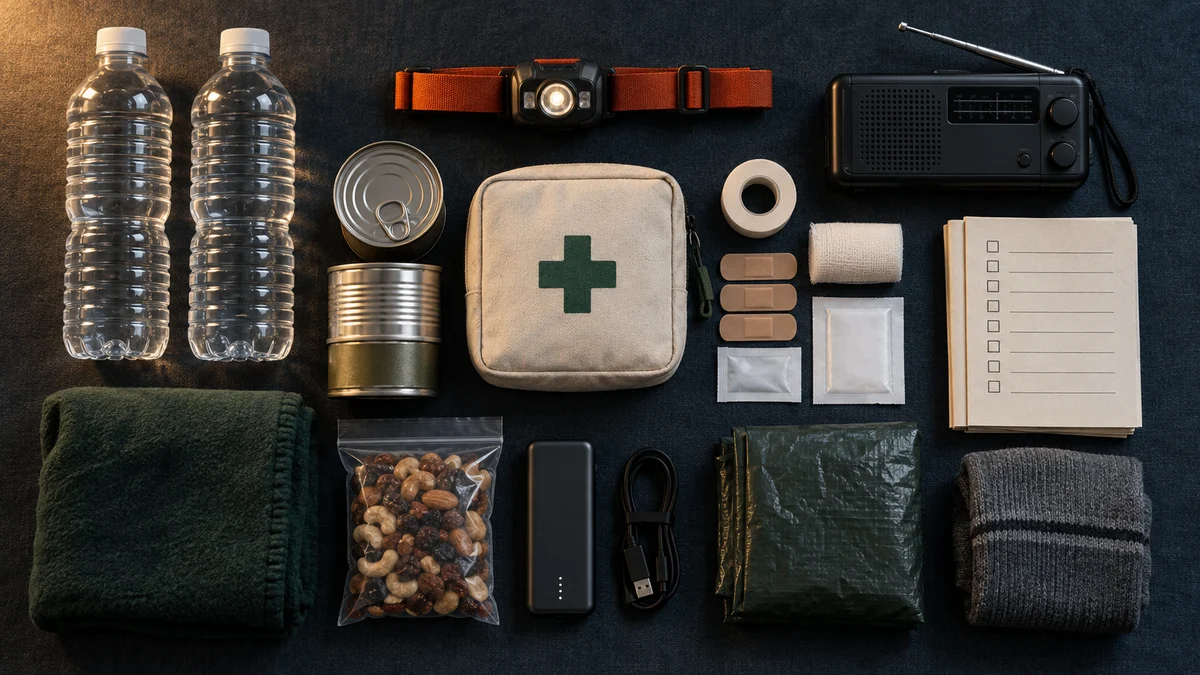
Water, “one gallon per person per day for several days, for drinking and sanitation.” Food, “at least a several-day supply of non-perishable food.” A “battery-powered or hand crank radio and a NOAA Weather Radio with tone alert.” A flashlight. A first aid kit. Extra batteries. A whistle. A dust mask. Plastic sheeting with scissors and duct tape. Moist towelettes with garbage bags and ties. A “wrench or pliers.” A manual can opener. Local maps. A cell phone with chargers and a backup battery.
Fourteen lines. Nothing tactical, nothing that belongs in a forest. It is the inventory of a house that has stopped working, written by an agency whose problem is reaching a great many houses at once — which is also why it will not tell you how many of anything.
The one instrument on that list nobody improvises is the radio. A phone gives you alerts until the tower’s backup battery runs down; a NOAA receiver keeps working while the county does. Buy the version with tone alert — a NOAA weather radio with tone alertaff. wakes itself when a warning is issued for your county, which a radio you have to switch on will never do at two in the morning. Which model, and why a car radio is a better backup than people assume, is argued out in the emergency weather radio guide.
Multiplying the list by your own household
Count the heads: adults, children, infants, animals. Note who takes a daily medication, who cannot see without glasses, who eats nothing with gluten in it. That is the whole input.
Then multiply. Below is the same federal list with a rule on each line and the result for four household sizes. The water rate is Ready.gov’s; the lines marked as mine are arithmetic you can argue with.
| Line | The rule | 1 person | 2 people | 4 people | 6 people |
|---|---|---|---|---|---|
| Drinking water | 1 gallon per person per day (Ready.gov) | 3 gal | 6 gal | 12 gal | 18 gal |
| — in cases | 1 case ≈ 3 gal, so one per person | 1 case | 2 cases | 4 cases | 6 cases |
| Refillable jug | 1, or 2 above four people | 1 × 5 gal | 1 × 5 gal | 1 × 5 gal | 2 × 5 gal |
| No-cook meals | 3 per person per day (mine) | 9 | 18 | 36 | 54 |
| Headlamps | 1 each, never one for the house (mine) | 1 | 2 | 4 | 6 |
| Spare battery sets | 1 per lamp, plus 1 for the radio (mine) | 2 | 3 | 5 | 7 |
| Weather radio | 1 per household | 1 | 1 | 1 | 1 |
| Manual can opener | 2 — one stays in the go bag (mine) | 2 | 2 | 2 | 2 |
| First aid kit | 1 per household | 1 | 1 | 1 | 1 |
| Power bank | 1 per two phones (mine) | 1 | 1 | 2 | 3 |
| Heavy trash bags | 2 a day, plus toilet bags (mine) | 6 | 6 | 9 | 12 |
| Document pouch | 1 per household | 1 | 1 | 1 | 1 |
Two lines in that table deserve their reasoning out loud.
Water, and the qualifier that doubles it
Ready.gov’s water page says “store at least one gallon of water per person per day for several days, for drinking and sanitation,” then adds the qualifiers that make the figure move: “children, nursing mothers and sick people may need more,” and “in very hot temperatures, water needs can double.” Doubling twelve gallons to twenty-four is most of a closet floor and about seventy pounds of lifting. So the split that survives a real apartment is to keep three gallons a head sealed for drinking, and cover washing, dishes and the toilet tank with a refillable jug plus a bathtub filled the minute a watch is issued. The containers and the six-month rule for water you bottled yourself are the subject of emergency water storage.
One light per person, not one per house
Ready.gov writes “flashlight,” singular, and that singular is the most common defect in American kits: one light for four people means one person moves and three sit still in the dark, and it means the lamp goes into a bedroom at nine and never comes back. One LED headlamp per personaff. frees both hands for a can opener or a toddler, and the red setting lets someone cross a room at three in the morning without blinding the table. What else fails, and at which hour, is mapped in the extended power outage guide.
The lines people leave out
Every kit has the same shape of hole in it: the big obvious objects are there, the cheap specific ones are not. These are the lines that go missing, in the order I would go find them.
Three that are on the basic list
The manual can opener. It is on the federal list by name, and it is still the most reliably absent object in kitchens otherwise full of cans. Buy two stainless manual can openersaff., one in the bin and one in the bag, and the problem is closed for good. The electric one on the counter is not a backup.
The wrench or pliers. Ready.gov puts it on the basic list “to turn off utilities,” and nobody buys it, because it is the only line on the page that sounds like a plumbing errand. A four-in-one utility shutoff wrenchaff. hung beside the meter settles it. Find your shutoffs on a calm Saturday, not by flashlight with water coming through a ceiling.
Garbage bags and plastic ties. They sit in the basic supplies, not the nice-to-haves, and they are the whole sanitation answer for three days without a flushing toilet. A roll of heavy-duty contractor trash bagsaff. plus gelling toilet bags and a bucket is twenty unglamorous minutes a household with kids will be glad it spent.
Four more, from the additional supplies
Cash in small bills. Ready.gov’s financial preparedness page is blunt: keep a small amount of cash at home, in small bills, “because ATMs and credit cards may not work during a disaster when you need to purchase necessary supplies, fuel or food.” Card readers sit downstream of the same grid as everything else, and nobody at a roadside stand can break a fifty.
Paper and pencil. It reads like filler until the night you need to write down a bulletin time, a shelter address and a number that is not in your phone. A ballpoint refuses to write on a damp page; a pencil does not care.
Spare eyeglasses, and something for the kids to do. Both sit on the additional supplies list. An adult who cannot read a label is not a functioning member of a household in an outage, and the old pair is already in a drawer. And a deck of cards holds an hour under a lantern that no dead tablet will.
The documents. Copies of IDs, birth certificates, insurance policies, housing paperwork, medical and physician information — Ready.gov’s own financial inventory, the cheapest post of the kit and the most expensive to reconstruct. The full version, plus the uncomfortable test of what you could still prove if your phone died right now, is in important documents in an emergency.
None of those lines is heavy or hard to find. They go missing because they are boring, and because a checklist read on a screen never forces you to touch them one at a time.
Infants, prescriptions and animals
Three household variables change the list more than any other, and the federal pages handle them with a sentence each.
An infant moves the arithmetic furthest. Ready.gov’s food page is specific about the one thing that matters: “use ready-to-feed formula. If you must mix infant formula use bottled water or boiled water as a last resort.” Powder needs safe water, the exact resource in question. Add diapers at roughly eight a day, wipes, one more warm layer than you think, and a second comfort object — the first one is always in the car.
Animals get their own page, and it is more demanding than owners expect. Ready.gov asks for “several days’ supply of food in an airtight, waterproof container,” a bowl and several days of water, an extra supply of any regular medication, “a backup leash, collar and ID tag,” copies of the registration papers, and a picture of you and your pet together. A collapsible travel bowl and a spare leashaff. live in the bin and weigh nothing. Then the line most people miss: “many public shelters and hotels do not allow pets inside.” That is a decision to make now, on paper, with a friend’s phone number beside it — not at a road closure.
Then the household’s ongoing prescriptions, which is where this page stops giving numbers.
The order to buy it in
A checklist read top to bottom implies that everything on it matters equally. It does not, and the order you buy in decides whether the kit is finished or abandoned halfway.
My order runs from what cannot be improvised to what can wait a week. Water first: the one line a neighbor cannot lend you, and the first shelf a store empties. Light second, because it fails at hour four and a phone used as a flashlight stops being a radio. Food third. Then the small objects that make the first three usable — a can opener, a receiver, batteries that do not leak. Then first aid, papers, sanitation. The stove last, and honestly optional.
That last one is where I break with most lists you will read. A camp stove photographs beautifully, and nine no-cook meals per person already solve the problem it addresses: it buys coffee and morale. It also carries a hard condition, since Ready.gov states that “charcoal grills and camp stoves are for outdoor use only.” A stove indoors is not a cooking question but a carbon monoxide question, settled by a detector, ventilation, and leaving at the first doubt. The rest of that argument is in heating a house without power.
Before you take my word for the sequence, run yours.
Buy order — six lines, in the order you would buy them
Which six would you carry out of the store first?
Click six lines in your own order. No quantities here, no household size — only the sequence. When the sixth is in, the drill compares it with the order in which a house actually runs out of things.
- 1 Empty
- 2 Empty
- 3 Empty
- 4 Empty
- 5 Empty
- 6 Empty
0 of 6 chosen
If the drill put water at position four or five, you are in ordinary company: it is heavy, it feels like something to grab later, and it is the one line that becomes unobtainable first. Everything else is still on a shelf on day two.
One list, one column per person
The table above multiplies, and it still treats a household as a single object. Look at what that hides: a kit for two adults, and a kit for two adults, a four-year-old, a grandmother on a daily medication and a dog, share exactly one item — the radio. Everything else either scales with heads or exists for one particular person.
So cut the federal list three ways. The lines that multiply: water, meals, a lamp, a change of clothes. The lines you buy once for everybody: radio, first aid kit, can openers, jug, bags, wrench, pouch, map. And the lines that are on nobody’s list because they belong to one member of this house — a spare pair of glasses, food a particular diet allows, twenty-four diapers, a carrier the cat will go into willingly.
The third kind goes missing every time, because a generic checklist has no row for it.
The roster below builds one. A row per person and per animal, names optional, and it returns a sheet with a card each. It prints on its own, without this article around it.
The roster — one card per member, on one sheet
Who actually sleeps here, and what does each of them need?
One row per person and per animal. Names are optional and stay on your device. The sheet below splits the federal list three ways: what each member needs on their own, what the household shares, and the lines that exist only because that particular member lives here.
Print it, take it to the store, and one thing becomes obvious on the way: the shared card is short. Nine lines for the whole household, bought once. It is always the first card people finish, and the personal cards that are still half empty a year later — nobody puts “Dad’s old glasses” on a shopping list.
Tape the sheet inside the lid of the bin. Then the twice-yearly check has an agenda instead of a mood.
Where it lives, and the date on the lid
“I don’t have room for twelve gallons” is the objection that ends more kits than any budget does, and it deserves a measured answer.
Twelve gallons is four cases of half-liter bottles. Laid flat, each case is roughly the footprint of a sheet of paper, so four of them are a strip along the back of a closet, not a wall. And they do not have to live in one place — they have to be counted. Two cases under the kitchen sink, one in the coat closet, one behind the couch is the same twelve gallons and a far easier Saturday. What does have to sit in one known place is the bin, because the bin is what a hand reaches for in the dark. Measuring a real spot against real containers, at scale, is done in emergency water storage.
Where not to put any of it: the balcony, which bakes in August and freezes in January; the cabinet with the cleaning products; the car. A cool dark spot is Ready.gov’s own instruction for bottled water, and it rules out most of the clever hiding places.
If the only free volume is under a bed, a low-profile under-bed box on wheelsaff. holds the cases at a height that clears a standard frame and rolls out without the bed being moved. The jug goes elsewhere: a five-gallon jug with a spigotaff. stands upright next to the bin, refills at the kitchen sink and pours without anyone lifting forty pounds — the container that makes the six-month refill habit survive.
Then the check itself. Half an hour, two fixed dates — the fall clock change ahead of outage season, the spring one ahead of heat. Everything comes out onto the table. Dates checked, anything close to expiring eaten and replaced, power bank recharged, radio and every lamp tested, jug emptied and refilled. That last one is not a preference: Ready.gov asks for water that was not commercially bottled to be replaced every six months.
Label as you go. A set of waterproof labels and a markeraff. is the least glamorous purchase on this page and the one that decides whether the rest holds together, because an undated container is a container nobody rotates. Write the next check date on the lid before the bin goes back.
And check the sheet, not only the supplies. A school changed its release policy. A phone number stopped working. Someone moved out. The equipment ages slowly; the roster ages fast.
What I would do this weekend
Buy water and a headlamp per person. That is it — one trip, one afternoon, and a household is already through the overwhelming majority of outages it will ever see. The rest of this page is refinement, and refinement is what second weekends are for.
I would rather someone finished those two lines and left the other twelve for October than read the whole list twice and ordered a boxed kit with a fire steel in it. The method behind the arithmetic sits in the 72-hour emergency kit guide, the buying criteria on the equipment page, and the two-week version in long-term food storage and long-term emergency preparedness. If the honest answer is that you would be leaving rather than staying, the bin is the wrong object: the go bag is the right one, with its own checklist, and which hazards apply where you live is the first question of natural disaster preparedness.
One hundred and thirty-nine hours is what February 2021 asked of Dallas. Seventy-two is what the list asks of you. The gap between those two numbers is an argument for starting — and the first case of water closes more of it than anything else you could buy.
Frequently asked questions
- What is on the 72 hour kit checklist?
- The federal version is Ready.gov's basic disaster supplies kit: water at one gallon per person per day, a several-day supply of non-perishable food, a battery-powered or hand crank radio and a NOAA Weather Radio with tone alert, a flashlight, a first aid kit, extra batteries, a whistle, a dust mask, plastic sheeting with scissors and duct tape, moist towelettes with garbage bags and plastic ties, a wrench or pliers to shut off utilities, a manual can opener, local maps, and a cell phone with chargers and a backup battery. A 72 hour kit checklist that stops there is only half done, because exactly one of those lines carries a number. The rest has to be multiplied by the people who live in your house.
- How much water does a family of four need for 72 hours?
- Twelve gallons. Ready.gov's rate is one gallon per person per day for drinking and sanitation, so three gallons a head covers three days and four people need twelve. In practice that is four cases of half-liter bottles, since a 24-bottle case holds roughly three gallons — one case per person is the version people remember at the store. Ready.gov adds two qualifiers worth reading: children, nursing mothers and sick people may need more, and in very hot temperatures water needs can double. The workable answer is to keep the twelve gallons sealed for drinking and cover washing and flushing with a refillable jug plus a bathtub filled the moment an alert goes out.
- What does the official list leave out?
- Nothing, technically — but it buries the small things among the obvious ones, and the small things are what fail. The manual can opener, named on the list, is the single most reliably missing object in kitchens full of cans. The wrench or pliers for shutting off utilities is on the list and almost never bought. So are the garbage bags and plastic ties, which is the whole sanitation answer for three days without a flushing toilet. Ready.gov's additional supplies go further still: cash in small bills, paper and pencil, spare eyeglasses, children's activities, pet food and water. None of it is expensive. All of it is forgettable.
- How many meals should a 72-hour kit hold?
- Nine per person, which is three meals a day for three days. Ready.gov asks for a several-day supply of non-perishable food without setting a number, and suggests ready-to-eat canned meats, fruits and vegetables with a can opener, protein or fruit bars, dry cereal or granola, peanut butter, dried fruit, canned juices and non-perishable pasteurized milk. The rule that decides whether the shelf survives: store what your household already eats. A reserve nobody likes never rotates, expires quietly, and gets thrown out in one trip to the trash. For a household of four, thirty-six meals is one large grocery run, and most of it goes through normal dinners within the year.
- Does a 72-hour kit need a camp stove?
- No, and that is why it sits at the bottom of the buying order. Nine no-cook meals per person work with no flame at all, so a stove buys morale rather than survival: coffee, noodles, a warm bottle. If you add one, Ready.gov is unambiguous about where it runs — charcoal grills and camp stoves are for outdoor use only. Never under a range hood that is not drawing, never in a garage with the door up, and never as a heat source for a room. Anything that burns indoors is a carbon monoxide question, and that one is settled by a detector, ventilation, and leaving at the first doubt.
- What goes on the checklist for a baby or a pet?
- For an infant: ready-to-feed formula rather than powder, because Ready.gov says to use ready-to-feed and to fall back on bottled or boiled water only if you must mix — and safe water is the thing you may not have. Add diapers at roughly eight a day, wipes, an extra warm layer, and a spare comfort object. For an animal: Ready.gov asks for several days of food in an airtight waterproof container, a bowl and several days of water, a backup leash, collar and ID tag, medication, and copies of the registration papers in a waterproof container. It also notes that many public shelters and hotels do not allow pets inside — which is a planning problem, not a shopping one.
- How often should the checklist be run again?
- Twice a year, half an hour, on a date you do not choose fresh each time. The two clock changes work: fall, ahead of outage and storm season, and spring, ahead of heat. Everything comes out onto the table. Check dates, eat what is close and replace it on the next grocery run, recharge the power bank, test the radio and every lamp, empty and refill the jug — Ready.gov asks for water that was not commercially bottled to be replaced every six months, which is exactly this cadence. Then reread the plan sheet, because a school rule changed and a phone number stopped working. Write the next date on the lid in marker.
Who wrote this
Baptiste S.
Founder and writer · bs-media
I am not a firefighter, a paramedic or a survival instructor. I am someone who read his government's household preparedness guide cover to cover, lives where winter storms knock the power out every year, and decided to do the work properly: read the official guidance, run the numbers, compare the spec sheets, and write down what I wish I had found. This site sells neither fear nor bunkers. It explains what an ordinary household can put together in a weekend, and in what order.
- I start from official guidance — FEMA, Ready.gov, the National Weather Service, the CDC, the American Red Cross — and I link to it. If I have not checked it, I do not write it.
- No guns, no bunkers, no doomsday: this site prepares an ordinary household for three days, two weeks, a month.
- I say what is not worth buying, including the things that sell best in survival stores.
- On health, medication and electrical work, I defer to your doctor, your pharmacist or a licensed electrician. That is not my job.
Read next
Emergency Water Storage: How Much, Where, How Long
Emergency water storage, sized and drawn: gallons per person, which containers fit where, the six-month rule, and how to keep it drinkable. Start this weekend.
Emergency Weather Radio: How to Choose One That Wakes You
An emergency weather radio earns its shelf only if it wakes you at 2 a.m.: NOAA All Hazards, SAME coding, tone alert, battery backup. Compare before you buy.
Extended Power Outage: What to Do, Hour by Hour
An extended power outage fails in stages: hour 0, hour 4, hour 24, hour 72. What breaks at each one, what to do, what to keep or throw out. Start your clock.
Why 72 Hours Is the Number Everyone Uses
Why 72 hours? Ready.gov never states the number, yet every campaign uses it. Where it came from, what it measures, and US disasters that beat it. Set yours.