Eleven hours. That is what the average American electricity customer spent without power across 2024, according to the Energy Information Administration — “nearly twice as many as the annual average experienced in the decade before,” with major events accounting for eighty percent of the total. Hurricane Helene alone took power from 5.9 million customers across ten states.
Which tells you something useful about an extended power outage, and something misleading. The misleading part is the average: almost nobody experiences eleven hours. Most households get a flicker and twenty minutes, twice a year, and then one week where the number is five days.
The useful part is the shape. Long outages are not longer versions of short ones. They fail in stages, and each stage has a point before which you can act and after which you cannot. The refrigerator is not a countdown ending in spoiled food; it is a decision you make at hour four or lose. What follows is that sequence, for a household with no generator in the garage.
Minute zero: what stops before anyone misses the lights
The lights are what everybody expects. They are the least of it.
The modem goes dark, and with it the Wi-Fi, the streaming and the landline — which has run through that modem for years, whatever the jack in the wall suggests. The range, the oven and the microwave become countertops. The garage door, the gate, the entry buzzer and the elevator stop. And the furnace stops, which is what catches most households heated by gas: the fuel still arrives, but the blower, the control board and the ignition are electric. No current, no heat. A heat pump does the same. So does a pellet stove.
In an apartment above the third or fourth floor the clock is shorter still. The booster pump that lifts water up the risers is on the same grid as everything else, and the upper taps go dry within minutes. Those households fill the bathtub and two stockpots at minute zero, not at minute forty. That water is not for drinking — it flushes the toilet and washes hands. What gets drunk over three days is the stored supply, a gallon per person per day, and holding it in an apartment with no basement is the subject of emergency water storage.
The problem is that the first reflex is the wrong one, in every household, every time: the phone’s flashlight. It drains in an hour the one object that will carry alerts and family messages for three days. The right reflex is a lamp nobody has to hunt for — one LED headlamp with a red modeaff. per person, in a drawer everyone can name. Both hands stay free for a can opener, a stairwell, a child.
For the room where everyone ends up, add a battery-powered LED lanternaff. in the middle of the table. It lights a meal rather than a spot, and it cannot be knocked onto a tablecloth, which candles can and do during exactly the days when fire response is slowest.
The four things that fit inside five minutes
Look out the window, because a dark street means it is not your breaker. Unplug the computer and the television, since Ready.gov’s guidance is that power may return “with momentary surges or spikes that can cause damage.” Leave one hallway lamp switched on, so it tells you at three in the morning that the grid came back. And write the time on a sticky note stuck to the refrigerator, because everything below is counted from it.
Minute zero is the only milestone on the whole scale where nothing has been lost yet.
Outage timeline — drag the hour, watch the house stop
What has already failed, at the hour you are standing on
The first minute
0 of 11 down
The timeline above changes with the building and the season, because a fourth-floor apartment in August and a house on a private well in February are not the same outage at all. The rest of this article follows the general case; the tool gives you yours.
Hour four: the refrigerator, the phone, and the first decision you can lose
Four hours is the refrigerator’s published limit. Ready.gov puts it plainly — “The refrigerator will keep food cold for about four hours. A full freezer will keep the temperature for about 48 hours” — and the CDC adds the middle case: “4 hours in a refrigerator, 48 hours in a full freezer, 24 hours in a half-full freezer.”
In practice that means one opening, not five. Decide before the door moves: what gets eaten tonight, what goes into the cooler with ice, what leaves in a bag. Ready.gov’s discard rule settles the arguments — “Throw away any food that has been exposed to temperatures 40 degrees or higher for two hours or more, or that has an unusual odor, color or texture.” The CDC’s sentence is shorter still: “Never taste food to know if it is safe to eat. When in doubt, throw it out.”
An appliance thermometeraff. left permanently in each appliance replaces the estimating with a number. It is the cheapest object on this page and the one that most reliably saves food a household would otherwise have dumped out of caution.
Cold chain clock — the hours, then the ruling
What is still safe in there, shelf by shelf
0 hsince the outage
The refrigerator
The freezer
The phone, and the network behind it
The second decision of hour four was really made at minute zero, if the flashlight stayed off. Low power mode, brightness at the bottom, Wi-Fi and Bluetooth off, and text rather than call: a short message gets through a congested network and costs a fraction of a voice call’s battery.
The network itself is on borrowed time. Cell sites run on backup batteries measured in hours, and the larger ones on generators measured in days provided a fuel truck can reach them — which, after Helene, it frequently could not. A charged 20,000 mAh power bankaff. covers two or three refills, enough for three evenings in low power mode. It has to have been charged beforehand, which is a calendar question rather than a shopping one. The car does the rest: half a tank is several days of charging, as long as the adapter is not in the glovebox of the vehicle parked somewhere else.
Hour twenty-four: heat, hot food, and where information comes from now
By morning it has changed category. No longer an incident; a day that has to be organized.
The freezer first. At twenty-four hours a half-full one has reached its limit, while a full one has about a day left if the door stayed shut. This is the morning to cook the best of it, and cooking means a flame that is not in the wall. A portable butane camp stoveaff. and two canisters cover three days of coffee, noodles and one real meal a day — outdoors or on a balcony, never as a heater, never under a dead range hood. A stew of everything that was thawing beats a third day of crackers, and it does more for the mood of a cold house than anything else here. Going from three days of food to several weeks is another discipline, with dates and rotation, and it belongs to long-term food storage.
Warmth, or its opposite
In winter the rule is the same in every building: one room, the smallest that holds everyone, doors closed, blinds down at night, two to a bed. A house built in 1972 reaches outside temperature overnight; an apartment surrounded by other apartments does far better. Sleeping warm costs nothing and works, which is why a sleeping bag rated around 30 °Faff. per person beats any portable heater as a purchase. Read the comfort rating, never the “extreme” number on the tag.
In summer the problem inverts and the reasoning does not. Blinds down on the sun side by day, everything open after dark, lowest floor, water more often than thirst asks. Past a day the building has stored the heat and gives it back all night, and that is where a public cooling center beats stubbornness — the method is in getting through a heat wave without AC.
What does not come indoors, in either season: a generator, a charcoal or propane grill, a camp stove, or the kitchen range left on for warmth. The CDC issued a health alert on February 17, 2021, during the Texas freeze, telling clinicians to expect carbon monoxide poisoning in patients from areas without power, and naming the sources exactly: gasoline generators, propane grills, charcoal grills, camp stoves. These, it says, “should never be used inside an enclosed space, home, basement, garage, or camper — or even outside near an open window.”
That storm is worth knowing in detail. NOAA’s climate centers describe the Great Texas Freeze of February 11–20, 2021: “At the peak of the outage, nearly 10 million people were in the dark,” six to nine consecutive days of freezing temperatures across central Texas, and a death toll the Texas Department of State Health Services put at over two hundred. People did not only die of cold. They died of what they burned indoors to escape it.
So the least glamorous object here is the one that is literally about not dying: a battery-operated carbon monoxide alarmaff. on every level of the home, tested before the season needs it. There is no clever workaround. Detector, ventilation, and if it sounds, everyone outside and call 911 from outside. The ways to stay warm, ranked by what is actually safe in an apartment, are sorted in heating a house without power.
Information stops arriving through the phone
By the second day most phones in the house are dead or nearly, and the useful channel is the one that needs nothing from your street. A hand-crank NOAA weather radioaff. receives National Weather Service broadcasts directly, carries county tone alerts, and works on a crank when every battery is flat. Listen at fixed times rather than continuously. Which receiver suits which household is compared channel by channel in the emergency weather radio guide.
Day two is also when you knock on doors. The older neighbor upstairs, the person living alone at the end of the street: a day with no radio and a dead phone is long. Bring a lamp, take their number, agree to come back. Nothing on the equipment page matters more, and it costs nothing.
Hour seventy-two: an extended power outage is decided here
Three days is the floor federal preparedness guidance asks every household to cover alone, and the reasoning is logistical rather than dramatic: it is roughly how long a regional utility needs to restore most of a grid and how long shelters and distribution points take to run properly. No federal page actually names the figure, which is the odd part of where the three-day number came from. Hurricane Ida shows the bad end of that. It came ashore in Lower Lafourche Parish near Port Fourchon at 11:55 AM on August 29, 2021, with maximum sustained winds of 150 mph, and restoration across much of southeast Louisiana was counted in weeks.
What changes past seventy-two hours is the nature of the loss. Until then you lose comfort and food. From here you lose supplies: batteries, fuel canisters, the water drawn at minute zero, the power bank, patience. That is the point the household kit was sized for, and its line-by-line version is the 72-hour kit checklist.
Two things get done here. The first is administrative: photograph what came out of the freezer, list it with rough values, keep the sticky note with the outage time, and call your insurer. Many homeowners and renters policies cover food spoilage with a cap and sometimes a deductible, and some want an outage confirmation the utility will issue on request. That paperwork, and the rest of what a household has to be able to produce afterwards, sits in important documents in an emergency.
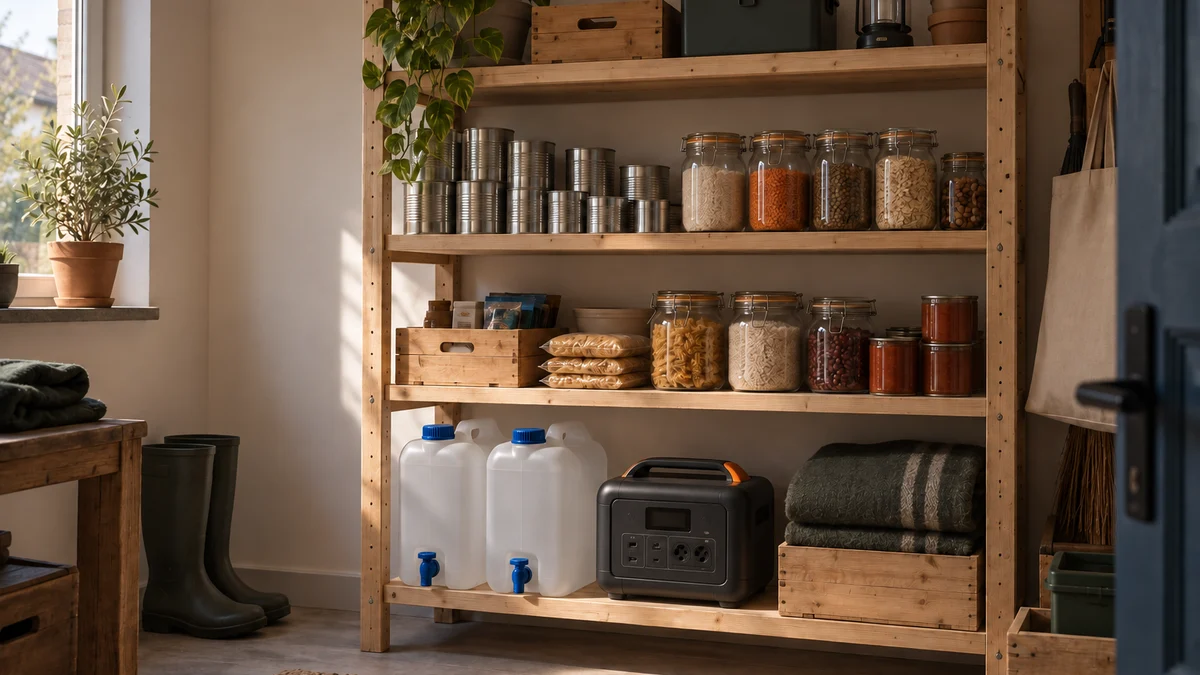
The second is a decision, best made now, while you still remember what you wished you had. A portable power station is silent, has no exhaust, is sane in an apartment, and runs a modem, lamps, phones and a small appliance intermittently — but not electric heat. A generator runs a house, well pump and sump pump included, and arrives with the twenty-foot rule and an electrician for anything touching the panel. In an apartment there is no debate: it is the portable power stationaff.. In a house it is a real comparison, made criterion by criterion in portable power station versus generator.
When outages stop being accidents and become a pattern — a season of storms, supply gaps — the reasoning changes again, and that is long-term emergency preparedness rather than this page.
When someone in the house runs on electricity
One household escapes every milestone above: the one where a person depends on a powered device — an oxygen concentrator, a CPAP, a feeding or infusion pump, home dialysis. There, an extended power outage is not a question of refrigerators. It is a question of hours, sometimes minutes, decided by the device’s own battery.
That decision belongs to the first hour, and it should have been made in advance, in writing, at a kitchen table with the lights on. Where do you go — family, a facility, the county’s sheltering arrangement? How long does the device really run on its battery, measured rather than assumed? Who supplies the equipment, and what is their after-hours number? Does your utility keep a medical needs registry, are you on it, and do you understand that it protects you from a planned interruption and not from a fallen line?
Ready.gov frames it as a conversation to have before it is needed: talk the plan through with the doctor who manages the device, and with whoever manages medication that has to stay cold. Its line on that last point is blunt — if the power is out for more than a day, discard any medication that should be refrigerated, unless the drug’s label says otherwise.
What does not help, including the things that sell well
The boxed “blackout kit” first. A mediocre flashlight, a foil blanket, a poncho and a strip of bandages, sold as though it settled the question. No water, no stove, no cooler, no charged battery, no radio that receives the National Weather Service — and several still ship candles, an open flame burning all night in a room where everyone sleeps, during the week fire response is slowest. What a household needs it mostly owns. What it lacks is the count and the location.
Then the generator bought for an apartment, which will never be used: a balcony is not “outdoors” in any sense Ready.gov recognizes, since the rule is twenty feet from windows, doors and attached garages. And the hand-crank charger sold as a power source, which trickles, which nobody cranks for forty minutes, and which has quietly replaced a real power bank in a lot of kits.
What does deserve the money, and sells far less well, is the dullest line on the list: lithium AA and AAA batteriesaff. and nothing else in the drawer where the outage supplies live. Alkalines leak in storage and take the headlamp with them, and a lamp that fails on the second night is the same as no lamp at all.
One more, harder to say because it sounds prudent: buying a second freezer to have more reserve. More frozen food means more to lose, and a second appliance halves the only trick the first one has, which is being full. Fill the freezer you own with jugs of water instead. It becomes a block of ice and holds cold like one — free, and the only real freezer preparation there is.
The question this leaves open
Three days are survivable with what is described here, and the 72-hour emergency kit guide has the quantities post by post. What stays open is the question only your own house answers: which appliances do you actually insist on keeping alive, and for how long?
Write that list during the blackout, not after it — the honest version only exists while you are annoyed. Then read the comparison between a power station and a generator with it in hand, or, if you live where the answer arrives every September, hurricane preparedness, which starts a week before any of this does.
Frequently asked questions
- What should I do first in an extended power outage?
- Four things inside five minutes. Put on a headlamp instead of using your phone's flashlight, because the phone is what keeps you reachable for the next three days. Look out the window: if the street is dark too, it is not your breaker and there is nothing to reset. Unplug the computer, the television and anything with a circuit board, because power often comes back with a surge. Then write the time the power went out on a sticky note and put it on the refrigerator door, because every decision that follows is counted from that moment. In an apartment above the third floor, add a fifth: fill the bathtub before the building's booster pump drains the risers.
- How long will food last in the fridge and freezer without power?
- With the doors closed, the published figures are about four hours for a refrigerator and about forty-eight hours for a full freezer, with twenty-four hours for a half-full one. Every opening costs you, and a hot kitchen shortens all three. Past the window, anything that sat at 40 °F or higher for two hours or more goes in the trash: meat, poultry, seafood, dairy, eggs, leftovers, cut fruit. Butter, hard cheese, jam and whole fruit come through fine. The one rule with no exception is that you never taste anything to decide, and a thermometer left inside the appliance turns the whole argument into a reading.
- Will my gas furnace work during a power outage?
- Almost never. The gas keeps arriving, but the blower, the control board and the electronic ignition all run on household current, so the furnace sits there doing nothing. Heat pumps stop, pellet stoves stop, and a boiler's circulator pump stops. What still produces heat without an outlet is a wood stove or a fireplace with a sound flue, or a heater built and rated for indoor use, run with a window cracked and a carbon monoxide alarm in the room. What never comes indoors, not even into an open garage: a generator, a charcoal or propane grill, a camp stove, or the kitchen range left burning for warmth.
- Do cell phones still work when the power is out?
- For a while. Cell sites carry backup batteries measured in hours and, at the larger ones, generators measured in days if a fuel truck can reach them; in a wide outage they fail one after another through the first day. Your landline is usually gone immediately, since the handset runs off a modem that has no power. Treat the phone as a rationed resource from minute zero: low power mode, brightness down, Wi-Fi off, and text rather than call, because a short message gets through a congested network and costs a fraction of the battery. For official instructions, a NOAA Weather Radio depends on nothing in your neighborhood.
- Where can I safely run a generator?
- Outdoors, and at least twenty feet from windows, doors and attached garages — that is Ready.gov's own wording, and it is not a suggestion with room in it. Not in the garage with the door up. Not on a covered porch, not under an open window, not in a basement or a crawl space. Carbon monoxide has no smell and no color, and it puts people to sleep before it hurts them, which is why the alarm belongs on every level of the house before the generator is ever started. Connecting a generator to your home's wiring is a separate matter entirely: that needs a transfer switch and a licensed electrician, because backfeed onto the utility line can kill the lineman repairing it.
- What happens to refrigerated medication during an outage?
- Ready.gov's guidance is that if the power is out for more than a day, you discard medication that should be refrigerated unless the drug's label says otherwise. That sentence is the end of what a preparedness site can usefully tell you, because the real answer depends on the specific drug, how long it sat, and what your prescriber can do about a replacement. The conversation to have is with your pharmacist and your physician, and it is worth having on a calm afternoon rather than on the second night of a blackout: ask what happens to each refrigerated prescription in the house, and whether a written plan exists for replacing it.
- How do I claim spoiled food after a power outage?
- Photograph the contents of both appliances before anything goes in a bag, write a list with rough values, and keep the note with the time the power went out. Many homeowners and renters policies include coverage for food spoilage, usually with a dollar cap and sometimes with a deductible, and some ask for an outage confirmation from the utility, which the utility will issue on request. Call your insurer within a few days and describe the outage and its length. Only your own policy says what is covered, and the page that says so takes five minutes to read — better read before the outage than after it.
Who wrote this
Baptiste S.
Founder and writer · bs-media
I am not a firefighter, a paramedic or a survival instructor. I am someone who read his government's household preparedness guide cover to cover, lives where winter storms knock the power out every year, and decided to do the work properly: read the official guidance, run the numbers, compare the spec sheets, and write down what I wish I had found. This site sells neither fear nor bunkers. It explains what an ordinary household can put together in a weekend, and in what order.
- I start from official guidance — FEMA, Ready.gov, the National Weather Service, the CDC, the American Red Cross — and I link to it. If I have not checked it, I do not write it.
- No guns, no bunkers, no doomsday: this site prepares an ordinary household for three days, two weeks, a month.
- I say what is not worth buying, including the things that sell best in survival stores.
- On health, medication and electrical work, I defer to your doctor, your pharmacist or a licensed electrician. That is not my job.
Read next
72 Hour Kit Checklist: Every Line, Counted
The 72 hour kit checklist, counted for your own household: gallons, meals, lights, batteries, the seven lines people leave out, and where it all fits at home.
Emergency Water Storage: How Much, Where, How Long
Emergency water storage, sized and drawn: gallons per person, which containers fit where, the six-month rule, and how to keep it drinkable. Start this weekend.
Emergency Weather Radio: How to Choose One That Wakes You
An emergency weather radio earns its shelf only if it wakes you at 2 a.m.: NOAA All Hazards, SAME coding, tone alert, battery backup. Compare before you buy.
Why 72 Hours Is the Number Everyone Uses
Why 72 hours? Ready.gov never states the number, yet every campaign uses it. Where it came from, what it measures, and US disasters that beat it. Set yours.