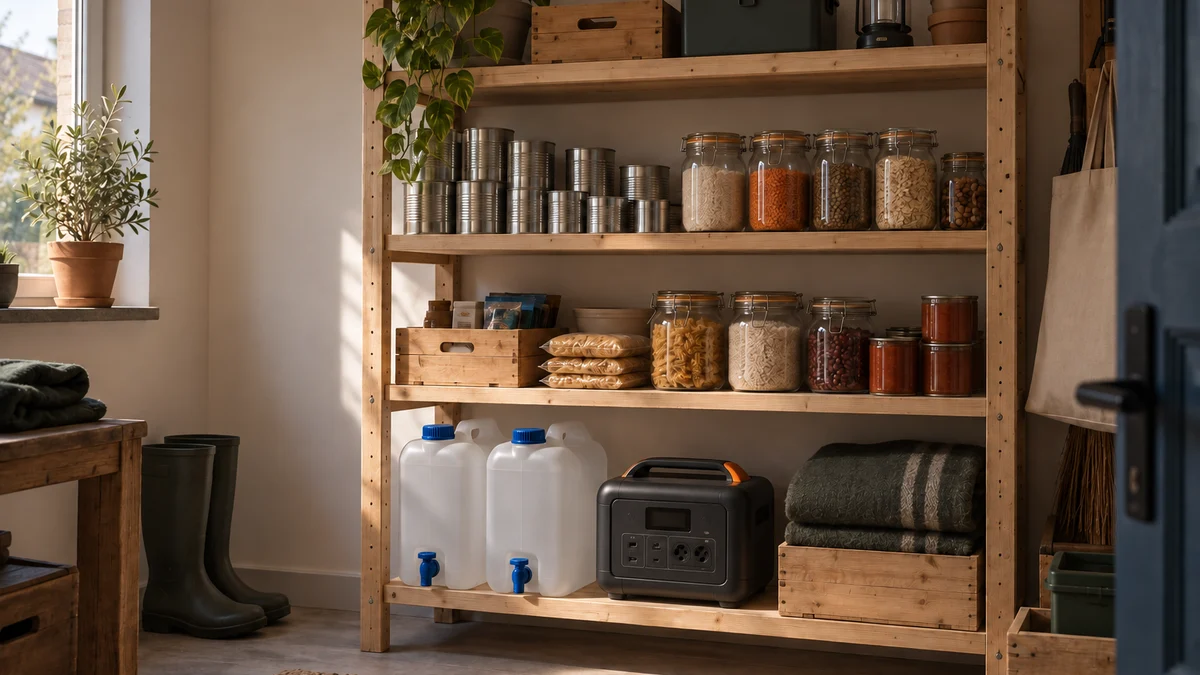
A portable generator will run your refrigerator, your furnace blower, your well pump and a window air conditioner at once. A power station the size of a toolbox will not. That looks like the end of the argument, and it is roughly where the internet stops.
Then you read the instruction that comes with the engine. The Consumer Product Safety Commission leaves no room in its wording: operate portable generators outside only, at least 20 feet away from the house, never inside a home, garage, basement, crawlspace or shed, and not on a porch or in a carport. The same agency estimates that about 100 Americans a year die of carbon monoxide poisoning from portable generators.
Twenty feet of outdoors you actually control is a specification, exactly like watt-hours are. Most apartments do not have it. Plenty of townhouses do not either.
So we take this in the other order from everyone else. Appliances first. Building second. The machines last, when there is something left for them to answer.
What each machine actually is, under the marketing
A power station is a battery with an inverter bolted to it. It holds a fixed number of watt-hours, taken off the wall or off a panel beforehand, and gives them back as 120 V household current until they are gone. A generator is a small engine turning an alternator. It holds nothing and makes watts on demand, as long as there is fuel in it.
Reserve against production. That is the whole difference, and almost nothing else follows from the word “power.” A reserve is silent, clean, indifferent to weather and finite in a way you can calculate to the hour. Production is loud, makes exhaust you cannot be near, and needs a supply chain you maintain yourself.
The spec-sheet arguments settle none of it. Outlet count, the app, the display, electric start. Manufacturers lead with those because the two numbers that matter are boring and comparable, and comparable numbers are bad for marketing.
Six things decide it, in the order a household meets them: what you keep alive, whether any of it has a motor, where you may put an engine, what you own between now and the outage, who can hear it, and how long your outages run. What fails during the event itself is a separate piece — what happens in an extended power outage walks it from minute zero to day three. This page is about the purchase.
Running watts and starting watts: the number on neither label
Two numbers govern everything below, and the one printed largest is the less important of them.
Running watts are what an appliance draws once it is going. That is the figure on the nameplate, and the one people add up. A refrigerator lives around 150 watts while its compressor turns. A gas furnace blower, several hundred. A room of LED lights, sixty for the whole room.
Starting watts are the other number, and it is usually nowhere on the appliance. Anything with a motor — compressor, pump, blower — pulls several times its running draw for a fraction of a second as it spins up from a dead stop. Resistance loads do not: a 1,500 watt space heater draws 1,500 watts at the first millisecond and at the last.
Here is the part that catches people. The instant that sizes your machine is not the sum of the starting watts, because motors almost never start together. It is the sum of everything already running, minus the running draw of one motor, plus that motor’s inrush. And a machine that clears your steady total by a wide margin can still trip on that spike, once an hour, all night, without warning: the inverter cuts out and the refrigerator stops being cold.
I would settle it with a plug-in watt meteraff. rather than with arithmetic. Nameplate figures are maximums, and a real refrigerator spends two-thirds of every hour drawing almost nothing.
The surge axis — one watt scale, six machines
Switch on what you would keep alive. The spike decides, not the sum.
Cold
Small loads
Motors
Heat
Typical, rounded figures for a CATEGORY of appliance — not the specification of any product. Yours is on the nameplate, on the back or the bottom of the machine.
Two things usually surprise people. A household that has given up on heat draws astonishingly little — lights, phones, a modem and the refrigerator land around 250 watts. And the moment a pump joins the list, the peak marker jumps most of the way across the axis and half the ladder goes dark.
What a battery cannot do, and it is always the same thing
Heat. And cooling. That is the entire list, and a bigger battery does not fix it.
The Energy Information Administration is blunt about where the kilowatt-hours in an American home actually go: air conditioning at 19 percent of home use in 2020, space heating at 12 percent, water heating at another 12 percent. Forty-three percent of a house’s electricity, in three loads that work the same way: they turn watts into temperature, and temperature is expensive.
A 1,500 watt space heater on a 1,000 watt-hour power station runs under forty minutes and will not have warmed a room you would notice. A window air conditioner is the same arithmetic in a different hat. Central air is not a candidate at all.
Which is why a summer outage is a building problem rather than an electrical one — blinds, night flushing, the lowest floor, a cooling center once the walls have stored a week of heat. That is getting through a heat wave without air conditioning, and none of it costs a watt.
Winter is the same admission in the other direction. What carries a household through a cold night is a room closed down to nothing, a sleep system read by its comfort rating, and only then, under strict conditions, something that burns — which is the order heat without power sets out, and the battery’s job shrinks to light and information.
What a battery is excellent at is everything that is not temperature. Refrigeration, a small motor running a third of the time. Light. Phones, laptops, the modem, a CPAP with the humidifier off. A fan, which moves air rather than cooling it, at a twentieth of the cost.
Twenty feet, and the households where that ends the argument
This criterion outranks the watts, and it is not a matter of care or competence.
Ready.gov states it in one line: “Generators and fuel should always be used outdoors and at least 20 feet away from windows, doors and attached garages.” Not the garage with the door rolled up. Not a covered porch, a carport, a shed, a basement or a crawlspace. CPSC explains why the rule has no flexibility in it: poisoning from a portable generator can happen so quickly that exposed persons may become unconscious before recognizing symptoms, and portable generators alone account for an estimated 765 non-fire carbon monoxide deaths since 2009 — forty percent of all such deaths from consumer products.
The CDC, which counts more than 400 American deaths a year from unintentional carbon monoxide poisoning not linked to fires, repeats the placement rule word for word.
So walk your property in daylight and find the spot. Twenty feet from every window and door, including the neighbor’s and the one above you, sheltered from rain without being enclosed. A surprising number of suburban lots contain no such place, and every apartment in the country fails on the first clause.
The detector, and the cord that crosses twenty feet
One object is not negotiable whichever machine you end up with, and it is the cheapest thing here: a carbon monoxide alarm with a ten-year sealed batteryaff., one on every level, tested before the season needs it. Your own machine is not the only risk — during a regional outage the household two doors down is also solving the cold, possibly in their garage. Detector, distance, never indoors. If it sounds, everyone outside and call 911 from outside.
The rule also creates a second object: an outdoor-rated 12-gauge cordaff. long enough that the engine sits where it belongs rather than where the cord happens to end.
Fuel, and the part you own between now and the outage
A battery asks one thing: keep it between half and eighty percent charged in a temperate room, topped up every three months. A phone reminder is the entire maintenance schedule. Lithium iron phosphate is the chemistry to look for in anything that sits in a closet for years — manufacturers quote thousands of cycles before capacity falls to eighty percent, against a few hundred for older lithium-ion.
An engine asks for considerably more, and this is where most generators quietly die.
Oil changes. A start every month or two so the carburetor does not gum, which means hauling it out, setting it twenty feet from the house, running it a quarter of an hour and putting it away. A spark plug. And gasoline, which does not keep: months in a can, less in a half-empty tank, and what remains starts nothing.
So a household with an engine also owns a rotation. Ten to fifteen gallons in approved five-gallon gas cansaff., stored outside the living space, poured into the car every three months and replaced on the way home. Fuel stabilizeraff. stretches the interval; it does not abolish it. Storing much more than that against a hypothetical is where preparedness starts manufacturing its own emergency.
Propane sidesteps part of this — no stale fuel, no varnished carburetor, a tank that keeps for years. It is still an engine, with the same oil, the same exhaust and the same twenty feet.
This is the criterion I would weigh most heavily, and it has nothing to do with watts. Ask honestly whether you will drag a machine into the yard six times a year to run it for fifteen minutes. If the answer is no — and for most of us it is no — a generator in the garage is not backup power. It is an object that will not start on the night you need it, and it cost more than the battery that would have.
Noise, and the neighbor who settles more of these than any number
Nobody puts this in a comparison table and it decides an enormous share of real purchases.
A power station makes no sound except the inverter fan under heavy load. Nobody outside the room knows it is running.
A generator makes the sound of a lawnmower, continuously, for hours, at night, on a street where every window is open because the air conditioning is off. Inverter models — variable engine speed, an enclosed case — are dramatically quieter than open-frame units and are the only shape worth considering for a house. They are still audible next door.
The consequence is practical rather than social. Noise is why you will not start the engine at three in the morning for the freezer, and why a generator delivers far less than its runtime suggests. It works in windows: two hours after breakfast, two before bed. Which is why households that own both find they bought the right pair — the engine does the heavy lifting in daylight, the battery the quiet hours.
For a household with a yard, neighbors within earshot and a real reason to want an engine, an inverter generator in the 2,000 watt classaff. is the format I would look at first: quiet enough to be tolerated, clean enough for electronics, light enough that one person can move it the twenty feet.
Two things I would skip. The 300 watt-hour “solar generator” sold with a panel the size of a sheet of paper, which charges phones and lights a lamp — work a good 72-hour emergency kit already does with two power banks. What decides those is capacity per dollar rather than outlet count, and a pair of high-capacity USB power banksaff. buys the same watt-hours without the screen, the fan or the carrying handle. And the bargain open-frame unit with no voltage regulation, whose output wanders enough to damage the electronics it was bought to protect.
Power station vs generator: five households, five answers
Five ordinary American households, five different answers, and the facts that separate them are not preferences.
| Household | Verdict | What decides it |
|---|---|---|
| Apartment or condo, no yard | Power station only | No spot twenty feet from every opening. A balcony is not outdoors here. |
| Townhouse, city water, short outages | Power station | Outages of hours. A battery covers all of them, silently. |
| Detached house, full freezer, multi-day outages | Both | Engine twice a day for the freezer and the recharge; battery for the night. |
| Private well, or a basement sump pump | Generator, plus a transfer switch | Hard-wired, and a well pump is usually 240 V. No cord answers this. |
| Powered medical equipment | The physician and the utility, first | Draw and tolerance are clinical facts. The machine comes after that call. |
Why the pumps change the answer and the freezer does not
A sump pump is not a comfort load. In a basement that floods it is the difference between a wet floor and a rebuilt lower level, and the pump failing and the water arriving are usually the same event — the reasoning runs through what to do in a flood. A well pump is worse, because when it stops the drinking water stops too, and the gallons described in emergency water storage become the whole supply rather than a backup to it.
A freezer, by contrast, holds about 48 hours by itself with the door shut. That is not a load you must power. It is a deadline you can plan around, which is why it moves the answer less than people expect. What the household eats once that deadline has passed is not in the freezer at all: it is the shelf-stable reserve counted in calories, which asks for no watts and has no deadline.
The component below runs your own seven facts, then does what a table cannot: it holds six still, changes the seventh, and names the single fact carrying your answer.
The hinge — 7 facts, 1 verdict, and what is carrying it
Describe your household. Then see which single fact decides it.
Where you live
Somewhere outdoors, 20 ft from every window, door and attached garage
Your water
Below-grade space
A freezer worth saving
The outage you actually get where you live
Someone at home depends on powered medical equipment
Most households find the hinge is one fact, and rarely the one they were arguing about. It is almost never the watts.
What I would put in my own house
In a townhouse where outages are measured in hours, I would buy one thing: a lithium iron phosphate power station in the 1,000 to 2,000 watt-hour range, sized on continuous and peak watts for a refrigerator and a modem, with a foldable 200-watt solar panelaff. so a three-day event does not end on day two. No engine — not because engines are bad, but because I know I would not drag one into the yard six times a year, and a generator that has not run in three years does not run.
Change one fact — a basement with a sump pump, or a well — and I would change my mind that afternoon, with an electrician’s number attached to the purchase rather than a shopping cart.
What would not change is the order. A carbon monoxide alarm on every level goes up first, before any machine arrives, because it is the one object here that covers a mistake you did not make. Then water, because the pump stops when the power does. Then light. Then the battery. A way to hear official instructions once the phones die belongs near the top too, and an emergency weather radio costs less than a tank of gas. The rest sits on the equipment page.
If you live where the answer arrives every September with a name attached, all of it starts a week earlier — that is hurricane preparedness, where the generator question gets settled in the spring rather than in the checkout line the day before landfall.
One question before spending anything: what is actually on your list? Not the house. The four or five things you would refuse to lose at nine at night with the street dark. Write it during the next outage rather than after it, because the honest version only exists while you are annoyed.
Frequently asked questions
- Power station vs generator: which one should I buy for my house?
- Start with your building, not the watts. If you have no outdoor spot at least twenty feet from every window, door and attached garage, the generator is out before the comparison begins, and the answer is a power station. If you do have that spot, the next question is what has a motor in it. A refrigerator and a freezer are a battery's work. A well pump or a sump pump is an engine's work, because both are hard-wired and a well pump is usually on a 240 V circuit. Everything in between comes down to how long your outages actually run, and for most American households that is hours, which is a battery.
- What is the difference between running watts and starting watts?
- Running watts are what an appliance draws once it is going. Starting watts are what it pulls for a fraction of a second when a motor spins up from a dead stop, and for anything with a compressor or a pump that figure is several times the running number. It matters because the instant that decides your purchase is not the sum of the labels. It is the sum of everything already running, minus that one motor's running draw, plus its inrush. A machine that comfortably covers the steady total can still shut down on a spike it only sees once an hour.
- Can a power station run a refrigerator?
- Yes, and it is the load batteries are best at. A full-size refrigerator draws on the order of 150 watts while the compressor is turning, cycles roughly a third of the time, and needs several hundred watts for the half-second the compressor starts. What you need to check is not the outlet count on the front but two numbers on the back of the spec sheet: continuous watts high enough for the steady draw, and peak watts high enough for the start. A battery that trips every time the compressor kicks in is a battery that did not fail gracefully — it simply stopped.
- How far does a generator have to be from the house?
- Ready.gov's wording is that generators and fuel should always be used outdoors and at least 20 feet away from windows, doors and attached garages. The Consumer Product Safety Commission gives the same distance from the house and adds the places people actually put them anyway: never inside a home, garage, basement, crawlspace or shed, and not on a porch or in a carport. Carbon monoxide has no color and no smell, and CPSC notes that poisoning from a portable generator can happen so fast that people lose consciousness before they recognize any symptom. A carbon monoxide alarm on every level of the house is not optional alongside this.
- Can I plug a generator into an outlet in my house?
- No. A cord with a male plug on both ends pushes current back through your outlets into the house wiring and, if the main breaker is closed, out onto the utility line, where a crew is working on what they believe is a dead circuit. It also destroys the generator when grid power returns. The only lawful way to feed a panel from a generator or a home battery is a transfer switch that makes it physically impossible for both sources to be connected at once, sized for your service and installed by a licensed electrician. Without one, you run appliances individually on outdoor-rated extension cords and nothing else.
- Will a portable power station run my furnace or my air conditioner?
- A gas furnace, sometimes: the burner needs no electricity but the blower, the control board and the ignition do, and a blower motor is a real load with a real start-up spike. Central air conditioning, no. Electric resistance heat, no — a 1,500 watt space heater empties a 1,000 watt-hour battery in well under an hour and warms nothing you would notice. Heat and cooling are where residential watt-hours go: EIA figures put air conditioning at 19 percent of home electricity use and space heating at another 12 percent. That is the wall every portable battery hits, and no amount of capacity gets you over it.
- Is a solar panel worth adding to a power station?
- For anything longer than a day, yes, because it converts a fixed reserve into something that refills. The catch is that the wattage printed on a panel is a laboratory figure measured under full perpendicular sun, and a panel leaning against a deck rail under a gray December sky returns a fraction of it. What a panel reliably buys back each day is the small stuff — phones, a lamp, the modem, a radio. It will not restart a refrigerator on its own in January. Size the battery for two cloudy days and treat the panel as what keeps you from running out on day four.
Who wrote this
Baptiste S.
Founder and writer · bs-media
I am not a firefighter, a paramedic or a survival instructor. I am someone who read his government's household preparedness guide cover to cover, lives where winter storms knock the power out every year, and decided to do the work properly: read the official guidance, run the numbers, compare the spec sheets, and write down what I wish I had found. This site sells neither fear nor bunkers. It explains what an ordinary household can put together in a weekend, and in what order.
- I start from official guidance — FEMA, Ready.gov, the National Weather Service, the CDC, the American Red Cross — and I link to it. If I have not checked it, I do not write it.
- No guns, no bunkers, no doomsday: this site prepares an ordinary household for three days, two weeks, a month.
- I say what is not worth buying, including the things that sell best in survival stores.
- On health, medication and electrical work, I defer to your doctor, your pharmacist or a licensed electrician. That is not my job.
Read next
Heat Without Power: Warm Up Before You Burn Anything
Heat without power, in the order that works: how fast a house really cools, the one room to close down, sleeping warm, and the combustion rules. Start tonight.
Important Documents in an Emergency: What to Copy
Important documents in an emergency: the FEMA and Operation HOPE checklist, the three copies rule, the photo inventory a claim needs, and who reissues what.
Long Term Food Storage: Count Calories, Not Cans
Long term food storage counted in calories rather than cans: how much per person, what really keeps, and the rotation that lasts a year. Size yours this week.
72 Hour Kit Checklist: Every Line, Counted
The 72 hour kit checklist, counted for your own household: gallons, meals, lights, batteries, the seven lines people leave out, and where it all fits at home.