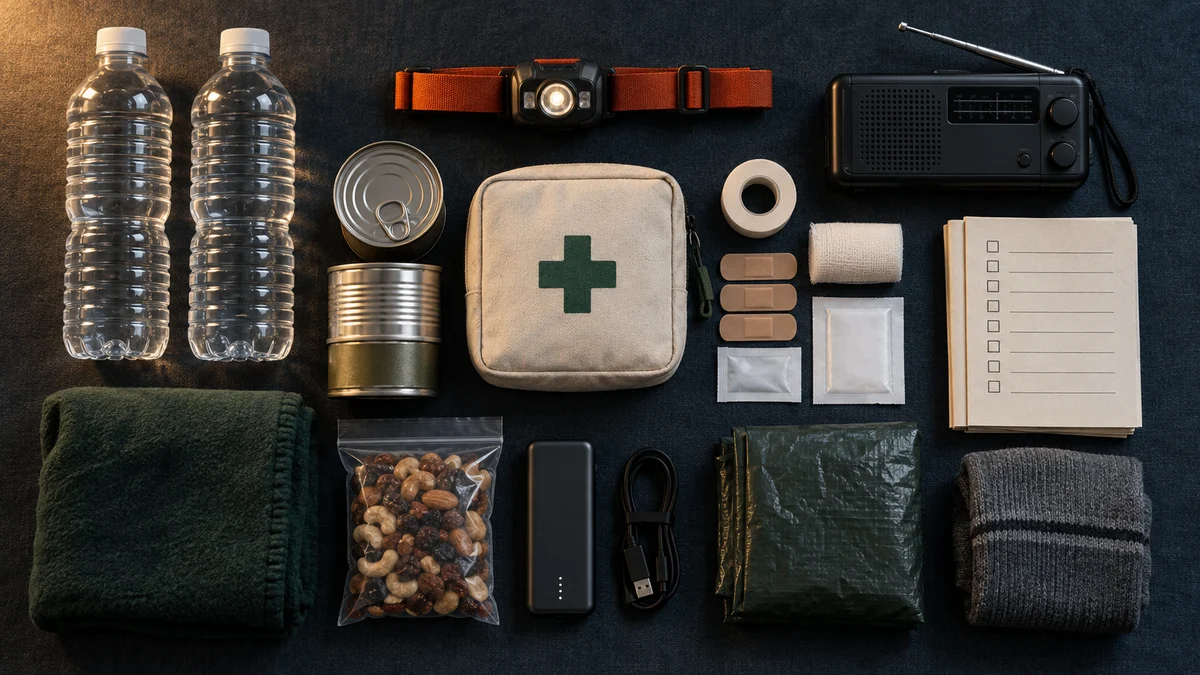
Twenty percent. That is the share of consumer food waste in this country that the Food and Drug Administration attributes to one thing: confusion over the date printed on the package. Not spoilage. Not bad shopping. A misread label.
That number belongs at the top of an article about long term food storage, because the practice rests on the opposite belief. A pantry works only if food stays food for years, and the thing most likely to empty yours into a trash bag is a date that was never a safety date.
The second thing that empties a pantry is arithmetic nobody did. People count cans. Cans are a terrible unit — a can of peaches and a can of chili are the same object on a shelf and nothing like it in a stomach. What you store is energy, per person, per day, times the days you mean to cover.
So this page counts calories, then converts them back into things you can put in a cart.
Long term food storage is counted in calories, not in cans
One figure every American household already owns is printed on every box in the kitchen. The FDA states it plainly: “2,000 calories a day is used as a general guide for nutrition advice”, adding that your needs “may be higher or lower and vary depending on your age, sex, height, weight, and physical activity level.”
Not a prescription. A planning number, which is exactly what a shelf needs.
| Duration | What it covers | Per adult | In dry rice, for scale |
|---|---|---|---|
| 3 days | the federal floor: the time it takes for help to organize | 6,000 cal | about 4 lb |
| 2 weeks | a long outage, a closed road, a supply gap | 28,000 cal | about 18 lb |
| 1 month | the point where a reserve becomes an organization | 60,000 cal | about 38 lb |
Rice is only there to give the numbers a body. Nobody eats thirty-eight pounds of rice in a month, and the right-hand column shows faster than any paragraph why three days fits in a cabinet and a month does not.
That third row is where the reserve stops being loose packages and starts needing furniture. Cans in rows, bags off the floor, everything visible from the front: a few lidded stacking binsaff. do more for a month of food than any single purchase here, because a reserve you cannot see is a reserve you will not rotate.
Children, teenagers, and a body that is cold
Young children eat less — planning a child under twelve at three-quarters of an adult is honest and slightly generous, which is the direction to err. Teenagers frequently eat more than the adults in the same house. And physical work moves the number hard: hauling water up four flights, clearing a yard, sleeping in a room at 55 °F, because a body kept cold spends energy staying warm all night. I plan a margin of about twenty percent for a household that will be working and cold, and I call it a margin rather than a figure, because it is mine and not anyone’s published guidance.
Then plan for the people who will actually be there. A storm that closes a road tends to close it on a Saturday, with a grandmother and two cousins inside.
Twenty chips — one adult, thirty days
Spend a month of calories, then look at what it weighs
The pool is fixed: 60,000 calories, which is thirty days at the 2,000-a-day figure the Nutrition Facts label is built on. Each chip is 5 percent of it. Move chips between the eight families until none are left — the board will not rule until the pool is empty, because a pantry that is 80 percent spent is not a pantry.
0 chips left to spend
- Dry grains white rice, pasta, flour, rolled oats 0%0 lb · 0 gal
- Dry beans and lentils pinto, black, lentils, split peas 0%0 lb · 0 gal
- Cooking fat vegetable oil, olive oil, shortening 0%0 lb · 0 gal
- Sugar and syrup white sugar, honey, maple syrup 0%0 lb · 0 gal
- Canned protein tuna, chicken, chili, baked beans 0%0 lb · 0 gal
- Canned produce tomatoes, green beans, corn, peaches 0%0 lb · 0 gal
- Nuts and dried fruit peanut butter, almonds, raisins 0%0 lb · 0 gal
- Powdered dairy powdered whole milk, shelf-stable milk 0%0 lb · 0 gal
Push the chips toward grains and beans and watch both numbers move: the shelf gets lighter and cheaper, the gallons at the stove climb. That bill arrives on exactly the day water is hardest to get, which is why a pantry built entirely of dry goods is not the clever answer it looks like.
What “best by” means, and what believing otherwise costs
Here is the sentence that changes how a pantry works. The FDA: “Except for infant formula, manufacturers are not required by Federal law or regulation to place quality-based date labels on packaged food.”
Read that again. The date on your canned chili is voluntary. The agency notes there are “no uniform or universally accepted descriptions used on food labels for open dating” in the United States, that manufacturers apply “Sell By, Best By, Expires on” and the rest “at their own discretion and for a variety of reasons,” and that the most common reason is “to inform consumers and retailers of the date to which they can expect the food to retain its desired quality and flavor.”
Quality. Flavor. Not safety. The FDA has been pushing the industry toward “Best if Used By” so the phrasing stops sounding like a deadline, and infant formula is the one exception where the date is federally required and must be respected.
So a can of beans three months past its printed date is not expired. It is a can of beans.
What does end a can, and it is never the date
The FDA’s consumer guidance defines the damage that matters: “swelling, leakage, punctures, holes, fractures, extensive deep rusting, or crushing or denting severe enough to prevent normal stacking or opening with a manual, wheel-type can opener”, and adds that stickiness on the outside may indicate a leak. Ready.gov’s emergency food page puts the same rule in the negative, listing under its “don’t” column eating from cans that are swollen, dented or corroded, and eating any food “that looks or smells abnormal, even if the can looks normal.”
Dent on the body, keep. Dent on a seam, bulge, rust through, weeping, off smell: gone, whatever the date says. That is the whole of what a preparedness site should tell you; anything more specific belongs to the agencies.
What actually keeps, and what quietly does not
Sort the pantry by how long it forgives being ignored, and it falls into three bands.
At the top, the dry staples that outlive the house: white rice, dry pasta, dry beans and lentils, sugar, salt, honey. Cool, dark, dry and sealed, these are measured in years, and the limiting factor is almost never the food. It is the packaging. A paper bag of rice is an invitation to pantry moths, flour cakes with humidity, and cardboard stops no rodent that has decided otherwise. Moving dry goods into food-grade buckets with gasket lidsaff. is the cheapest upgrade here, and I would do it before buying a second bag of anything.
In the middle, commercial cans and jars. Long-lived, edible cold, no fuel and no water required — you can open one in a dark kitchen with no stove at all. Their weakness is density: most of what is in the can is water, which is why a shelf built only of cans weighs three times what it needs to. Push every chip on the board above into canned goods and look at the pounds.
At the bottom, and this is the band people get wrong, sit the fats.
The fats are the clock in the room
Cooking oil, nut butter, nuts, whole-grain flour, anything with oil in it: these go rancid. Not dangerous, not dramatic, just increasingly unpleasant until nobody will eat it. That puts them on a much shorter cycle than the rest of the shelf, which matters because fat is where the calories are — at roughly four thousand calories a pound, cooking oil is the densest thing in the kitchen, and a reserve without it is enormous for no reason.
The answer is not to skip it but to buy it in sizes your household finishes. One working bottle in the kitchen and one spare bottle of cooking oilaff. behind it, swapped when the first runs out, gives the density with none of the rancidity. Whole-grain flour sits in the same band, which is why white flour stores better than the healthier version of itself.
The line most lists omit: powdered whole milkaff.. Hard to find in a grocery store, easy online, keeps a year or two sealed, and it puts fat, protein and calcium into breakfasts that would otherwise be sugar and crackers. In a house with children it changes a month more than anything else you can buy for the space.
Water is the second bill, and every dry food sends it
This is the trap in the cheap pantry. Everything that makes dry storage economical — rice, pasta, beans, powdered milk — arrives as dry weight and can only be eaten after water and heat. A cupboard holding a hundred thousand calories is worth nothing on the evening the taps and the stove go together.
Ready.gov’s baseline covers drinking and sanitation only: “Store at least one gallon of water per person per day for several days”, with the warning that in very hot temperatures “water needs can double” and that children, nursing mothers and sick people may need more. Cooking sits on top of that. A two-week dry reserve for four people asks for something near ten to fifteen extra gallons at the stove — a planning estimate of mine, not a published figure, and easy to check against your own recipes.
So the food reserve and the water reserve are one project. How much, in what, and where it goes is the subject of emergency water storage; the short version is that stackable food-grade water containersaff. along a wall beat fifty loose bottles that get drunk at soccer practice, and that Ready.gov asks you to replace non-commercial stored water every six months.
Then heat. Twenty minutes of flame a day is nothing until you multiply it by fourteen, and a portable butane camp stove with a box of canistersaff. bought with one canister is a stove with three days in it. Buy fuel by the box, use it outdoors or by an open window, never as a heater and never in a closed room, because heat without power works differently — the reasoning runs through what to expect in an extended power outage.
The refrigerator is not part of the reserve. What is in it gets eaten on day one, before this shelf is touched.
The lines that fall off every list
Four things with no calories in them, and without any of them the shelf does less than you think.
Salt first, because it never expires and because plain rice on the third evening is inedible without it. A box lasts months and costs nothing.
Then what a rational list deletes and a household that has lived two weeks without power puts at the top: coffee, tea, cocoa, cookies, jam, honey. Ready.gov lists “comfort/stress foods” in its own supply list, which for a federal agency is a strong statement. A breakfast that looks like breakfast on the fourth morning changes the temper of the day, and three bags of coffee ahead is not stockpiling, it is being early on the shopping. The one substitution worth making here is the brewing method rather than the brand: instant coffee in single-serve packetsaff. needs one mug of boiled water instead of a full pot, on the days when every cup of hot water is counted.
Third, the can opener — the manual kind, stored with the food, not in the drawer where the electric one quietly replaced it. Ready.gov names it in the same breath as the cans.
Fourth, and this is where a shelf stops being a general problem: the specific people in your house.
First in, first out: the only system that survives a year
A reserve is not a purchase. It is an afternoon, then half an hour twice a year — and the half hour is the part almost nobody does.
The method is embarrassingly simple. What you buy goes to the back or the top. What you cook comes from the front. The date goes on the lid in marker the day it comes home, large enough to read from the doorway, because the printed date lives in gray type on the underside of a can and no one reads it twice. Twice a year — the clock changes are a good anchor — pull everything forward, find what comes due within six months, cook it that month, replace it on the next shop.
The bench below runs that year for you. Ten crates, one click a month, a counter for what you threw away.
The bench — one click, one month
Run a shelf for a year and count what you threw out
Ten crates, oldest at the front, newest at the back. Each month you cook one of them and a replacement arrives at the back. Everything left on the shelf loses a month off its date, and anything that runs out goes in the trash with a mark against your name. Twelve clicks is a year. Pick an end and keep picking it.
Month 0 · 0 cooked · 0 thrown out
- — —
- — —
- — —
- — —
- — —
- — —
- — —
- — —
- — —
- — —
Nothing has happened yet.
Most people run it from the back the first time, because the back is where your hand goes, and the counter tells them something uncomfortable: the shelf held food all year and a tenth of it still went in the trash. Not a storage failure. A reaching failure, fixed by geometry — a rack that loads at the back and delivers at the front — or by a marker, so the oldest crate is legible rather than merely present.
Much of what gets thrown out during a twice-yearly sort is thrown out for passing a quality date on a sound package, which is the twenty percent the FDA is talking about. Your own date on the lid does two jobs: it tells you what is oldest, and it stops the printed date from deciding for you.
Under all of it sits the rule that makes rotation possible at all: store only what your household already eats. A shelf of ordinary groceries renews itself through the normal shopping. A shelf of special crisis food expires in silence, and the 72-hour kit checklist makes the same point about batteries and light.
Removable labels and a bold markeraff. are the entire infrastructure of this section. Less than the price of one abandoned bucket.
Grocery shelf or sealed bucket: the honest comparison
The best seller in this category is the twenty-five-year bucket, and it deserves a fair hearing rather than a sneer.
| Built from the grocery store | Sealed long-term bucket | |
|---|---|---|
| Cost per calorie | lowest available, by a wide margin | several times higher |
| Shelf life | years, and longer in sealed containers | very long, sealed, undisturbed |
| Rotation | happens on its own, through normal meals | none — it sits until an emergency |
| Water and fuel | needed for most of it | needed for almost all of it |
| Taste test | done constantly, by everyone | usually never done at all |
| Space | bins, buckets, a closet shelf | compact and stackable |
Two honest advantages for the bucket: the shelf life is real, and so is the space efficiency. If a reserve can sit untouched for a decade — a cabin, a second home, a garage you rarely open — that is a genuine use case, and so is a go bag, where weight is everything and a day or two of food is all you need. That line is covered in the go bag checklist.
For the house, I would not. Cost per calorie is the least of it. The problem is that nobody eats it in normal life, so it never rotates, you never learn to cook it, and you discover on the fourth evening of a blackout that the children will not touch it. A food you have never prepared is not a reserve — it is a bet.
The middle path is what I would take for anything going into deep storage: ordinary bulk staples, sealed properly yourself. Mylar bags with oxygen absorbersaff. inside a bucket give rice and beans a long life for a fraction of what the same calories cost pre-packaged, and it is food you already cook. Seal what you store for years; leave what you eat monthly in containers you open.
What I would put on the shelf, and in what order
Three days first, this weekend, mostly from what is already in the cabinets: an inventory, dates on lids, the manual can opener moved in with the food. That is the food post of the 72-hour emergency kit, one post out of a dozen — and the reasoning behind that number is in why 72 hours is the figure everyone uses.
Then two weeks, across a month of ordinary shopping. A bag of rice, two bags of beans, a can of powdered milk and two fuel canisters each time you are at the store, until the board above says the pool is spent. Three bins, the extra gallons, a stove that takes a family-sized pot. No buckets, no ration bars, no supplements bought on a website’s say-so.
The month I would leave for later, because it stops being a food problem and becomes a whole-household one — power, heat, water, documents — which is long-term emergency preparedness. Food is the easiest post in that guide, and the cheapest.
One last thing about where it goes. A pantry wants cool, dark, dry and steady, and the two places most households pick are the worst two: the cabinet beside the oven, and the garage. A summer that pushes a garage past 100 °F ages everything in it — the same argument, from the other end, as getting through a heat wave without air conditioning. Where the season arrives on schedule, the shelf gets built in spring, before hurricane preparedness becomes a weekly conversation; the equipment side sits on the emergency kit page.
So: what is the oldest thing on your shelf right now, and could you find it without picking anything up?
Frequently asked questions
- How much food do I need for long term food storage?
- Count energy, not packages. The Nutrition Facts label is built on 2,000 calories a day for an adult, and that is the figure worth planning against: 6,000 calories per adult for three days, 28,000 for two weeks, 60,000 for a month. Children under twelve run lower, teenagers frequently higher than the adults in the same house, and anyone hauling water, clearing a yard or sleeping in a cold room burns more than a normal week. For a family of four over two weeks, the honest planning number lands somewhere near 100,000 calories — which is roughly thirty to forty pounds of dry goods and cans, not the two grocery bags most households picture.
- Does food really go bad after the best by date?
- Usually not, and this is the costliest misunderstanding in the whole subject. The FDA is explicit that except for infant formula, manufacturers are not required by federal law to put quality-based date labels on packaged food at all, and that the common reason for printing one is to tell you when the food will still have its intended quality and flavor. The agency estimates that confusion over date labeling accounts for about twenty percent of consumer food waste. A dented, swollen or leaking can is a different question entirely, and that one has nothing to do with the date.
- What foods last the longest without refrigeration?
- White rice, dry pasta, dry beans and lentils, sugar, salt and honey sit at the top, as long as they stay cool, dark, dry and sealed against insects. Commercially canned food follows close behind, and a sound can outlives its printed date by a wide margin. The short end of the shelf is fat: cooking oil, nut butter, whole-grain flour and nuts all carry oils that go rancid, so they are the items to buy in sizes you finish rather than sizes that impress. Powdered milk and dried fruit sit in the middle.
- Are freeze-dried emergency buckets worth buying?
- For a go bag, yes — light, compact, very long shelf life, and you only need a day or two of it. For a pantry at home, I would not. The cost per calorie is several times rice and beans, every serving needs hot water you may not have, and nobody in the house has ever eaten it, so it never rotates and you find out what your children think of it on the worst possible evening. Keep two or three pouches with the bag and build the shelf out of groceries. A food you have never cooked is not a reserve.
- How do I rotate a food reserve without throwing things out?
- First in, first out, made physically easy. New purchases go to the back, cooking comes from the front, and the date goes on the lid in marker the day it comes home, big enough to read from the doorway — the printed date is gray six-point type on the underside of a can and nobody reads it twice. Twice a year, at the clock changes, pull everything forward, find what comes due in six months, cook it that month and replace it. The rule underneath all of it: store only food your household already eats.
- How much water does a dry food reserve need?
- More than people plan for, and it is separate from drinking water. Ready.gov asks for at least one gallon per person per day for drinking and sanitation. Cooking is on top of that: rice, pasta, beans and powdered milk all arrive as dry weight and leave as wet food, and a two-week dry reserve for a family of four asks for something on the order of ten to fifteen additional gallons at the stove. That is the line that turns a cheap pantry into an expensive one, because every gallon of it has to be stored, filtered or boiled.
- Where can I store food in an apartment with no basement?
- High and sealed. The bottom of a kitchen cabinet away from the oven, the top of a closet, under a bed in lidded bins: what the food needs is dry, dark and a steady temperature, not a cellar. Bags of rice and flour move into airtight containers, which stop pantry moths and rodents and stack properly. Two weeks for four people is about three storage bins. What is ruled out is the balcony and an uninsulated garage — heat in July, freezing in January, damp all year, and the FDA also asks you to keep food away from household cleaning products and chemicals.
Who wrote this
Baptiste S.
Founder and writer · bs-media
I am not a firefighter, a paramedic or a survival instructor. I am someone who read his government's household preparedness guide cover to cover, lives where winter storms knock the power out every year, and decided to do the work properly: read the official guidance, run the numbers, compare the spec sheets, and write down what I wish I had found. This site sells neither fear nor bunkers. It explains what an ordinary household can put together in a weekend, and in what order.
- I start from official guidance — FEMA, Ready.gov, the National Weather Service, the CDC, the American Red Cross — and I link to it. If I have not checked it, I do not write it.
- No guns, no bunkers, no doomsday: this site prepares an ordinary household for three days, two weeks, a month.
- I say what is not worth buying, including the things that sell best in survival stores.
- On health, medication and electrical work, I defer to your doctor, your pharmacist or a licensed electrician. That is not my job.
Read next
Heat Without Power: Warm Up Before You Burn Anything
Heat without power, in the order that works: how fast a house really cools, the one room to close down, sleeping warm, and the combustion rules. Start tonight.
Important Documents in an Emergency: What to Copy
Important documents in an emergency: the FEMA and Operation HOPE checklist, the three copies rule, the photo inventory a claim needs, and who reissues what.
Power Station vs Generator: Which One Your House Needs
Power station vs generator, decided on your household rather than the spec sheet: running watts, starting surge, fuel storage, noise and the twenty-foot rule.
72 Hour Kit Checklist: Every Line, Counted
The 72 hour kit checklist, counted for your own household: gallons, meals, lights, batteries, the seven lines people leave out, and where it all fits at home.