Hurricane Maria came ashore in Puerto Rico in September 2017 and took the entire electrical grid with it. Not a county, not a corridor: the island. The Government Accountability Office, reviewing the federal response, recorded that all of Puerto Rico’s 3.3 million residents were left without power and that it took roughly eleven months to restore service to every customer whose home was safe to reconnect.
Eleven months. Not seventy-two hours.
That gap is the entire subject of this guide. Long term emergency preparedness is what happens to a household after the third day, when the kit in the hall closet has done its job and the lights are still off. Federal guidance is excellent up to that line and silent past it — Ready.gov asks you to be ready to survive on your own for several days, and “several” is where the official advice stops.
What this guide will not do, and why it costs you nothing
No firearms. No tactical gear, no bunkers, no collapse scenarios, no politics, and no opinion about which way the country is going. That is not squeamishness, it is arithmetic.
A household does not get to pick the disaster that arrives. What it gets is an interruption — of power, of water, of the road, of the supply chain, of the pharmacy, or several at once. Whether that interruption came from a hurricane, an ice storm, a wildfire, a cyberattack on a utility or something nobody has named yet makes no difference at all to what happens in your kitchen at nine at night. The refrigerator stops. The phone drops to twelve percent. The card reader at the corner store goes dark.
So the preparation is the same preparation. The shelf you build for a two-week ice storm is the shelf that covers everything else, and the reader who wants to argue about causes can do that on somebody else’s site while their water is already stored.
What this costs you: nothing. Not one item on any list here would be bought differently by someone who believed in a more dramatic story. The gravity filter is the same filter. The propane is the same propane. The dramatic story adds expense and dread, and I have never seen either one boil water.
I also give no medical advice and no wiring instructions. Both subjects appear below, both are marked, and both end the same way: that one goes to a professional.
Long term emergency preparedness starts where the 72-hour kit stops
Here is the mistake almost everyone makes, myself included until I sat down with a calculator: treating the second tier as the first tier multiplied.
It is not. Multiplying breaks immediately, and it breaks on the very first post. Ready.gov’s figure is one gallon of water per person per day, for drinking and sanitation. For a family of four over three days, that is twelve gallons — two cases of bottled water and a couple of jugs, easily done, fits under a bed. Run the same multiplication over fourteen days and you get 56 gallons. Over 450 pounds. A footprint the size of a small refrigerator, in a place most people do not have.
So the second tier cannot be the first tier times five. It has to be a different design.
That is the rule that organizes this entire guide: at 72 hours everything is stored; at two weeks you start producing; at one month it becomes an installation. Water goes from jugs to a filter. Power goes from a battery to a battery plus a panel. Food goes from a box of cans to a rotating pantry. Heat, which did not exist at all in the first tier, suddenly exists and brings a lethal hazard with it.
Some posts do not scale at all. Documents are finished the day you put copies in a folder. Cash is finished the day you get the bills. Your neighbors’ first names never expire. Those three belong at the top of the first weekend precisely because they are done forever.
The component below does the arithmetic for your household at each tier and, more usefully, says in one line what changed since the tier before it.
The three tiers — click one, the quantities follow
What changes at 72 hours, two weeks, one month
Nothing is sent anywhere: the math runs in your browser. Each post shows the quantity for your household and the one line that separates this tier from the one before it.
Notice what happens to the water row when you click from 72 hours to two weeks: the stored volume barely moves, and a filter appears. That single row is the thesis of this page.
If you have not built the first tier yet, build that first — the 72-hour emergency kit guide covers it item by item with quantities for your household, and the reasoning behind that particular number is laid out in why 72 hours is the number everyone uses. Everything here assumes that shelf already exists.
Water: at two weeks you stop stacking and start treating
Municipal water depends on electricity far more than most people realize. Treatment plants run on pumps. Buildings over three or four stories run on booster pumps. Tanks have to be refilled. A long outage takes water away from the top floors first and from everyone eventually.
And sometimes the pressure stays while the water goes bad, which is worse, because nothing tells you until the notice arrives.
Western North Carolina lived the full version of this in the fall of 2024. After Tropical Storm Helene, the City of Asheville’s own year-end account records non-potable water restored in 21 days and potable water in 52 days. Seven weeks before the tap was drinkable again, in a mid-sized American city with a functioning utility and national attention. No amount of bottled water on a shelf covers 52 days.
So the design changes. Store about a week — 28 gallons for a family of four, which does fit along a garage wall in stackable water containers with spigotsaff. rather than in fifty loose bottles that get drunk at soccer practice. Write the fill date on each one in marker. Refill every six months.
Then add treatment, which is what actually buys you the long tail. A gravity filter for the counteraff. pushes several gallons an hour through a ceramic or hollow-fiber element with no pump, no power and no moving parts to break, and it works on cloudy tap water, rain off a clean roof, or what came out of the water heater in your utility closet. A backpacking straw filter is a fine thing in a pack; it will not keep up with four people drinking four gallons a day.
Chemistry is the backup to the filter, not a replacement for it. Ready.gov’s disinfection instructions are plain: bring water to a rolling boil for one full minute, or add an eighth of a teaspoon of unscented household bleach per gallon, stir, and let it stand thirty minutes. Tablets do the same job in a smaller package and are worth having for the evening the filter clogs.
The one thing I would skip entirely: emergency water pouches. Long shelf life, yes, and about four ounces each at a cost per gallon that makes no sense when a jug filled from your own tap does the identical job. They belong in a car, not in a house.
The full calculation — how much, in what containers, where it goes, how to rotate it and what to do with a water heater — is the subject of the emergency water storage guide.
Food: a pantry you eat, not a bucket you bury
A closed refrigerator holds for about four hours. A full freezer holds for about 48. Those are Ready.gov’s own numbers, and they are the reason the food question changes shape on day three.
After the second day, everything you eat comes off a shelf.
For 72 hours, the rule is simple: food that needs neither refrigeration nor a long cook. Canned chili and soup, canned fish and chicken, peanut butter, crackers, dried fruit, shelf-stable milk. Nine meals per person. And a manual can opener — the single most common gap in American kitchens, because the one in the drawer plugs into the wall.
Two weeks is a different animal: 42 meals per person, roughly 28,000 calories. That is no longer a bin in the closet, it is a shelf, and the only version of it that survives contact with real life is food your family already eats. Rice, pasta, beans, canned vegetables, oil, sugar, salt, coffee. Bought in the weekly shop. Eaten oldest first and replaced on the way home.
That habit has a name — rotation — and it is the difference between a pantry and a museum. Nothing expires because nothing sits. Dry goods keep far better in food-grade buckets with gasket lidsaff. than in the paper bags they came in, which is a five-dollar fix for pantry moths and humidity both.
Cooking is the post people forget. Twenty minutes of flame a day for two weeks is roughly one fuel canister every three days, so a portable butane camp stoveaff. bought with a single canister is a stove with three days of use in it. Buy the canisters by the box. Use it outdoors or by an open window, never in a closed room.
At one month, the constraint changes again. Ninety meals per person is achievable in a closet, but thirty days of rice will leave you tired and irritable: the missing pieces are fat and protein. Canned meat and fish, oil, powdered milk. The full calorie-by-calorie breakdown, by household and by food group, lives in the long-term food storage guide.
The buckets that sell well and get eaten never
A word about the thing that sells best in this category. Freeze-dried buckets advertising twenty-five years of shelf life have one real virtue, which is the shelf life, and two real problems: the cost per meal, and the fact that nobody in your family has ever tasted the contents. A pantry you discover on the worst day is a pantry you eat badly.
I would keep two or three pouches for a go bag and build everything else out of grocery store food. That is not frugality for its own sake. It is the only version that gets rotated.
Backup power: from a power bank to an installation
Start with the load, not with the hardware. It is the only way this post stays honest.
A phone charge is on the order of 15 watt-hours. A LED lantern running an evening is maybe 10. A radio, a couple. So a family of four, charging four phones and lighting one room, is spending something like 70 watt-hours a day — which means three days of no production costs you roughly 220 watt-hours, and two large USB-C power banksaff. cover the entire first tier for less than the price of a tank of gas.
Then the arithmetic turns on you. Fourteen days of that same load is about a kilowatt-hour, and thirty days is over two — and those figures assume you never plug in anything that matters, like a refrigerator, which for a full-size American unit runs on the order of 1,200 watt-hours a day all by itself.
You cannot store your way out of that. This is the same wall the water post hits, and it has the same answer: production.
At the two-week tier, the right shape is a lithium iron phosphate power station in the 500 to 1,000 watt-hour range paired with a foldable solar panelaff.. The battery is now sized for two cloudy days rather than for the whole event, because the panel refills it every afternoon the sun is out. That chemistry holds a charge for years without degrading and tolerates thousands of cycles, which matters enormously for a device whose job is to sit in a closet being ready. The specifications worth comparing are watt-hours of capacity and watts of solar input. Not the number of outlets on the front.
Generator or battery is a real decision, not a false one, and it turns on your building. In an apartment, the battery, with no discussion — a generator needs to be outdoors and, per Ready.gov, at least twenty feet from windows, doors and attached garages, which a third-floor unit cannot provide. In a house with a full freezer and a yard, a generator earns its place. The trade-offs, noise, fuel logistics and runtime are compared side by side in portable power station or generator, and what actually fails in what order once the grid goes down is walked through hour by hour in what to expect in an extended power outage.
Heat without electricity, and the mistake that kills people
An outage in July is misery. The same outage in January is a medical emergency, and it is the one post in this guide where a clever workaround kills you.
We know precisely how, because Texas documented it. After the February 2021 winter storm, the Department of State Health Services ran a full mortality surveillance and confirmed 246 storm-related deaths as of October 2021. Extreme cold exposure accounted for 161 of them, hypothermia alone for 156. And 19 deaths — 7.7 percent — were carbon monoxide poisonings, which the report attributes to “inappropriate use of generators, grills, heaters, vehicles running in enclosed spaces, and ice obstructing vents in gas powered heating equipment.”
Nineteen households that solved the cold problem and created a worse one. The CDC puts unintentional carbon monoxide deaths not linked to fires at more than 400 Americans a year, and its rule has no exceptions in it: never run a generator inside a home or garage even with the doors and windows open, and keep it more than twenty feet from windows, doors and vents.
So the first purchase in this section is not a heater. It is a carbon monoxide alarm with a ten-year sealed batteryaff., one per level, installed before any combustion appliance comes through the door. It is the cheapest item on this entire page and the only one I would call non-negotiable.
For 72 hours, the answer is not to heat at all. Shrink the house to one room, close the interior doors, put a rolled towel at the base, and everyone sleeps in there under covers. A reasonably insulated home loses a few degrees a day; three nights in the low sixties is unpleasant and not dangerous for healthy adults. For an infant, an elderly parent or anyone with a heart or lung condition, it is a different calculation, and that household should be at the second tier already.
At two weeks you need an actual heat source, and in a home without a fireplace the only category that works is a combustion appliance built and certified for indoor use: an indoor-safe propane heater with an oxygen depletion sensor and tip-over shutoffaff., run in a room with a window cracked, alarm already on the wall. On low, a small unit burns roughly a pound of propane an evening — call it fourteen pounds for two weeks, thirty for a month, which is a refillable tank in the garage rather than a pile of little cylinders in a closet.
What is excluded, permanently: charcoal grills indoors, camp stoves as heaters, an open oven door, a generator in an attached garage, a car idling to warm a room. Every one of those appears in the Texas causes of death. The full ranking of options by building type is in how to heat without power.
Medication, and the refrigerator that has to keep running
The Texas report contains a line that gets less attention than the carbon monoxide number and is, for some households, more important. Twenty-five deaths — 10.2 percent — came from exacerbation of pre-existing illness: disrupted dialysis and oxygen treatment, frozen medical devices and medication, interrupted hospice care, and loss of power to electricity-dependent equipment required to sustain life.
That is the sentence that turns preparedness from a hobby into a plan, and it applies to a lot more homes than people think. Anyone on a concentrator, a CPAP, a pump, refrigerated injectables or scheduled dialysis is running a small medical facility that assumes the grid.
What you can do without anyone’s permission: write down every prescription in the household, the dose, the prescriber and the pharmacy, and keep that list with your documents rather than in a phone that dies. Keep three days of everything physically together. Know which items must stay cold.
What you cannot decide alone is everything else — how far ahead you may refill, what your insurance permits, which medications tolerate a few hours in a cooler and which are ruined by it. Ready.gov’s own instruction is blunt: if the power has been out more than a day, discard refrigerated medication unless the label says otherwise, and contact your doctor or pharmacist immediately for a replacement supply. An insulated medication cooler caseaff. buys hours, not days, and the hours it buys are only useful if you already know the plan.
At the one-month tier, the constraint stops being the pill count and becomes the cold chain, which means something has to keep running. That is a specific load, with specific watt-hours, and it belongs in the power budget before the lights and the phones do. A small 12-volt compressor cooleraff. on a power station is a far better answer than ice, because ice is a resupply problem and a compressor is an energy problem you have already solved.
Information when the networks are down
The phone is the first thing you reach for and the first thing you kill. Flashlight, refreshing news, calls that will not connect — by midnight it is dead, and it was your only link to the outside.
Cell sites have battery backup measured in hours. Broadcast is a different animal, and in the United States the backbone that survives is NOAA Weather Radio All Hazards: more than a thousand transmitters covering all fifty states, Puerto Rico, the Virgin Islands and the Pacific territories, broadcasting National Weather Service warnings, watches and forecasts continuously on seven VHF frequencies between 162.400 and 162.550 MHz. It carries far more than weather — natural disasters, environmental incidents, public safety emergencies, AMBER alerts.
A receiver for that network is the second object in the kit after water. Your car radio works, but using it means going outside, spending fuel and leaving someone alone in the house to do it. A small hand-crank set with a built-in light settles the question for the length of an entire event with no batteries at all, and the comparison of crank, battery, solar and app-based alerting is worked through in choosing an emergency weather radio.
Three things that cost nothing. Write your local NWR frequency on the case of the radio in permanent marker, because nobody hunts for it in the dark. Leave Wireless Emergency Alerts turned on in your phone settings — they are on by default, and a fair number of people switched them off after a test. And agree with two neighbors on who listens and who relays.
At the one-month tier the equipment stops changing and the organization starts. A notebook by the radio, the hour and the instruction written down, so the people who were asleep at six in the morning do not have to be briefed from memory. A weatherproof notebookaff. in the kit sounds fussy until the third time someone asks what the county actually said.
Cash, documents, and the posts you finish in one weekend
Three posts here, and what they share is that they do not grow with time. Finish them once and they are finished — which is exactly why they are the ones most often missing.
Documents first. Fire or flood destroys a file in an hour and it takes months to rebuild; an evacuation order gives you ten minutes, which is not enough to go looking. Copies of identification, insurance policies with the policy numbers, the deed or the lease, prescriptions, medical information, bank details, the pet’s records, one printed family plan — in a fire-resistant waterproof document bagaff. that lives somewhere everyone in the house knows about, plus an encrypted backup stored outside the building. A zip pouch from an office store does not survive an hour in a wet bag; the kind sold for boats does. The inventory by category, and a test of what you could still open if your phone died tonight, is in the documents to have ready before an emergency.
Cash next. A card reader is an electrical appliance connected to a network, and so is the ATM. When a county goes dark, the stores that keep selling are the ones with a drawer and a pen. I will not name an amount: the equivalent of a few days of groceries, in fives, tens and twenties, because nobody makes change for a fifty with the register dead. Keep it with the documents. It is a bridge across the first days, not a reserve.
And the family plan, which is the cheapest post of all. Two meeting points — one near the house, one outside the neighborhood. An out-of-area contact everyone calls to report where they are, because long-distance circuits often clear when local ones jam. Where the water, gas and electric shutoffs are. Schools, daycare, pets, allergies. One page, redone every year and every time a school changes. The go bag guide builds it out alongside the decision tree for when leaving is even the right call.
Fuel, the car, and getting around a county that is closed
A hurricane or an ice storm does not only take the power. It takes the gas stations, because pumps are electric, and it takes the roads, and it takes the ability of anyone to deliver anything for several days.
The rule I keep is one sentence long and costs nothing: the tank never goes below half. No purchase, no storage, no maintenance, and it covers most of what actually happens, because a supply disruption resolves in days and half a tank is a couple of hundred miles. It is the single highest-return habit on this entire page.
Past that, a modest amount of stored fuel is reasonable if you have a generator or a gas heater — a five-gallon CARB-approved gas canaff., stored outside the living space, treated with stabilizer, rotated into the car twice a year. No further. Storing large quantities of gasoline at home is the point where preparedness starts creating the emergency.
The object that solves the most problems here is the one no preparedness store pushes: a bicycle that actually works, with air in the tires and a light on the front. Bread, information, a check on a neighbor, a trip to the county shelter — with no fuel, no charging and no road clearance required. A working bike beats a second gas can every time.
When to leave, with what, and who makes that call is a separate question with its own logic, and it is worked through in preparing for natural disasters, which sorts hazards by where you actually live — coast, floodplain, wildland interface, tornado alley. The short version: the order to evacuate comes from officials, not from your inventory, and the bag gets packed out of the kit rather than instead of it.
Neighbors: the post you cannot buy
I put this last because it is the hardest to purchase and the one that changes the most at the two-week mark.
Gear is individual. Duration is collective. For three days a household can be an island; over two weeks it cannot, and the households that came through Helene and Uri in reasonable shape were overwhelmingly the ones embedded in a street where somebody had a chainsaw, somebody had a generator, somebody had a truck and somebody knew which houses had an eighty-year-old in them.
A building where three units own a filter, a stove and a battery between them is better supplied than thirty units that each own a flashlight. Equipment sits idle in a single household: a gravity filter running for four people is barely working. Run it for twelve and it is still barely working.
There is also the part nobody puts on a checklist. Mental health over a long outage rests on three things you can actually prepare: knowing what to do, having something to do, and not being alone. The first is the plan. The second is the chores — water to filter, the radio hour, dinner to cook, the log to write up. The third is the door across the hall.
Start with the first names of the people on your floor. That is the whole assignment, and it is free. If you want to know where all of this sits in the rest of the site, the guides index lists every piece by topic, and who writes this site and how explains the method — an ordinary household reading the official guidance and doing the arithmetic, with no field credentials claimed anywhere.
What I would actually do next
Run the chart below with your real numbers, not the ones you wish were true. Count the water in the garage. Count the meals that need no refrigeration. Be honest about the battery.
The chart — move a slider, the bars follow
How long do you last, post by post
Nothing is sent anywhere: the math runs in your browser. The axis runs from zero to thirty days, with the three tier lines drawn across it. The shortest bar is your answer.
Almost everybody finds the same thing, and it is not the thing they expected. One bar is dramatically shorter than the other three, and every dollar spent on the long bars was wasted. For most households in this country the short bar is water, and the reason is that water is heavy, boring and cheap — the exact combination that guarantees procrastination.
So that is where I would start, and it is what I would do in one weekend rather than one year: a week of stored water with dates in marker, a gravity filter next to it, a carbon monoxide alarm on each floor whether or not there is a heater yet, and the documents in a bag. Four things. One afternoon of shopping and one of putting away.
The second weekend is the pantry, which is really just a bigger version of the shopping you already do, and the power station with a panel. The third is everything that is left, and by then you will know from the chart which post it is.
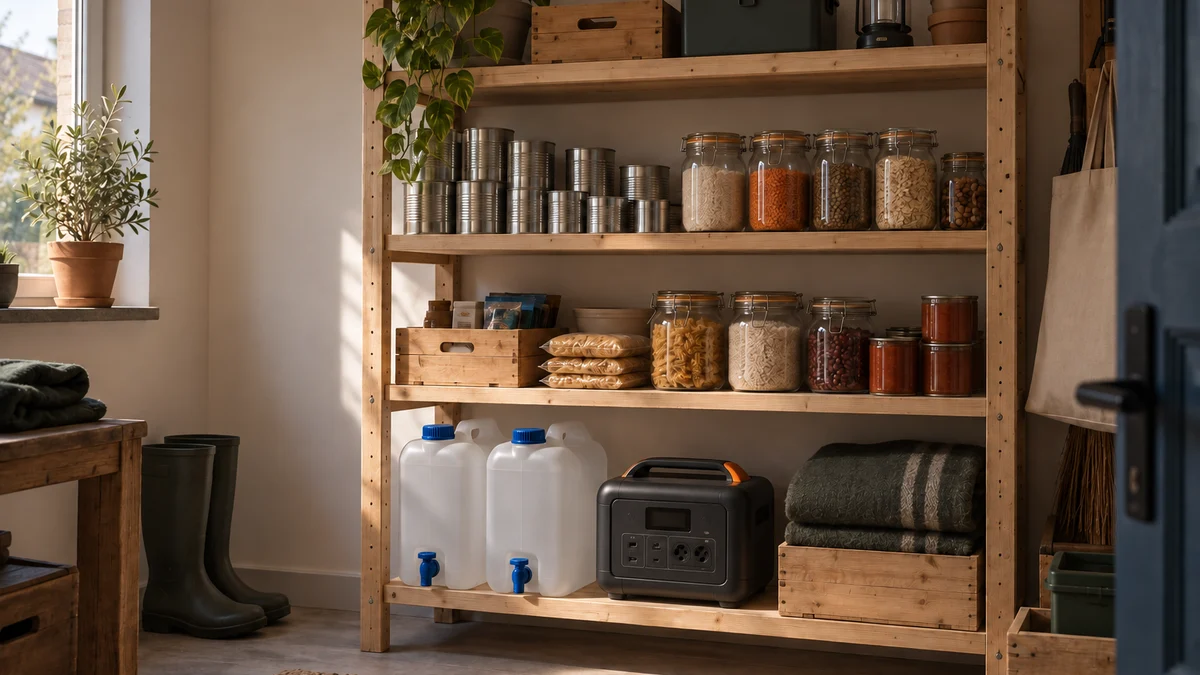
What you end up with is not a bunker. It is a shelf in a garage: containers with dates on them, cans in rows getting eaten and replaced, a radio with a frequency written on the case, a battery on charge, a tank and an alarm, a bag of papers, some small bills. It handles a hurricane, an ice storm, a wildfire evacuation, a boil-water notice and a grid failure identically, because from inside a kitchen those events are the same event.
Eleven months in Puerto Rico. Fifty-two days in Asheville. Two hundred and forty-six deaths in Texas, most of them from cold and nineteen from trying to fix the cold the wrong way. None of those households had done anything wrong. They had prepared, at most, for the duration the official guidance describes — several days — and the event did not read the guidance.
I would rather be the house on the street that has a filter and knows the neighbors’ names. That is the whole ambition of this page, and it fits on one shelf.
Frequently asked questions
- What does long term emergency preparedness mean for an ordinary household?
- It means being ready for the outage that does not end on schedule. Ready.gov tells you to store one gallon of water per person per day and a several-day supply of food, and that covers most storms. Long term emergency preparedness is the next tier up: two weeks, then a month. The list of posts does not change — water, food, power, heat, medicine, information, documents, cash — but the logic does. Storage stops working and treatment, production and rotation take over. You cannot stack fourteen days of drinking water in an apartment, so you filter instead. You cannot hold a month of watt-hours in a box, so you put a panel on it.
- How much water do I actually need for two weeks?
- At the Ready.gov figure of one gallon per person per day, two weeks for a family of four is 56 gallons. That is over 450 pounds of water and roughly the footprint of a small refrigerator, which is why almost nobody stores it. The honest answer is to store about a week — 28 gallons for that same family, which fits along a garage wall — and to add a way to treat what is already in the building or falling on the roof. A gravity filter handles several gallons an hour with no pump and no power. Tablets cover the day the filter clogs.
- Is a generator or a battery better for a long outage?
- For most households in most outages, a battery with a solar panel. It is silent, it makes no carbon monoxide, it can sit in the living room, and it needs no fuel run. A generator wins in exactly one situation: a house with a full freezer, a place outdoors at least twenty feet from windows and doors to run it, and someone willing to store gasoline. If you want either one feeding the house wiring rather than extension cords, that is a transfer switch and a licensed electrician, not a weekend project.
- How long will food in my refrigerator and freezer stay safe?
- Ready.gov gives four hours for a refrigerator kept closed and about 48 hours for a full freezer. Those numbers are the whole argument for a long-outage pantry: after the second day, everything you eat comes off a shelf, not out of a cold box. Plan meals that need no refrigeration and no long cook — canned protein, rice and beans if you have a stove and fuel, nut butter, crackers, dried fruit. And keep a manual can opener, because the one in most American kitchens plugs into the wall.
- What do I do about prescriptions that have to stay cold?
- You ask your doctor and your pharmacist, before anything goes wrong, and you do it in that order. Ready.gov's own instruction is that medication requiring refrigeration should be discarded if the power has been out for more than a day, unless the label says otherwise, and that you should contact a doctor or pharmacist immediately for a new supply. How far ahead you may refill, what your insurance allows, what tolerates a cooler and what does not — all of that is a clinical question with your name on it. This site does not answer it and neither should any other site.
- How do I heat a house safely when the power is out?
- For three days you do not heat the house. You close it down to one room, shut the doors, put everyone under blankets and sleep together. Past that you need a heat source, and this is the single place where improvising kills: after the February 2021 Texas storm, the state health department confirmed 19 carbon monoxide deaths from generators, grills, heaters and vehicles used in enclosed spaces. Only appliances rated for indoor use, only with a window cracked, and only with a carbon monoxide alarm in the room, installed before the heater arrives.
- Do I still need cash if everything is digital?
- Yes, in a small amount, because a card reader is an electrical appliance on a network and so is the ATM down the street. When the grid is down across a county, the stores that stay open are the ones with a cash drawer and someone doing arithmetic on paper. Keep the equivalent of a few days of groceries in fives, tens and twenties — not fifties, because nobody can make change with the register dark — stored with your documents. It is not a reserve. It is a bridge across the first two or three days.
- Is a month of supplies realistic in an apartment?
- A month of food, yes: ninety meals per person is a closet, not a basement, if it is food you already eat and rotate. A month of stored water, no, and you should stop trying. A month of heat, probably not, and that is the honest limit of apartment preparedness — at some point the answer is somewhere warm to go and a family member expecting you. Where an apartment beats a house is neighbors: three units on a floor with a filter, a stove and a battery between them cover thirty people better than thirty separate kits.
Who wrote this
Baptiste S.
Founder and writer · bs-media
I am not a firefighter, a paramedic or a survival instructor. I am someone who read his government's household preparedness guide cover to cover, lives where winter storms knock the power out every year, and decided to do the work properly: read the official guidance, run the numbers, compare the spec sheets, and write down what I wish I had found. This site sells neither fear nor bunkers. It explains what an ordinary household can put together in a weekend, and in what order.
- I start from official guidance — FEMA, Ready.gov, the National Weather Service, the CDC, the American Red Cross — and I link to it. If I have not checked it, I do not write it.
- No guns, no bunkers, no doomsday: this site prepares an ordinary household for three days, two weeks, a month.
- I say what is not worth buying, including the things that sell best in survival stores.
- On health, medication and electrical work, I defer to your doctor, your pharmacist or a licensed electrician. That is not my job.
Read next
Heat Without Power: Warm Up Before You Burn Anything
Heat without power, in the order that works: how fast a house really cools, the one room to close down, sleeping warm, and the combustion rules. Start tonight.
Important Documents in an Emergency: What to Copy
Important documents in an emergency: the FEMA and Operation HOPE checklist, the three copies rule, the photo inventory a claim needs, and who reissues what.
Long Term Food Storage: Count Calories, Not Cans
Long term food storage counted in calories rather than cans: how much per person, what really keeps, and the rotation that lasts a year. Size yours this week.
Power Station vs Generator: Which One Your House Needs
Power station vs generator, decided on your household rather than the spec sheet: running watts, starting surge, fuel storage, noise and the twenty-foot rule.