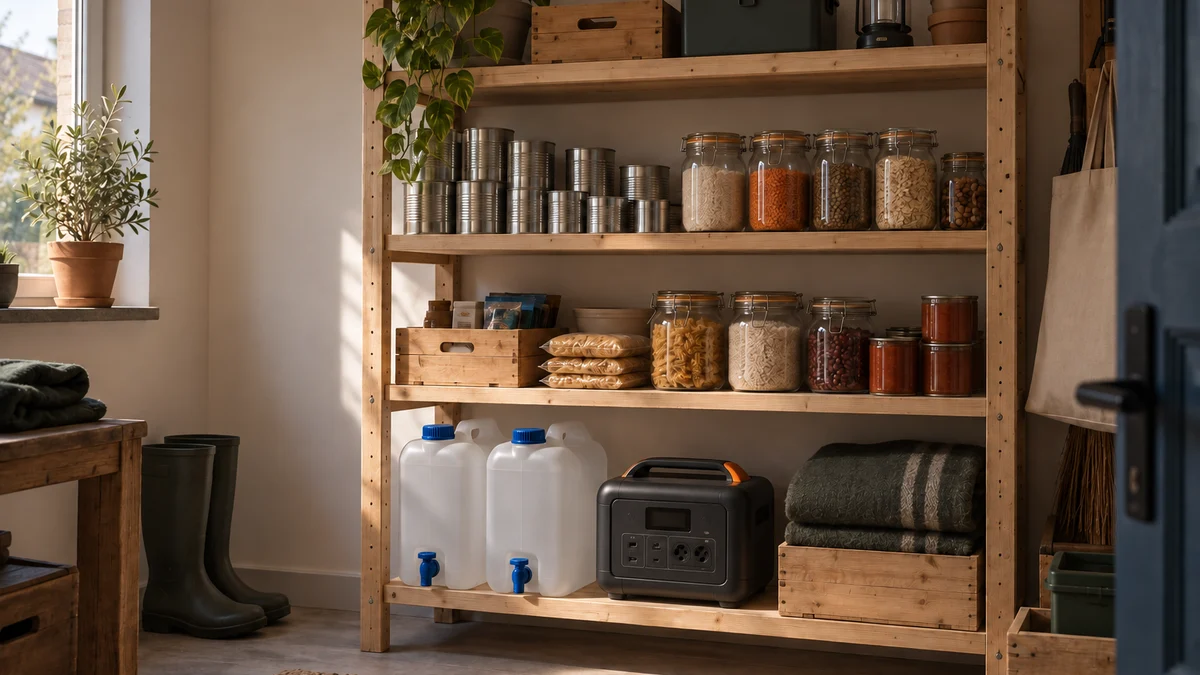
The first thing to buy for a house with no heat and no power is not a heater.
I will put the evidence behind that early, because it is the whole argument of this page. On February 11, 2021, a winter storm sat down on Texas and did not move. NOAA’s climate centers record it plainly: “At the peak of the outage, nearly 10 million people were in the dark, lacking warmth and the ability to cook food”, and the freeze itself “lasted 8 days, 23 hours, and 23 minutes.” The same page reports the Texas Department of State Health Services counting the dead at over two hundred.
People died of the cold. People also died of what they burned indoors to get away from the cold — a different problem, with a different fix, and the reason this page puts the flame last.
A house does not hold heat, it delays it
Insulation is not a container. It is a rate limiter, and what it limits is how quickly your living room becomes the street.
That matters because the question people ask — how long until it gets cold in here — has no general answer. The rate depends on the envelope, on the wind pushing through whatever gaps exist, on sun through south-facing glass, on how much of the house is still warm, and above all on the gap to the outside air. A house sheds heat fastest when that gap is widest. So the first hour after the furnace quits is the fastest hour of the whole outage, and everything after it is slower.
I went looking for a published American figure for this and did not find one, which I will come back to further down. What exists instead is a thermometer and two glances at a clock, and the only feature worth paying for is a memory that holds the night’s minimum and maximum: a digital room thermometer with min-max memoryaff. reports what the room did while everyone was asleep, which is the reading nobody is awake to take.
That is what the tool below does, and it is the only honest version: it does arithmetic on readings you took yourself, in your own room, and it refuses to invent anything else.
Your house, measured — not modeled
How fast is this room actually cooling?
No page on the internet knows how fast your house loses heat, including this one. Two readings off a thermometer in the room you are sitting in do know. Write them down here.
First reading
The moment you started paying attention
Second reading
An hour or two later — the longer the gap, the better the number
Third reading
Optional. Useful if the first two were close together
Outside, right now
The floor your house is falling toward. It cannot go below this.
Run it once in an ordinary winter and you learn something you will use for years — whether your house is a slow one or a fast one. A slow one changes the plan completely. A household drifting under a degree an hour does not need a heater at all for a three-day outage; it needs blankets and patience, which is also the conclusion of what actually fails in an extended power outage, hour by hour, for everything else in the building.
Close the house down to one room
The instinct is to keep the whole house habitable. It is the wrong instinct, and it is expensive in exactly the currency you are short of.
Every room you keep in play is more surface losing heat and more air to warm. The National Weather Service’s own guidance for an outage during extreme cold is a list of four small things, and they are all subtractions: “Close off rooms to avoid wasting heat”, “Place towels or rags in cracks under doors,” “Close blinds or curtains to keep in some heat,” and “Wear layers of loose-fitting, lightweight, warm clothing as well as hats, mittens, and blankets.”
So pick the room before you need it. The best candidate is usually not the living room: it is the smallest room that holds everyone lying down, on an interior wall if you have one, with the fewest windows and a door that closes properly. In an apartment, a room with neighbors on both sides is doing better than anything a house can offer, because their heated walls are yours too.
Subtract, then spend on glass
Interior doors shut, including the ones to rooms you are not using — an unheated bedroom with its door open is an extension of the room you are trying to hold. Rolled towels at the base of the doors that matter. Curtains closed at dusk, opened again on any window the sun reaches. A under-door draft stopperaff. at the front door does more in one night than most of what gets sold as preparedness gear, and it is doing that job the other three hundred days of the year too.
Windows are where the money goes if you are going to spend any. Glass is the weakest part of most American walls, and a pair of heavy thermal insulated curtainsaff. on the coldest window is the one purchase in this section that keeps paying after the power comes back. Not because curtains are clever. Because a cold window makes a room feel colder than the thermometer says, and the people in it start making bad decisions about heaters.
Sleeping warm is the purchase that comes first
Here is the part that feels wrong and is right: the best object to own for a cold house is one you use lying down.
A sleeping bag does not heat air. It traps what a body is already producing, in a space the size of a body, which is the most efficient heating anybody has ever managed — and unlike everything in the last section of this page, it cannot poison a household. For three nights of an outage, a sleeping bag with a comfort ratingaff. per person is the whole plan, and the pillar on long-term emergency preparedness reaches the same conclusion by counting what two weeks of anything else would cost.
Now the number on the tag, because it is where people get hurt.
Most bags carry more than one figure. The comfort rating describes somebody sleeping relaxed and staying comfortable. The lower limit describes somebody curled up, holding on until morning. The third, usually printed as extreme or survival, describes staying alive with a real risk of hypothermia — and it is the one the packaging shows largest, because it is the most impressive. Read the comfort number. Treat the extreme number as advertising and nothing else.
Then take some of the comfort number back, for a reason nobody mentions at the register: those ratings assume something insulating underneath. Compressed loft does not insulate, so the bottom of a bag is doing almost no work, and a bag on a floor is a bag missing half its rating. A closed-cell foam sleeping padaff. under whoever is on the floor is the cheapest half of a sleep system and the most frequently skipped.
Three habits that cost nothing. Two people in a bed beat two people in two beds. Nobody sleeps in the clothes they wore all day, because damp fabric is a cooling device — dry base layers go on at bedtime and come off in the morning. And keep hot drinks away from bedtime, for a reason everyone discovers at three in the morning.
Dress for the room, not for the house
Layers work because of what sits between them. The insulation is trapped air, which is why three thin layers beat one thick one, and why a layer that gets damp stops insulating and starts refrigerating.
The CDC’s list for cold weather is worth following indoors as well as out: “a hat”, mittens or gloves, and “several layers of loose-fitting clothing”. The word doing the work there is loose. A tight second sock or a jammed-on boot squeezes out the air that was doing the insulating and gets cold feet faster than no second sock at all.
The hat is the item people argue about, and the argument is a distraction. The old claim about losing most of your heat through your head is wrong, but a head is a large uncovered surface with a lot of blood going through it and no fat on it, and it is usually the only part of you that is bare in a cold room. A wool knit beanieaff. worn indoors and in bed is the single most effective thing per ounce on this entire page. It also looks ridiculous, which is the actual reason most households do not do it.
Wool or synthetic against the skin, never cotton, because cotton holds sweat and a house with no heat is full of people doing physical work — hauling water, moving furniture, going up and down stairs to check on somebody. Move slowly enough not to sweat. Sweating in a cold house is a mistake you pay for two hours later, and the CDC is blunt that hypothermia is possible at temperatures most people would describe as merely chilly, “even at cool temperatures (above 40°F)”.
Pipes freeze while you are busy keeping people warm
The house has a second body in it, and it runs through the walls.
The National Weather Service says one sentence about it — “Take precautions to ensure your water pipes do not freeze” — and leaves the method alone. So what follows is mine rather than theirs, and I would rather say so than dress it up as federal guidance.
Three jobs. Find the exposed runs while it is still autumn: an unheated crawlspace, a garage wall, an attic, the pipe under the kitchen sink on an outside wall. Foam sleeves go on those in October, not in February — foam pipe insulation sleevesaff. cost less than one plumber’s call-out and take an afternoon. Second, open the cabinet doors under any sink on an outside wall, so whatever warmth the room still has can reach the trap. Third, know where the main shutoff is, and know that you personally can turn it, because a valve nobody has moved in nine years is a valve that may need a wrench.
The damage arrives at the thaw, not at the freeze. Ice expands quietly and splits the pipe with the water still locked in place; the flood starts when the house warms back up, often while everyone is out celebrating that the power came back. If you leave a house that has gone cold, turn the water off at the main before you go. That single gesture has saved more ceilings than anything else on this page. The ceiling it does not save turns into a claim, and a claim is made of a declarations page and photographs of the rooms as they were, which is the boring morning described in the documents worth copying before an emergency.
While the water is on your mind: what you drink over those days is a separate calculation, worked out in emergency water storage along with the gallons already sitting inside the building. What you eat over them is the other calculation, and a cold house pushes it both ways: bodies that sleep cold burn more than usual, and almost everything on a dry shelf wants boiling water first, which is why a food reserve is counted in calories rather than in cans.
Only now, the things that burn
Everything above is subtraction, fabric and arithmetic. This section is the one where a household can kill itself, so it is written as a set of locks rather than as a list of tips.
Start with the part that has no conditions attached. A generator, a charcoal grill, a gas or propane grill, a camp stove, the kitchen range or oven used for heat, and a car left running: none of these ever operate inside a house, a basement, a crawlspace, a shed, or an attached garage. Not with the garage door up. Not on a covered porch or in a carport. Not with a window open. The CPSC’s wording leaves no gap — “Never use portable generators inside homes or garages, even if doors and windows are open” — and Ready.gov’s version is twenty feet from windows, doors and attached garages, with the same page adding: “never heat your home with a gas stove top or oven”. Those twenty feet are a specification exactly like watt-hours are, and a household with nowhere on its property that satisfies them has already settled a power station against a generator without opening a single spec sheet.
The stakes are not abstract. The CDC counts “more than 400 Americans” a year killed by unintentional carbon monoxide poisoning not linked to fires, and the CPSC, in a winter storm warning issued on February 19, 2026, puts the portable generator share alone at “an average of nearly 100 people” a year.
The alarm, then the appliance
Which is why the first purchase in this section is not a heat source. It is a battery-operated carbon monoxide alarmaff., on every level of the home and outside the sleeping areas, bought and tested before any appliance that burns anything comes through the door. It is the dullest object on this page and the only one I would call non-negotiable.
Indoor-rated propane and kerosene heaters exist as a category, and they are not the same thing as the list above. What makes one of them usable is never the appliance alone — it is the appliance plus a room plus a set of habits, all at once. The component below walks that as six locks in order, and it is built so that a single no ends the run, which is what happens in most real houses.
Before anything is lit
Six locks, in order. One no ends it.
Only one question is answerable at a time, and the next one stays shut until this one is a yes. Most households stop at the second lock, which is the cheapest one to fix.
Not eligible for the gate — ever
These six are not questions. They do not come into a house or an attached garage under any circumstances, and an open window changes nothing about any of them.
- A generator Outdoors only, at least 20 feet from the house, exhaust pointed away.
- A charcoal grill Lethal levels of CO in an enclosed space — and not in the garage with the door up.
- A gas or propane grill Built for open air. A kitchen, a porch and a garage are not open air.
- A camp stove It cooks outdoors. It has never been a heater, in any weather.
- The gas range or oven Ready.gov: never heat your home with a gas stove top or oven.
- A car, running Not in an attached garage, not with the door open, not for five minutes.
The gate
0 / 6 cleared- 1
Is this appliance listed by its own manufacturer for indoor use?
Not “people use it indoors”. The manufacturer's own instructions say indoor use, and the unit has an oxygen depletion sensor and a tip-over shutoff.
locked - 2
Is there a working carbon monoxide alarm in that room, tested this season?
In the room it will burn in — not one alarm downstairs. CPSC asks for alarms on each level of the home and outside separate sleeping areas.
locked - 3
Can a window in that room be cracked open and stay cracked the whole time it runs?
The whole time. A window opened for ten minutes when someone remembers is not ventilation, it is a gesture.
locked - 4
Will it be switched off before anybody sleeps, in every room where anybody sleeps?
Carbon monoxide takes people who are asleep. CPSC's own line: never leave a portable heater running unattended in a confined space.
locked - 5
Are there three clear feet on every side of it, and is the fuel stored outside the living space?
CPSC: three feet from beds, clothes, curtains, papers, sofas and anything else that catches fire. Fuel lives where the manufacturer says, which is not a bedroom closet.
locked - 6
Will one named adult be awake and in that room the entire time it burns?
Named. Not “someone will keep an eye on it”. The person who lights it is the person who stays with it.
locked
Most households stop at the second lock. That is not a failure of the tool; it is the finding.
Heat without power in a multi-day freeze, in a house with no fireplace
Three nights is one problem. Nine days is another, and February 2021 is the case that shows the difference.
A house with no fireplace, no wood stove and no fuel in the yard has, honestly, no way to make heat for nine days. Everything above buys time: closing down buys some, the sleep system buys a lot, a rated indoor heater run in the evening under supervision buys an evening at a time. None of it makes the house warm. What it does is keep the household functioning long enough to make the decision that actually solves the problem, which is going somewhere that has power.
That is the sentence the federal guidance keeps coming back to, and it deserves to be read as instruction rather than as consolation: “Go to a community location with power if heat or cold is extreme.”
The households that end up in trouble are rarely reckless. They are the ones who decide at hour sixty that they can manage hour seventy-two, then hour eighty-four, each decision reasonable on its own and the sequence of them not reasonable at all. So decide the trigger in advance, in daylight, with the roads open — a room temperature you will not go below, or a morning you will not wake up to twice — and decide who you call and where you go, on the same sheet of paper as the rest of the plan in the 72-hour kit checklist.
Knowing when the freeze is actually going to break belongs to the National Weather Service rather than to a guess, and in a house with dead phones that means the receiver compared in the emergency weather radio guide. In summer the same building and the same instincts produce the opposite failure, which is worked through in getting through a heat wave without AC — and the reason every one of these pages is written around three days in the first place is laid out in why 72 hours is the number.
What I would buy, in order
I would spend nothing on heat until the sleep system exists. Bags read by comfort rating, a pad under anyone on the floor, wool against the skin, a hat each, and a pair of merino wool socksaff. per person kept in the same drawer as the headlamps rather than in the laundry. That is a household that gets through three nights of a winter outage irritated rather than endangered, and none of it can go wrong at two in the morning.
Then the alarm, before any appliance that burns. Then the draft stoppers and the curtain on the worst window. Then, if the house is genuinely a fast one and the budget is there, an indoor-rated heater for evenings — bought last, used least, switched off before bed.
The rest of the equipment, post by post, is on the emergency kit page, and where heat sits among everything else a long outage takes away is preparing for natural disasters.
One question left, and it is the one only your own thermometer answers: is your house a slow one or a fast one? You will not find out in February. Run the two readings on the next cold Saturday, with the heat off for an afternoon and everybody home, and write the number on the inside of the closet door where the blankets live.
Frequently asked questions
- How do I get heat without power in a house with no fireplace?
- For the first two or three nights, you do not heat the house at all — you shrink it. Pick the smallest room that holds everyone, shut every interior door between it and the rest of the house, put something at the base of those doors, and close the curtains after dark. Then move the warmth onto people rather than into air: layers with a wool or synthetic layer against the skin, a hat indoors, a sleeping bag rated by comfort for the temperature you are actually seeing, and something insulating under whoever sleeps on the floor. That sequence costs less than a heater, works in an apartment, and cannot poison anybody. A combustion heater is a fourth step, not a first one, and it comes with conditions that most rooms fail.
- How fast does a house cool down when the power goes out?
- Nobody can tell you from a web page, and the pages that give you a curve made it up. The rate depends on the envelope, the wind, the sun, how much of the house is still warm, and above all on the gap between inside and outside — a house sheds heat fastest when that gap is widest, so whatever rate you see at the start flattens as the room falls. The honest version is to measure it: write down the indoor temperature and the clock time, do it again an hour or two later, and divide. That number is worth more than any average, because it is your house, your weather and your night.
- What does the comfort rating on a sleeping bag actually mean?
- Most bags carry more than one number, and they do not mean the same thing. The comfort rating describes a person sleeping relaxed and staying comfortable. The lower limit describes someone curled up and just holding on. The third figure, usually labeled extreme or survival, describes staying alive with a real risk of hypothermia — it is a marketing number, and it is the one printed largest on the packaging. Read the comfort figure and ignore the rest. Then subtract some of it back, because ratings assume an insulating pad underneath, and a bag laid straight on a cold floor loses much of what it is rated for.
- Can I use a propane or kerosene heater indoors during an outage?
- Only an appliance whose own manufacturer lists it for indoor use, and only with every condition met at once: an oxygen depletion sensor and a tip-over shutoff on the unit, a working carbon monoxide alarm in that room, a window cracked the entire time it runs, three clear feet on every side, fuel stored outside the living space, a named adult awake with it, and never in a room where anybody sleeps. If any one of those is missing, it does not run. What never comes indoors under any circumstances, open window or not: a generator, a charcoal or gas grill, a camp stove, the kitchen range, or a car in an attached garage.
- How do I keep pipes from freezing when the heat is off?
- The National Weather Service asks households to take precautions so water pipes do not freeze, and leaves the method to you. What I do is treat it as three jobs. Find the runs that are exposed — an unheated crawlspace, a garage wall, an attic, the outside wall of a kitchen sink — and get foam sleeves on them before winter rather than during it. Open the cabinet doors under sinks on outside walls so what warmth is left in the room reaches the pipe. And know where the main shutoff is and that you can turn it, because the damage from a freeze happens at the thaw, when the ice lets go and the split starts pouring.
- Where do I go if the house gets too cold to stay in?
- Ready.gov's instruction is direct: go to a community location with power if the heat or cold is extreme, and check with local officials about warming centers near you. That is not a defeat, it is the plan working. The households it is written for hardest are the ones with an infant, an adult over 65, a pregnancy, or a heart or lung condition in them, and the moment to decide is in daylight with the roads open, not at two in the morning with a phone at eight percent. Agree in advance on where you would go and who you would tell, and write it on the same page as the rest of the family plan.
- What should I do if the carbon monoxide alarm goes off?
- Get everyone outside into fresh air immediately, then call 911 from outside — that is the CPSC's own sequence, and there is no step in it where somebody opens a window and waits to see. Do not go back in to fetch anything, do not reset the alarm, do not assume it is a low battery because the noise is inconvenient. Nothing gets lit again until the appliance has been inspected. Carbon monoxide has no color and no smell, its early symptoms are a headache and tiredness on a night when everybody has a headache and is tired, and it takes people while they sleep.
- Is an electric space heater any use in a power outage?
- None at all, and it is worth saying because a lot of households believe they are covered. A space heater is a resistance element and a fan running off household current, so it stops the moment the grid does. Running one off a portable power station is arithmetic that does not work either: electric heat is the hungriest load in an ordinary home, and a battery sized for phones, lamps and a modem across several days empties in well under an hour feeding a heater. Backup power buys you light, information and a charged phone in a cold house. It does not buy you a warm one.
Who wrote this
Baptiste S.
Founder and writer · bs-media
I am not a firefighter, a paramedic or a survival instructor. I am someone who read his government's household preparedness guide cover to cover, lives where winter storms knock the power out every year, and decided to do the work properly: read the official guidance, run the numbers, compare the spec sheets, and write down what I wish I had found. This site sells neither fear nor bunkers. It explains what an ordinary household can put together in a weekend, and in what order.
- I start from official guidance — FEMA, Ready.gov, the National Weather Service, the CDC, the American Red Cross — and I link to it. If I have not checked it, I do not write it.
- No guns, no bunkers, no doomsday: this site prepares an ordinary household for three days, two weeks, a month.
- I say what is not worth buying, including the things that sell best in survival stores.
- On health, medication and electrical work, I defer to your doctor, your pharmacist or a licensed electrician. That is not my job.
Read next
Important Documents in an Emergency: What to Copy
Important documents in an emergency: the FEMA and Operation HOPE checklist, the three copies rule, the photo inventory a claim needs, and who reissues what.
Long Term Food Storage: Count Calories, Not Cans
Long term food storage counted in calories rather than cans: how much per person, what really keeps, and the rotation that lasts a year. Size yours this week.
Power Station vs Generator: Which One Your House Needs
Power station vs generator, decided on your household rather than the spec sheet: running watts, starting surge, fuel storage, noise and the twenty-foot rule.
72 Hour Kit Checklist: Every Line, Counted
The 72 hour kit checklist, counted for your own household: gallons, meals, lights, batteries, the seven lines people leave out, and where it all fits at home.