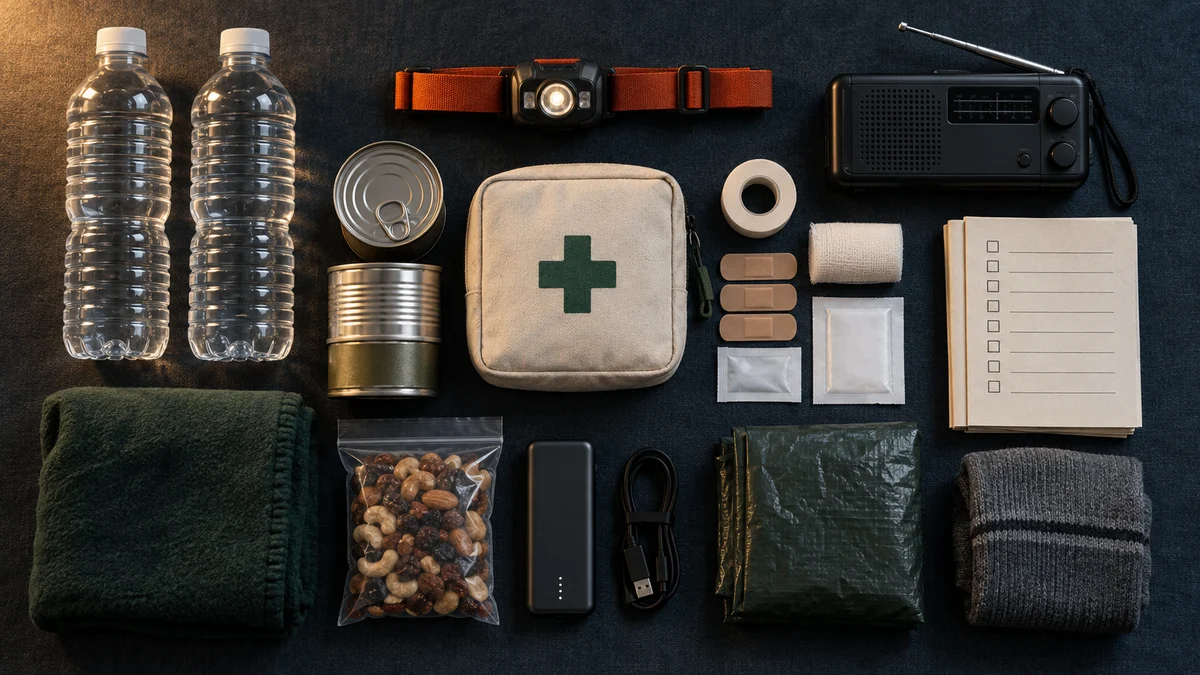
Ready.gov does not say seventy-two hours.
Not on the kit page, not on the water page. What it says is that “after an emergency, you may need to survive on your own for several days”, and then it goes straight to the shopping list. Several. The most repeated number in American preparedness is not printed on the page every campaign points back to.
So why 72 hours? Why does the county emergency office, the utility mailer and the magnet on the refrigerator all say three days, when the federal source they are all quoting declines to give a figure at all?
The answer is more interesting than a typo, and it changes what you do with the number.
Why 72 hours became the number, and who never says it
The three-day figure has the texture of something official. It appears in school drills, in utility bill inserts, in the pamphlet at the county fair table, in the name of half the products sold in this category. It sounds like it came down from somewhere.
Read the federal pages and it did not.
Ready.gov’s Build A Kit page describes a household that “may need to survive on your own for several days.” Its water page says “store at least one gallon of water per person per day for several days, for drinking and sanitation”. The food line on the kit page asks for “at least a several-day supply of non-perishable food.” Four instructions, one unquantified span carrying all of them.
That is not an oversight. A national page cannot name one duration that fits a barrier island in Florida and a fourth-floor apartment in Seattle, so it names a rate and leaves the multiplication to the reader. The trouble is that almost nobody does the multiplication, and a rate with no duration attached is not actionable. So the campaigns filled in the blank, and they filled it in with the roundest plausible number: three days.
Meanwhile, some agencies closer to their own hazards went the other way. Washington State’s emergency management division runs a program called Be 2 Weeks Ready, and its kit page is blunt about the target: “gather supplies at home to last at least 2 weeks.” Not three days. Fourteen.
The ledger below puts the actual wording side by side. Filter it by what each page asks for, and watch how few of them ask for a number at all.
The ledger — nine official lines, quoted as written
Who actually asks a household for a number of days?
Every line below comes from a page that was opened before it was quoted. Filter them and watch what happens to the count of pages that name a duration.
Ready.gov Build A Kit
no number“After an emergency, you may need to survive on your own for several days.”
Ready.gov Water
a rate, no duration“Store at least one gallon of water per person per day for several days, for drinking and sanitation.”
Ready.gov Build A Kit
no number“At least a several-day supply of non-perishable food.”
Ready.gov Water
a multiplier, no duration“If you live in a warm weather climate more water may be necessary. In very hot temperatures, water needs can double.”
Washington State Emergency Management Preparedness
two weeks“Learn more about how to prepare yourself, your household and your neighbors to be 2 Weeks Ready.”
Washington State Emergency Management Kits
two weeks“Gather supplies at home to last at least 2 weeks.”
National Weather Service Hurricane Helene, Morristown office
no number“Winds of 40 to 60 mph … led to extensive and long-lasting power outages.”
Government Accountability Office GAO-04-204, the 2003 blackout
hours to several days“In some areas, power was restored in hours, while in others power was lost for several days.”
City of Asheville Year-end account, 2024
21 and 52 days“Restoring non-potable water in 21 days and potable water in 52 days following the storm.”
What that exercise settles, I think, is the status of the figure. Seventy-two hours is not a finding. It is a communications decision — the number chosen because it is short enough that ordinary households will actually do it, and long enough to matter. Which makes it useful, and makes it something quite different from a limit.
What the three days are actually measuring
Here is the misreading that does the most damage: treating 72 hours as the expected length of the emergency.
It is not measuring the emergency. It is measuring you, and where you sit in a line.
On an ordinary Tuesday, an incident affects a handful of households and public resources are enormously oversized relative to the need. A truck comes. A crew comes. Nobody needs a reserve, because the system has slack in every direction.
The day an event takes a whole region, that ratio inverts in an instant. The same crews, divided by a hundred thousand simultaneous calls, become a queue. And a queue has an order that has nothing to do with fairness: the hospital first, then the nursing home, then the dialysis center, then the substation that feeds all three, then the person on home oxygen, then the collapsed building. A household that is cold, dark and basically fine is at the back of that list, correctly.
Three days is an estimate of how long the back of the list waits.
Which is a useful thing to understand, because it tells you what the back of the list is like. It is not dangerous. It is dark, and it is spent by a household in one room, and the single object that changes that evening more than any other is a battery-powered LED lanternaff. that sits in the middle of a table and lights a meal without anyone holding it. Candles do the same job while being an ignition source during exactly the days when fire response is slowest.
The number that gets misquoted as proof
The August 2003 Northeast blackout is the event Americans reach for when they want to say the lights come back fast. The Department of Energy records that approximately 50 million customers were impacted across an area running from New York and Massachusetts west to Michigan and north to Toronto.
And how long did it take? The honest answer is that there is no single figure, and the government says so. GAO’s review states only that “in some areas, power was restored in hours, while in others power was lost for several days.”
Hours for some, several days for others, from the same event. That is what a queue looks like from the inside, and it is why the preparedness figure is a duration rather than a promise.
The practical consequence is small and specific: you cannot tell, at hour six, which end of that range you are on. Nobody in the house can. The only thing that tells you is an outside broadcast — which is the argument for a hand-crank NOAA weather radioaff. living in a kitchen drawer rather than in a wish list. It runs on nothing you own, it carries the restoration estimates, and it is the only object in a kit that tells you when the thing is over. Which receiver actually earns its place, and why a car radio is a worse backup than people assume, is compared in the emergency weather radio guide.
Five American episodes, measured against the line
Now the part that makes this page uncomfortable to write, because the record does not flatter the number.
The ruler below plots five documented durations on a logarithmic scale against the 72-hour mark. Every bar is a figure an official source published; two of them are drawn open, because their sources publish no closing figure and drawing a guess would defeat the point. Pick how far your own household reaches and the line moves.
Restoration ruler — published durations, drawn to scale
How far past 72 hours did these actually run?
Pick how long your household can hold out with nobody helping. The line moves, and every bar tells you whether it reached the end of that episode.
Northeast blackout August 14, 2003
—
Electricity, about 50 million customers
hours in some areas, “several days” in others
“In some areas, power was restored in hours, while in others power was lost for several days.”
U.S. Government Accountability Office, GAO-04-204 — open the page
Winter storm Uri, Texas February 2021
—
Rotating outages across the ERCOT grid
midnight February 15 through February 18
“ERCOT began implementing rotating outages at midnight on February 15 … [the gap between net generation and forecast demand] persisted through February 18.”
U.S. Energy Information Administration, Today in Energy — open the page
Hurricane Ida, Louisiana Landfall August 29, 2021
—
Electricity, more than a million customers at peak
day 9 to day 15 after landfall
“About half a million customers in Louisiana were still without power [on September 7] … As of the morning of September 13, CESER estimates that power had been restored to 85% of Louisiana customers.”
U.S. Energy Information Administration, Today in Energy — open the page
Helene, Asheville water system Storm September 27, 2024
—
Municipal drinking water for a mid-sized city
21 days to non-potable, 52 days to potable
“Restoring non-potable water in 21 days and potable water in 52 days following the storm.”
City of Asheville, year-end account — open the page
Helene, one year later September 2025
—
Households still in federal disaster housing
1,026 families, twelve months on
“FEMA is providing disaster housing in four states for 1,026 families.”
FEMA, recovery update one year after Helene and Milton — open the page
A hatched end means the source publishes no closing figure. The bar stops rather than guessing one. The dashed line is 72 hours; the orange line is yours.
Three of those deserve to be said in words as well.
Texas, February 2021. EIA’s account of the cold snap records that “ERCOT began implementing rotating outages at midnight on February 15”, with the gap between generation and forecast demand reaching at least 30,000 megawatts that day and persisting through February 18. That is a grid emergency landing almost exactly on the 72-hour line — in February, in houses with no insulation to speak of, in a state where nobody owns cold-weather gear. That last clause is the whole lesson of Uri for a household outside the cold belt: the gap was not the length of the outage, it was that a house holding at fifty degrees had nothing in it rated for fifty degrees. One cold-rated sleeping bagaff. per person, bought in a summer sale and stored flat, covers that gap for a decade and takes a shelf.
Hurricane Ida, 2021. Landfall in Louisiana on August 29. EIA reports that the storm caused more than a million customer outages across Louisiana, Mississippi and Alabama, that about half a million Louisiana customers were still without power on September 7, and that 85 percent had been restored by the morning of September 13. Day nine and day fifteen. Not day three.
Helene, 2024. The National Weather Service’s Morristown office measured 12 to 20 inches of rain across a large swath of western North Carolina, with winds of only 40 to 60 mph that, it notes, “led to extensive and long-lasting power outages.” The City of Asheville’s own year-end account is where the real number is: non-potable water restored in 21 days and potable water in 52. Seven weeks before the tap was drinkable, in an American city with a working utility and the whole country watching.
Fifty-two days is not a stocking problem. Nobody puts 52 days of drinking water in a closet, and nobody should try. Past the first week the water question changes species entirely — it stops being about volume and becomes about treatment, which is what a countertop gravity water filteraff. is for: several gallons an hour, no pump, no power, working on whatever is already in the building. The containers, the rotation and the arithmetic behind both are laid out in emergency water storage.
The same shape applies to electricity. Two high-capacity USB-C power banksaff. cover three days of phones and a lamp without complaint, and they are the only energy purchase the three-day tier actually requires. Nine days is a different question, and the honest answer is that stored watt-hours stop scaling and something has to refill them — the trade-off argued out in portable power station or generator, and the hour-by-hour version of what actually fails in a house is in extended power outage.
Where the number holds, and where it plainly does not
None of the above means 72 hours is wrong. It means it is a floor, and floors are worth defending.
It holds well for the events that make up the overwhelming majority of what American households actually experience: a wind event that drops a line on one circuit, a summer storm, a transformer failure, a boil-water notice, a snowstorm that closes the roads for two days. In every one of those, three days of supplies means you never call anyone, never queue for anything, and never make a decision at eleven at night with a dead phone.
It fails in three specific situations, and they are worth naming rather than blurring.
When the water system itself is damaged. Power comes back before water does, every time, because a pipe network has to be repaired, flushed and tested before anyone can drink from it. Asheville is the documented case.
When it is cold. An outage in July is misery. The same outage in January is a medical situation, and it is the one place where improvising is genuinely dangerous rather than merely uncomfortable. Generators in garages, charcoal indoors, a camp stove used as a room heater, a car idling to warm a room: every one of those turns a power failure into a poisoning. The first purchase in any cold-weather plan is not a heater. It is a carbon monoxide alarm with a sealed ten-year batteryaff., one per sleeping level, installed before any combustion appliance comes through the door. The ranking of what is actually safe indoors is in how to heat a house without power.
When the event is regional rather than local. Helene reached hundreds of miles inland into counties where nobody owns a shutter. A year later, FEMA recorded disaster housing in four states for 1,026 families, alongside more than 107 million cubic yards of debris cleared across eight affected states. Twelve months on. That figure is not a restoration time and I am not presenting it as one; it is a measure of how long the tail of a wide event runs, which is precisely what a three-day shelf was never built to cover.
The arithmetic that turns a duration into a shelf
A duration is useless until it becomes a quantity, and this is where the federal rate earns its keep.
One gallon per person per day. That single figure, multiplied by the number of people in your house and the number of days you have decided to cover, produces the only line on any preparedness list that cannot be substituted, improvised or argued down.
Which is why I would not spend a second arguing about whether the right target is three days or fourteen before the three days exist. The first tier is entirely a stocking exercise, it costs one grocery run, and it teaches the arithmetic. The second tier is a different design, not a bigger pile, and it is worked through properly in long-term emergency preparedness.
For the three days themselves, the full build — seven posts, quantities by household size, and where it lives in an apartment with no basement — is the 72-hour emergency kit guide, with the item-by-item version in the 72-hour kit checklist.
The two posts that are finished forever
Most of preparedness scales with time. Two things do not, and they are the ones most often missing.
Documents scale with nothing. Copies of identification, the policy numbers, the deed or lease, prescriptions, the pet’s records and a printed page of phone numbers go into a waterproof, fire-resistant document pouchaff. once, and the job is done for years. The reason has nothing to do with duration: it is that a disaster recovery desk runs on paper, your phone may be the thing that got wet, and a borrowed phone does not carry your password manager. The inventory is in important documents in an emergency.
Light does not scale either, past one lamp per person. A shared flashlight means one person moves and everyone else sits still, and it means the light goes into a child’s bedroom and stays there. A LED headlamp with a red modeaff. each, with lithium cells that keep for a decade, is the cheapest post on the list and the one that changes the first night most.
What I would do with the number, knowing the record
Keep it. Then stop treating it as a ceiling.
Seventy-two hours is the right first target precisely because it is modest. It is achievable in a weekend by a household in a one-bedroom apartment with no garage and no budget for a project, and a country where most households have done it completely is a country where crews reach the people who cannot do it on day one instead of day four. That is the real function of the figure, and it is the opposite of a doomsday number: it is the amount of time you hand back to someone who needs it more than you do.
What I would not do is read it as a forecast. Three of the five episodes on that ruler ran past it, one of them by seven weeks, and none of those households had done anything wrong. They had prepared for the duration the guidance describes, and the event did not read the guidance.
So the thing I would actually change, having spent this page with the sources open, is not the size of my shelf. It is the order of two purchases. I would still buy water first — three gallons a head, this weekend, because it is the only line nothing rescues. But the second item I would buy is not more of anything. It is the thing that tells me which end of the GAO range I am on: a radio that works when nothing else does, with the county frequency written on the case in marker.
Everything after that is a decision you get to make with information instead of in the dark. And if the hazard where you live is the kind that gives you three days of warning rather than none, the preparation looks quite different — that is the subject of hurricane preparedness, and of working out which risks are actually yours in natural disaster preparedness. If the answer turns out to be that you leave rather than stay, the bag is a separate build with its own weight rules: the go bag.
Or start anywhere at all, from the blog. The number was never the point. The gallons were.
Frequently asked questions
- Why 72 hours and not one day or two weeks?
- Because three days is roughly how long it takes for organized help to work its way down to an ordinary household when a whole region is hit at once, and because it is a target most families can actually reach. One day is too short: an outage that starts at six on a Friday evening leaves you empty on Saturday morning, with the stores stripped. Two weeks is a different discipline — 56 gallons of water for a family of four, which is over 450 pounds and does not fit in an apartment. Seventy-two hours is one grocery run and one afternoon of putting things away, and a household that has done it completely is far better off than one that half-built a fortnight.
- Does FEMA or Ready.gov actually say 72 hours?
- Not in the wording on their pages. Ready.gov's Build A Kit page says that after an emergency you may need to survive on your own for several days, and its water page asks for one gallon per person per day, again for several days. No number of days appears. The three-day figure lives in state, county and utility campaigns, in Red Cross material and in decades of school posters, and it has become the shorthand everyone recognizes. That gap between the federal wording and the popular number is worth knowing about, because it tells you that 72 hours is a convention, not a measurement of anything.
- What is the 72-hour figure measuring — the disaster or the wait?
- The wait. Not the length of the storm, not the length of the outage, and certainly not how long you can go without water. It is an estimate of how long it takes for the machinery of response to reach a normal household that is basically all right: for utility crews to get past the hospitals and the substations, for a shelter to open, for a water distribution point to be set up, for a road to be cleared. You are at the back of that queue by design, and you should want to be. Three days is the span you cover so that nobody has to come to you first.
- Which recent US disasters ran past 72 hours?
- Several, and they are well documented. After Hurricane Ida made landfall in Louisiana on August 29, 2021, EIA reported about half a million customers still without power on September 7 — day nine — with 85 percent restored by September 13. After Helene, the City of Asheville's own account records non-potable water restored in 21 days and potable water in 52. In Texas in February 2021, ERCOT began rotating outages at midnight on February 15 and the shortfall persisted through the 18th. A year after Helene, FEMA was still providing disaster housing for 1,026 families.
- If three days is not enough, what number should I use?
- Build the three days first, completely, then decide. Washington State's emergency management division asks its households to be 2 Weeks Ready, and that is a defensible target if you have the space for it. What changes past the first tier is not the length of the list but its logic: you stop stacking water and start treating it, you stop storing watt-hours and start generating them. A fully finished 72 hours beats a half-finished fortnight every time, because an incomplete kit always fails at the post you left for later.
- Does the cause of the outage change what I should store?
- Almost not at all. A household never experiences a cause; it experiences an interruption — of power, water, cell service, roads, stores, pharmacies, or several at once. Whether a hurricane, an ice storm, a failed substation or something nobody has named yet took the grid down, the refrigerator warms at the same rate and the card reader at the corner store is equally dead. What the cause changes is the warning time and the likely duration. A hurricane gives you three days of notice; a grid failure gives you none. The shelf is the same shelf.
- What should I buy first if I only have one weekend?
- Water and light, in that order, and nothing else. Three gallons per person covers 72 hours at the federal rate, and water is the only item on any preparedness list that cannot be improvised, borrowed from a neighbor or replaced by ingenuity — it is also the first aisle emptied after an alert. Then one headlamp per person, because light is what fails around hour four and a phone burned as a flashlight is a phone that can no longer receive alerts. Those two purchases, in one trip, carry a household through the overwhelming majority of American outages.
Who wrote this
Baptiste S.
Founder and writer · bs-media
I am not a firefighter, a paramedic or a survival instructor. I am someone who read his government's household preparedness guide cover to cover, lives where winter storms knock the power out every year, and decided to do the work properly: read the official guidance, run the numbers, compare the spec sheets, and write down what I wish I had found. This site sells neither fear nor bunkers. It explains what an ordinary household can put together in a weekend, and in what order.
- I start from official guidance — FEMA, Ready.gov, the National Weather Service, the CDC, the American Red Cross — and I link to it. If I have not checked it, I do not write it.
- No guns, no bunkers, no doomsday: this site prepares an ordinary household for three days, two weeks, a month.
- I say what is not worth buying, including the things that sell best in survival stores.
- On health, medication and electrical work, I defer to your doctor, your pharmacist or a licensed electrician. That is not my job.
Read next
72 Hour Kit Checklist: Every Line, Counted
The 72 hour kit checklist, counted for your own household: gallons, meals, lights, batteries, the seven lines people leave out, and where it all fits at home.
Emergency Water Storage: How Much, Where, How Long
Emergency water storage, sized and drawn: gallons per person, which containers fit where, the six-month rule, and how to keep it drinkable. Start this weekend.
Emergency Weather Radio: How to Choose One That Wakes You
An emergency weather radio earns its shelf only if it wakes you at 2 a.m.: NOAA All Hazards, SAME coding, tone alert, battery backup. Compare before you buy.
Extended Power Outage: What to Do, Hour by Hour
An extended power outage fails in stages: hour 0, hour 4, hour 24, hour 72. What breaks at each one, what to do, what to keep or throw out. Start your clock.