6:33 in the morning, November 8, 2018.
That is the start time CAL FIRE records for the Camp Fire, in Butte County, California. Seventeen days later, when it was finally contained, the incident record read 153,336 acres, 18,804 structures destroyed, 85 confirmed civilian fatalities. Most of the people who left Paradise that morning left with what happened to be in the car.
A go bag exists for that gap — the distance between the moment you are told to leave and the moment you would have been ready. It is not a survival kit and it is not a statement about the state of the world. It is a packed bag by the door that turns a frantic thirty minutes into three.
Here is the idea the rest of this guide is built on, and it is a small one: you are not going into the woods. You are going to a cousin’s house two counties over, or to a high school gym with cots and a coffee urn. So the bag is built to get you out the door with everything that cannot be replaced at a Walmart the following week. The first thing I would buy for one is not the backpack — it is a collapsible 2.5-gallon water containeraff., which weighs almost nothing empty and turns any faucet you reach into a household supply.
Why this guide says “go bag” and not “bug-out bag”
The two phrases describe the same backpack and belong to two different worlds, and the choice of words changes what ends up inside.
“Bug-out bag” comes out of a subculture with its own aesthetic and its own assumptions: the collapse of order, the retreat to a defensible position, the pack that weighs fifty pounds because it holds a hatchet and a week of rations. This site is not part of it, and disagrees with it on the only question that matters — where you are actually going when you leave.
“Go bag” is the phrase used by the agencies whose job this is. Ready.gov, FEMA’s public preparedness site, tells readers plainly to “Build a go-bag with all the essentials you might need, so you don’t need to scramble in an evacuation situation.” Emergency managers say it. Shelter volunteers say it. It carries no politics and no fantasy, and it points at the real scenario: a few days somewhere else, among other people, with a roof and a line for the showers.
So the word is not a style preference. It is the whole design brief. A bug-out bag is packed for not coming back. A go bag is packed for coming back on Thursday to a house that may or may not still be there, and for making Monday through Wednesday bearable in the meantime.
Two fires that started in the morning
The Camp Fire ignited at 6:33 a.m. on a Thursday. People were making coffee.
Nearly five years later, on August 8, 2023, fire came through Lahaina on Maui. Hawaii’s attorney general commissioned a minute-by-minute reconstruction, and the U.S. Fire Administration’s summary of it describes a timeline that begins at 2:55 p.m. on August 8 and ends at 8:30 a.m. the next morning, with 101 fatalities. Seventeen and a half hours, start to finish, for a town.
I put these two side by side because they make the same point from opposite ends of the country. In both, the interval between “something is happening” and “the road is gone” was measured in tens of minutes. In both, the useful preparation had been done weeks earlier or not at all. And in both, the question on the day was never “do I own a bag.” It was: can this household be out the door on short notice, and does everyone know which door.
Hurricanes are the other half of the picture, and they run the opposite way — they announce themselves for days. Hurricane Ida in 2021, and every mandatory evacuation order along the Gulf and Atlantic coasts since, followed the same script: a cone, a watch, zone-by-zone orders, then a highway with the shoulders full. Fires give you no time; hurricanes give everybody the same time at once.
Smoke deserves its own line, because it travels far beyond the fire and it is the part of a wildfire most households actually meet. Fine particulate is not stopped by a bandana or a surgical mask; a fitted, NIOSH-approved N95 respiratoraff. is the cheap item that makes a smoky drive or a smoky week indoors materially better, and a box of them lives in the household bag. The full sequence — when to go, what to do with the house, what the return looks like — is in the article on wildfire evacuation.
Evacuate or shelter in place: the call belongs to local officials
The first instinct of a household that starts preparing is to want to make the call itself. It is the wrong instinct, and it has to be said before any gear is discussed.
Alerts in the United States reach you without your doing anything. Wireless Emergency Alerts are pushed to phones inside a targeted area, and Ready.gov is explicit that “You are not charged for receiving WEAs, and there is no need to subscribe.” The same page describes NOAA Weather Radio broadcasting official warnings and watches around the clock. Between those two, plus a county alert sign-up and a deputy knocking on doors, the instruction will find you. The one sentence to keep from the whole evacuation page is short: “Always follow the instructions of local officials and remember that your evacuation route may be on foot depending on the type of disaster.”
Why this is so categorical: intuition is wrong in most of these scenarios. Faced with a chemical plume, instinct says drive away; the instruction is almost always to go in and seal a room. Under a tornado warning, instinct says outrun it; the vehicle is the worst place to be. Faced with rising water, instinct says go move the car; that is how people drown in parking garages. Ready.gov’s flood guidance is blunt about the arithmetic — “just six inches of moving water can knock you down, and one foot of moving water can sweep your vehicle away” — and adds the rule worth memorizing: never drive around barricades.
What you actually control
What you do control is the posture your household is in when the instruction arrives. Bags staged or not. Tank above half or not. Kids briefed or not. That is exactly what the tool below sorts out: it will not tell you to leave, it tells you how to wait.
Decision tree — evacuate or shelter in place
Should you leave, or close the house?
A radio matters more here than it looks like it should. Cell networks fail in disasters, by congestion first and tower damage second, and the moment they do, the county’s instructions are still going out over NOAA Weather Radio and local AM and FM. A small hand-crank NOAA weather radioaff. weighs under a pound, needs nothing from the grid, and replaces rumor with instruction. It goes in the household bag, frequencies written on it in marker.
Two hazards deserve their own timeline, because with them the sequence matters more than the gear: what to do in a flood, hour by hour, and hurricane preparedness from the cone to the return. And if you have never checked what your address is exposed to, start with the pillar on natural disaster preparedness, which begins with the maps rather than the closet.
One go bag per person, and one bag for the household
The single family bag is the first mistake, and a logical one: people think in supplies, so they think in containers. The trouble is that supplies do not walk. Thirty pounds of water and clothing for four in one pack is a pack nobody carries up a stairwell, and a family that gets separated becomes a family in which three people have nothing.
The split that works has two layers.
The personal bag, one per member of the household, sized to whoever carries it. It holds what belongs to that person and only that person: their water, a change of clothes, their light, their copy of the paperwork, their prescriptions, a snack. For a child it is a school backpack with a bottle, a flashlight, a warm layer, and the object that makes bedtime possible. They carry it themselves. That is not symbolic — it is three pounds off an adult.
The household bag, carried by the strongest adult, holds what does not duplicate and what would be absurd to buy four times: the radio, the complete first aid kit, the original documents, the cash, the chargers and a power bank, the collapsible jug, the shared food.
The line-by-line inventory — every item, which bag it goes in, what to buy once and what to rotate — lives in the go bag checklist. This pillar stops at the reasoning; the checklist handles the count.
The container itself is a five-minute decision. For an adult, a 35- to 45-liter hiking pack is the right size: enough for three days, too small to overload, with padded straps and a hip belt because this thing gets carried, not rolled. A rain cover is not optional — a flood evacuation happens in the rain, by definition. Pick a bright color rather than black: you find it in a gym full of identical bags. Skip anything sold as tactical; it weighs more empty, costs more, and changes how strangers read you at the moment you may need to ask one of them for help. A plain 40-liter hiking backpack with a hip beltaff. does the job better in every measurable way.
The weight: 10 to 15 percent of whoever carries it
The rule comes from hiking, where it has been tested for a century: a pack that stays comfortable over a day weighs about 10 percent of the walker’s body weight, and 15 percent is the ceiling for someone conditioned to it. For a go bag I hold to the low end. Nobody trains to evacuate, and on the day the pack gets carried down an unlit stairwell, along a shoulder, often with a child on the other arm.
What that looks like for a household of four
| Carrier | Body weight | Bag at 10 % | Bag at 15 % | What it holds |
|---|---|---|---|---|
| Adult 1 | 180 lb | 18 lb | 27 lb | personal bag + household bag (radio, first aid, documents, jug) |
| Adult 2 | 135 lb | 13.5 lb | 20 lb | personal bag + shared food + chargers |
| Child, 10 | 75 lb | 7.5 lb | 11 lb | bottle, clothes, flashlight, snack, comfort object |
| Child, 5 | 45 lb | 4.5 lb | 7 lb | small bottle, one warm layer, a flashlight, the stuffed animal |
The first thing this table says is that the household carries 43 to 65 pounds together, not 90. The second is that water governs everything: a quart weighs a little over two pounds, and the one quart per person that gets you to the shelter door is already a tenth of a small adult’s allowance. That is why the jug travels empty.
The tool below does that arithmetic with your objects and your body weight, and it does not hedge — over the ceiling, it names which items come out first and in what order.
Pack weigher — pounds against the 10 % and 15 % marks
What does your go bag actually weigh?
0.0lb in the bag
One small object makes this stick: a digital luggage scaleaff. hooked through the haul loop. Ten seconds, a number, and no more arguing about whether the bag “feels heavy.” Weigh it at every rebuild and write the number inside the lid.
Post by post: what a go bag holds, and why
Nine posts. They are not equal, and the order below is the order of importance, not the order of packing.
Water and filtration
One quart per person in the bag is what you carry. The collapsible 2.5-gallon jug is what you fill on arrival. Between the two sits the case where the water at the far end is not trustworthy: a spigot after a flood, a well of unknown provenance, a boil-water notice for the whole county. That is where a hollow-fiber filter bottle earns its half pound — it makes clear but suspect water drinkable as you drink it, with no stove, no tablets, no waiting. It does nothing against chemical contamination and it clogs on muddy water; know both limits. For everything else it replaces two pounds of dead weight. One 0.1-micron water filter bottleaff. in the household bag, and a filter straw in each personal bag if the budget allows. How these work, and how to choose between membrane, chemical and UV, is in the article on the backpacking water filter — hiking is the best place to learn to use one before you need it.
FEMA reasons about the house, not the bag, and its number is useful precisely because it shows what you will never carry: one gallon per person per day for several days, for drinking and sanitation. For four people over three days that is twelve gallons — a hundred pounds of water. That supply stays home, and it belongs to the 72-hour emergency kit, not to this bag.
Shelter and warmth
Cold gets underestimated because people picture the evacuation in August, the way Lahaina was. Paradise was in November, and evacuations also happen in February, at night, in the rain, and a high school gym is not warm at the hour it opens.
The shelter post is three objects. A heavy, reusable emergency blanket — not the foil sheet that tears on the first unfold. A rain poncho long enough to cover the pack. And one warm layer more than the season seems to call for, hats included for the kids. No tent, and no sleeping bag except for an infant or a frail elderly person, and then a light one.
The heavy reusable emergency blanketaff. is the purchase I would make first in this post, because it works in three places: in the bag, in the car, and on the floor at home during a winter outage, where it insulates a child from a cold slab in the one room you are still heating.
Light and power
One headlamp per person, children included, with spare batteries in the household bag. A headlamp, not a flashlight: you are loading a car, holding a hand, reading a sign, and you need both hands. The phone stays a phone — draining it as a flashlight is the standard first mistake of an outage evening, and an evacuation is an outage that moves. A LED headlamp with a red modeaff. costs less than a tank of gas, and the red setting does not wake a room full of sleeping strangers when you go looking for a bottle at three in the morning.
For power: one charged power bank in the household bag with cables for every phone in the family, and a charger in the car. The bank gets recharged at each twice-yearly rebuild and loses some charge in between, which is normal and is the reason you check it. Capacity around 20,000 mAh is the sweet spot — two full phone charges, still allowed on a plane, still under a pound and a half. A 20,000 mAh power bank with two portsaff. charges a phone and a headlamp at once, which matters when four people share one outlet in a shelter hallway.
Information
The lightest post and the most often skipped. When the mobile network goes — and it goes, by congestion or by damage — instructions still move over NOAA Weather Radio and local stations. The radio is in the household bag with the frequencies written on the case. Add a laminated card with the family’s phone numbers written by hand, and the agreed meeting point. Then a whistle in each personal bag: Ready.gov puts one in the basic kit for a reason, because it signals your position when your voice is gone.
The card’s most important line is the out-of-area contact, the piece most households skip and the one that does the most work: local circuits congest first, and a cousin three states away can take five calls and tell each person where the other four are.
First aid and prescriptions
A first aid kit in the household bag, of the kind you would take hiking: bandages, gauze, tape, antiseptic, gloves, tweezers, shears, a thin spare emergency blanket, and your spare glasses. It is for a cut, a blister, a splinter. It is not for anything else.
What matters more than the kit is the prescriptions. Any household where someone takes a daily medication needs a few days’ supply in that person’s own bag, in the original labeled bottles, with a current list of what they take and at what dose. How many days to keep ahead, how to store something that needs refrigeration, what to do about a missed dose — those are questions for your physician or pharmacist. This site does not answer them, deliberately.
Documents and cash
After a fire or a flood, paperwork is what takes longest to rebuild and what gets asked for first, by the adjuster, by FEMA, by the bank, by the school. The household bag carries originals in a waterproof pouch — IDs, passports, birth certificates, Social Security cards, the deed or the lease, the insurance declarations page including the separate flood policy — and each personal bag carries copies. An encrypted USB drive with scans, plus photographs of every room taken beforehand, finishes the job.
Cash belongs here too. When power or the network drops, card readers drop with them, and a tank of gas, a motel room and a meal all get paid in bills. Keep a reserve in small denominations inside the pouch and never touch it for anything else. A clear waterproof document pouch in letter sizeaff. is enough, transparent so you do not have to open it to see what is inside; roll-top closures survive rain better than zip ones. The full method for gathering all of it is in the article on important documents in an emergency.
Hygiene
A small post with an outsized effect on morale by day three: travel toothbrush and toothpaste, a bar of soap, wipes, compressed toilet paper, hand sanitizer, menstrual products, a microfiber towel, and a few trash bags that double as a ground sheet and a dry seat. All of it fits in a child’s toiletry bag and weighs under a pound.
Kids, infants and animals
For an infant, the household bag gains an entire post: formula and bottled water to mix it, bottles, three days of diapers, wipes, two changes of clothes, and a carrier rather than a stroller — a stroller does not go up gym stairs or across a ditch. For an older child, their own light bag, plus something in the household bag that works without electricity: a deck of cards, a notebook, a paperback.
For an animal, the rule is short and not negotiable: it leaves with you. Ready.gov says to take pets along while warning that only service animals may be allowed in public shelters, which is why you find out in advance which motel or county shelter on your route accepts animals. The carrier stays out and reachable, not in the attic. Three days of food, a folding bowl, a leash and vaccination records ride in the household bag, because emergency boarding will ask for the records. A collapsible travel bowl and leash setaff. weighs a few ounces. And crate the cat before you start loading the car, not after — a cat disappears the moment the household starts moving fast.
The car bag, and the half tank
The Camp Fire started on a Thursday morning. Lahaina’s reconstruction opens in the middle of a Tuesday afternoon. An alert is far more likely to find you at work, on the interstate, or in a school pickup line than sitting in your entryway next to a packed bag. The car kit answers that: not a copy of the home bag, but what gets you through a night stuck in the vehicle or a walk home.
Inside, in a bin that does not roll around the trunk: a warm blanket, water rotated each season because trunk heat degrades bottles, a few bars, a flashlight, a car charger and a cable, a reflective vest, a poncho, and walking shoes for anyone who drives in dress shoes. The charger is the piece that earns its place — a stopped line of cars is the only power outlet in an evacuation, and a dual-port USB car chargeraff. tops up the phone and the power bank at once while you sit there.
The fuel gauge counts as much as the bin. Ready.gov puts it in two sentences: “Keep a full tank of gas if an evacuation seems likely. Keep a half tank of gas in it at all times in case of an unexpected need to evacuate.” A forty-car line at the pump is a standard scene in every evacuation ever filmed, and it is solved weeks earlier by simply never going below half. It is the cheapest preparation rule in this entire guide.
Last point, the direction the car faces. Backed into the driveway, it leaves in ten seconds; nose-in, you are reversing into a street where everyone else is reversing too. In a flood zone it does not spend a watch night in an underground garage, and that is its own subject inside what to do in a flood.
EDC: layer zero
There is a layer beneath the car kit, and it is the one nobody prepares: what you carry on your body every day without thinking about it. Phone, keys, wallet. Preparedness people call it EDC, for everyday carry, and the term has been badly damaged by photographs of knives and machined flashlights arranged on reclaimed wood. That is not the subject.
The subject is the difference between “I was at the office when the alert came” and “I was at the office with a light the size of a lighter, a small battery in the bag, a twenty-dollar bill I have never spent, and a photo of my prescription list on my phone.” Four objects, five ounces, and the first hour changes character. The light in particular is not a gadget: a parking garage during an outage, an office stairwell with no emergency lighting — you walk out instead of waiting. A rechargeable keychain flashlightaff. weighs under an ounce and stays on the ring, where it cannot be forgotten.
How to compose that layer around your actual day — commuter, city walker, driver, parent doing school runs — is the subject of everyday carry essentials. The principle is the same as for the bag: start from what you already carry, add five things, never add ten.
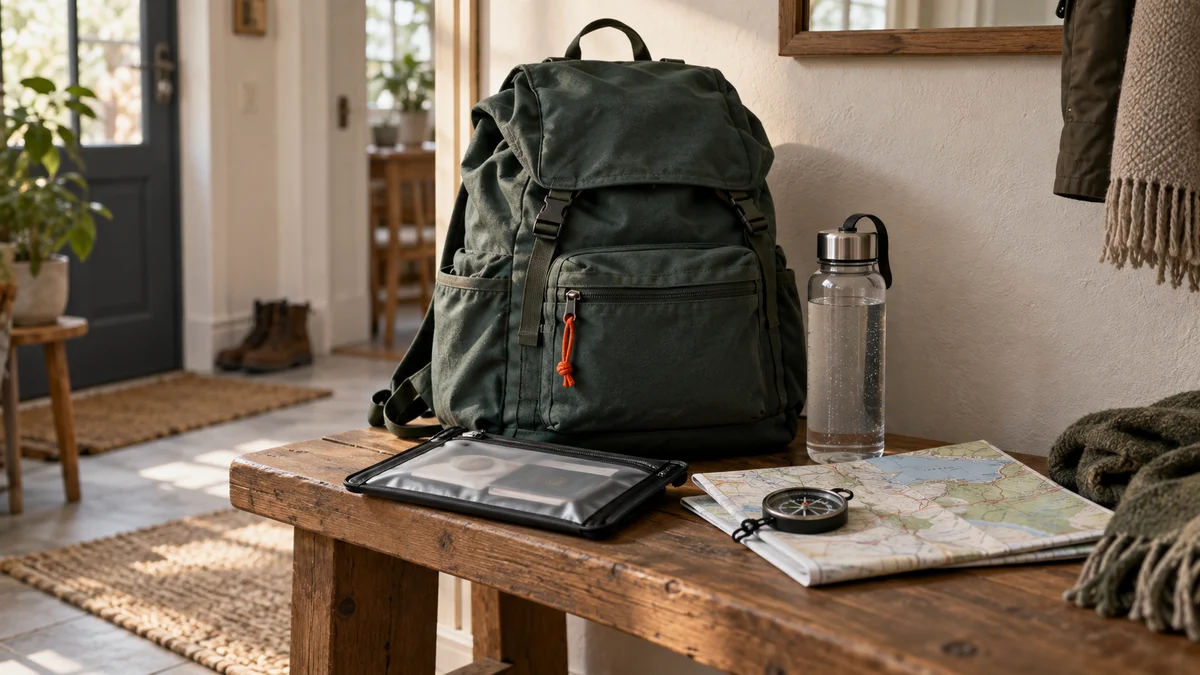
Navigation belongs in this layer too. An evacuation runs on an assigned route, often different from the one your phone suggests, on roads that are closed, sometimes on foot and at night, with a handset that has no signal or no battery left. Reading a paper map, finding north, estimating a walking time — that is what lets you follow “proceed to the shelter in the next town” when the app stops answering, and the article on how to navigate without GPS starts from three concrete situations. Nothing about it is military; it is what gets taught at scout camp. Two objects fit in the outside pocket: a county road map and a baseplate compassaff., the only kind that sits on a map to orient it — the one in your phone does not, and it dies when the phone does.
Where the bag lives, and the twice-a-year rebuild
The bag lives next to the door you actually leave by, in one fixed place every member of the household knows, kids and house-sitter included. Not the basement, not the underground garage, not the attic at the top of a pull-down ladder: those flood, fill with smoke, or take four minutes to reach. An entry closet, the floor of a coat closet, a storage bench. In an apartment it stays inside the apartment, never in a shared locker that needs a key.
A pair of closed-toe shoes sits on top of it, for everyone. That sounds trivial until the morning someone walks through a street full of broken glass in flip-flops. And a headlamp clips to the outside strap: in an unlit hallway, the first thing you need to see is the bag.
The bag does not get packed once. It gets rebuilt twice a year on a fixed date, and the clock changes in March and November are the easiest anchors — they fall in the right places, before spring severe weather and ahead of winter, and nobody forgets them. Empty everything onto the kitchen table. The water and the food go into normal use and get replaced. The power bank gets charged, the headlamp gets switched on, the radio gets tuned. Document copies and prescription lists get updated. Clothes change season and, for the children, size. Then you weigh it again.
It also gets rebuilt after anything that changes the household: a birth, a new prescription, a new animal, a move. A move changes everything, because the hazard changes with the address — which is why the pillar on long-term emergency preparedness handles the other side of the question: what stays home, at the scale of two weeks and a month, while this bag covers three days away.
If you want the rhythm without keeping it in your head, the Refuge72 blog publishes the seasonal reminders, and the about page explains who does the arithmetic here.
What is not worth carrying, including the things that sell well
I have kept the disagreement for the end, because it reads better once the bag makes sense.
The fifty-pound tactical pack. The loadout on the forums — tent, hatchet, stove, rope, a week of rations — is the best-selling product in this category and the least useful to a household. It is designed to disappear into the backcountry; you are going to a relative’s spare room. It is a third of your body weight; you have a stairwell to climb. It costs what four real bags would cost, and it is one bag.
The survival knife. In an ordinary evacuation you cut tape, a package, a zip tie. A small pair of shears in the first aid kit does all of that and alarms nobody in a shelter where two hundred people are sleeping in a gym. A fixed blade serves a photograph, not a task.
Pre-made kits, stored sealed. The pre-packed kit is not a bad object; it is a bad reflex. It holds what is identical for everyone and nothing specific to you, and shelving it unopened produces the feeling of being prepared — the worst position available, because it is the one where you stop doing anything else. If you buy one, open it that evening, weigh it, remove what does not serve you, and add what does, starting with a real first aid kit for a familyaff. instead of the dozen adhesive bandages inside. At that point it becomes a bag. Before that, it is a receipt.
The water supply, in the bag. A gallon per person per day is the rule for the house. In the pack it is eight pounds per person that will make you abandon everything else at the first flight of stairs. One quart, an empty jug, a filter. The supply stays home.
Which leaves the jug, empty, rolled flat at the bottom of the pack. At the March rebuild it will still be empty, and that is exactly what is asked of it. A go bag that works is one whose most important content is the room left for what you find at the other end: a faucet, a roof, people. Everything else fits in twenty pounds, already sitting by the door.
Frequently asked questions
- What should you put in a go bag?
- What you will miss in the first seventy-two hours away from home, and nothing more: a quart of water per person plus a collapsible jug to fill on arrival, food that needs no cooking, a heavy reusable emergency blanket, a headlamp, a charged power bank, a small weather radio, a first aid kit and a week of prescriptions, copies of your documents in a waterproof pouch, cash in small bills, a hygiene kit, one change of clothes. Then the parts that are specific to your household: formula and diapers, a leash and a carrier, spare glasses. Anything meant for living outdoors does not belong in it. You are going to a relative's house or a shelter gym, not into the woods.
- How much should a go bag weigh?
- Between 10 and 15 percent of the body weight of whoever carries it, and closer to 10 percent for anyone who does not walk under a loaded pack a few times a year. For a 170-pound adult that is 17 to 25 pounds, water included; for a 70-pound child, 7 pounds at most, meaning their own clothes and their own bottle. This is not backpacker fussiness. An evacuation can finish on foot, up a stairwell, along a highway shoulder, with a child on the other arm. A bag you cannot carry a mile is a bag you will set down. Put it on the bathroom scale once it is packed and take out whatever is over — it is almost always surplus water and objects kept just in case.
- Do you need one bag per person or one for the whole family?
- Both, and they hold different things. Each person carries a bag sized to them, with what is theirs: water, clothes, a light, their copy of the paperwork, their medications. The household then has one shared bag, carried by the strongest adult, holding what does not duplicate: the radio, the full first aid kit, the original documents, the cash, the chargers, the collapsible jug. The gain is double. If the household is split when it happens, nobody is left with nothing; and the shared bag stays light, because water and clothing — the heavy things — are spread across everyone. A six-year-old carries a stuffed animal, a bottle and a flashlight, and is proud to do it.
- Where should you keep a go bag in the house?
- Next to the door you actually leave by, in one fixed place everyone in the household knows, and never in a basement or an underground garage: those flood first and are the last place anyone wants to go when time is short. An entry closet, the floor of a coat closet, a bench with a lid all work. You should be able to reach the bag without moving anything else and without light, because evacuations happen at night and during outages. A pair of closed-toe shoes sitting on top keeps you from leaving in flip-flops. In an apartment, the bag stays inside the apartment, not in a shared storage room you need a key for.
- What belongs in a car emergency kit?
- What gets you through a night stuck in the vehicle or a walk home from wherever you were: a warm blanket, water rotated every season because trunk heat ruins bottles, a few bars, a flashlight, a USB car charger and a cable, a reflective vest, a poncho, and walking shoes if you drive in dress shoes. The fuel gauge matters as much as the box. Ready.gov asks for a full tank when evacuation looks likely and half a tank at all times otherwise, precisely because an evacuation often starts in a gas station line. The car kit does not replace the bag at home; it covers the far more common case where the alert finds you at work or on the road.
- How do you know whether to evacuate or shelter in place?
- You do not decide it. Local officials do, through Wireless Emergency Alerts, the county emergency manager, the sheriff, the fire department at your door, and their instruction outranks any rule you have read, including everything on this page. What you decide is the state your household is in before that instruction lands. In a surge zone, that means the bags are staged and the car is pointed at the street. In a chemical release, the reflex is to go in and close up, not to drive. Under a tornado warning, it is the lowest interior room, never the road. When you are unsure, keep the radio on, keep the phone charged, and do not go look at the water or the fire.
- How often should you rebuild a go bag?
- Twice a year on a fixed date, and the simplest anchors are the two clock changes in March and November. Empty everything onto the kitchen table. Water and food go into normal use and get replaced. The power bank gets recharged, the flashlight gets switched on, the radio gets tuned. Document copies and prescriptions get updated. Clothing changes season and, for children, size — kids outgrow a bag far faster than the bag wears out. Rebuild it after any change in the household as well: a birth, a new prescription, a new animal, a move. A bag packed once and forgotten for three years holds stale water, a dead battery, and pants two sizes too small.
- Are pre-made emergency kits worth buying?
- As a starting point, sometimes. As your bag, no. A sealed kit contains what is identical for everyone — a light, a blanket, a whistle, a few bandages — and nothing that is specific to you: your prescriptions, your paperwork, your chargers, the food your kids will actually eat, your animal's records. The real danger is storing it closed and feeling prepared, which is the state in which people stop doing anything else. If you buy one, open it the same evening, weigh it, take out what does not serve you and add what does. At that point it becomes a bag. Until then it is a purchase.
Who wrote this
Baptiste S.
Founder and writer · bs-media
I am not a firefighter, a paramedic or a survival instructor. I am someone who read his government's household preparedness guide cover to cover, lives where winter storms knock the power out every year, and decided to do the work properly: read the official guidance, run the numbers, compare the spec sheets, and write down what I wish I had found. This site sells neither fear nor bunkers. It explains what an ordinary household can put together in a weekend, and in what order.
- I start from official guidance — FEMA, Ready.gov, the National Weather Service, the CDC, the American Red Cross — and I link to it. If I have not checked it, I do not write it.
- No guns, no bunkers, no doomsday: this site prepares an ordinary household for three days, two weeks, a month.
- I say what is not worth buying, including the things that sell best in survival stores.
- On health, medication and electrical work, I defer to your doctor, your pharmacist or a licensed electrician. That is not my job.
Read next
Backpacking Water Filter vs Purifier: What Each Removes
Backpacking water filter: what a 0.1-micron membrane stops, what slips straight through, and which of six technologies fits your trip. The sizes, from the CDC.
Everyday Carry Essentials: The Five That Matter
Everyday carry essentials: the five items worth adding to your phone, keys and wallet, what each one weighs, and why the rest of EDC is a hobby. Build yours.
Go Bag Checklist: Every Item, Every Person
The go bag checklist, item by item and bag by bag: the household bag, one bag for each person, infants, prescriptions, pets, and the gear to leave at home.
Navigate Without GPS: Map, Compass, Declination
Navigate without GPS: read a USGS topo map, set the magnetic declination for your state, take a bearing and take it back, and fix the turnaround hour first.