11:41 in the morning, two days before New Year’s.
That is when the Marshall Fire started in the dry grass south of Boulder, Colorado, on December 30, 2021. The National Weather Service office in Boulder recorded gusts of 70 to 100 mph along the foothills that day, a peak of 115 mph, and 1,084 homes destroyed. A suburb. On a Thursday. In December.
A go bag checklist is what turns a morning like that into a list you already ran, instead of a list you write while the sky goes brown.
What follows is the packed inventory rather than the reasoning behind it — the reasoning, the weight ceiling and the question of when to leave are all in the pillar on the go bag. Here it is item by item, bag by bag, with the lines that change when there is a baby, an animal, a prescription or a pair of glasses in the household.
What a go bag checklist has to settle before it lists anything
Three decisions come before the first item, and a checklist that skips them produces a bag that weighs forty pounds and belongs to nobody.
Who carries it. Every line is assigned to a person, not to a household. An unassigned line ends up in whichever bag had room, which means nobody can find it.
Where you are going. A relative’s house, a motel two counties over, a high school gym. Not a ridge. That single assumption deletes the tent, the sleeping bag, the stove and most of the water — the bulk of what makes bags unliftable.
How long. Seventy-two hours, the span the federal guidance is written for. Why that number and not five days is the argument in why 72 hours; for packing purposes it means three days of clothes, not seven.
Ready.gov’s basic disaster supplies kit is the spine of everything below — water, food, a hand crank radio and a NOAA Weather Radio with tone alert, a flashlight, a first aid kit, batteries, a whistle, a dust mask, garbage bags, a can opener, local maps, a phone and a backup battery. It is written for a house that has stopped working. The job of this page is to say which of those lines walks out the door with you, in whose bag, and what gets added because a federal page cannot know that your household includes a diabetic cat.
The household bag, line by line
One bag, carried by whoever carries weight most comfortably. It holds the shared posts and nothing duplicated.
Water. A collapsible jug, empty, rolled flat at the bottom of the pack — it weighs half a pound and turns any faucet at the far end into a household supply. A filter bottle or a squeeze filter beside it. The gallons themselves stay home, where they belong to the standing reserve rather than the bag; the containers, the rotation and the six-month rule are in emergency water storage.
Information. The weather radio, with the county frequencies written on the case in marker. Cell networks fail by congestion first and tower damage second, and when they do, the county’s instructions are still going out over the air. Which receiver is worth buying, and why the car radio is a better backup than most people assume, is worked out in the emergency weather radio guide.
First aid. One kit for the household, of the sort you would take hiking: bandages, gauze, tape, antiseptic, gloves, tweezers, shears, a thin emergency blanket. It handles a cut, a blister, a splinter. Buy a real one rather than the dozen adhesive bandages that come inside a boxed kit — a compact soft-case first aid kitaff. costs about what a takeout dinner costs and is the only line here that gets used in ordinary life too.
The pouch, the cash and the card
Documents and cash. One waterproof pouch with the originals: IDs, passports, birth certificates, Social Security cards, the deed or the lease, the insurance declarations page including the separate flood policy. Cash in small bills inside the same pouch, never spent on anything else. Ready.gov is direct about why: “It is important to have small bills on hand because ATMs and credit cards may not work during a disaster.” The same page asks you to store the documents “either in a safety deposit box, an external drive or on the cloud” as well, which is the layer that costs nothing and survives the pouch being lost. The full method for assembling all of it sits in important documents in an emergency.
Power. One power bank, one cable per phone in the house, spare batteries for every lamp and for the radio. The bank gets recharged at each repack and loses some charge in between, which is normal and is exactly why you check it.
The contact card. A laminated card with handwritten phone numbers, the meeting point, and the out-of-area contact — the piece most households skip and the one that does the most work, because local circuits congest first and a cousin three states away can take five calls and tell each person where the other four are. A pack of self-laminating card pouchesaff. needs no machine and makes one card per bag in ten minutes.
Then no-cook food, trash bags, wipes, hand sanitizer, tape. That is the household bag finished.
The personal bag, one per person
Same eight lines for everyone, sized to the body carrying them: a quart of water, one change of clothes and dry socks, one warm layer and one rain shell, a headlamp, copies of the household paperwork, a snack that survives a hot trunk, a hygiene kit with a microfiber towel, and a couple of N95 respirators. Prescriptions go in the bag of the person who takes them, and nowhere else.
For children the list is shorter and the rules are different. Under ten percent of the child’s body weight — five pounds for a fifty-pound kid, which is a school backpack with a bottle in it. Their own bottle, their own flashlight, one warm layer and a hat, a snack they actually eat, the comfort object, something to do that needs no battery, and an identification card in the front pocket with their full name, their parents’ names and numbers, and the out-of-area contact.
Let them pack it themselves. A child who chose their own flashlight keeps track of it in a room full of strangers; a child handed a bag at the door does not. A plain 18-liter kids’ hiking backpack with a chest strapaff. beats a character-print school bag here for one reason only — the chest strap stops it swinging when they run.
The headlamp is the line I would not compromise on for anyone, adult or child. One light per person, never one light for the house: one light for four people means one person moves and three sit still. A rechargeable headlamp with a red modeaff. frees both hands for a car door or a toddler, and the red setting crosses a room of sleeping strangers at three in the morning without waking it. What else fails in the dark, and at which hour, is mapped in the extended power outage guide.
Below, the same two lists come out as cards — one per bag, for the household you actually have, with a print button so each card ends up taped inside the lid it belongs to.
Bag manifest — one card per bag, printed
Who carries what, written down
Describe the household and the tool writes a packing card for each bag — the household bag, one per adult, one per child, an insert for an infant, an insert for an animal. Print them and tape each card inside the lid of the bag it belongs to.
The lines that change with the person
This is where every generic checklist stops being useful, and where the federal pages are more helpful than their reputation suggests.
Infants
Ready-to-feed formula rather than powder, because powder needs safe water and safe water is the resource in question. Bottles. Three days of diapers, a pack of wipes, a folding changing pad, two changes of clothes, and one more warm layer than the weather appears to ask for. Then the carrier: a soft structured baby carrieraff. rather than a stroller, because a stroller does not climb gym stairs, cross gravel or fold into a car packed to the roof. The whole insert rides in the household bag.
Animals
Ready.gov’s pet page is more demanding than most owners expect: “several days’ supply of food in an airtight, waterproof container,” a bowl and several days of water, an extra supply of any regular medication, “a backup leash, collar and ID tag,” litter and a box, “a picture of you and your pet together” to document ownership if you are separated, and familiar toys or bedding. An airtight travel food containeraff. solves the first line permanently. The page also asks you to microchip the animal and keep the registration current, and it warns that many public shelters and hotels do not permit pets inside — which is a phone call to make on a calm evening, not at a road closure. The carrier stands beside the bags, one per animal, never in the attic.
Anyone on a daily prescription
The medications travel in that person’s own bag, in their original labeled bottles. Never decanted into a weekly organizer, where nobody can read what they are. The Ready.gov page for people with disabilities asks for a written list alongside them: “Keep a list of your prescription medicines. Include information about your diagnosis, dosage, frequency, medical supply needs and allergies.” It also names the two objects nobody thinks of — “a cooler and chemical ice packs” for anything refrigerated, and “an extra battery for a power wheelchair or other battery-operated medical or assistive technology devices,” kept charged. A waterproof case that holds the original bottlesaff. keeps the labels legible and dry, which is the whole requirement.
Older adults
Ready.gov’s page for older adults puts the emphasis somewhere unexpected — not on supplies but on people: “Make sure at least one person in your support network has an extra key to your home, knows where you keep your emergency supplies, and knows how to use lifesaving equipment or administer medicine.” That sentence belongs on the contact card, and the spare key belongs with whoever is named on it.
What gets left out, including the things that sell well
The fastest way to finish a go bag checklist is to delete from it.
The tent and the sleeping bag. Together, seven or eight pounds for a scenario that is not yours. An exception exists for an infant or a frail elderly person, and then it is one light bag, not four.
The stove, the hatchet, the fixed-blade knife, the rope. A camping load, sold as preparedness. In an ordinary evacuation you cut tape, a package, a zip tie; the shears in the first aid kit do all three and alarm nobody in a gym where two hundred people are sleeping.
The extra gallons. A gallon per person per day is the rule for the house, not the pack. In a bag it is eight pounds per person that will make you abandon everything else at the first flight of stairs. One quart carried, a filter, an empty jug — half a pound replaces eight. If there is one object in this whole article I would buy before the backpack itself, it is the filter, because it is the only line that converts weight into nothing: a 0.1-micron squeeze filter kitaff. weighs a few ounces and makes a strange faucet usable — though a membrane at that rating stops parasites and bacteria and passes viruses straight through, which makes choosing a filter a question about the water rather than the ounces. The supply stays home with the 72-hour kit, and its own counted version is in the 72 hour kit checklist.
The sealed pre-made kit, stored unopened. It is not a bad object; it is a bad reflex. It contains what is identical for everyone and nothing that is yours, and shelving it closed produces the feeling of being prepared, which is the state in which households stop doing anything else. Open it the evening it arrives, weigh it, strip it, add the specific half. Then it is a bag.
The criteria that separate a useful object from a marketed one — lumens, watt-hours, micron ratings — are gathered on the equipment page rather than repeated in every article.
The short list that cannot be packed in advance
Six things never live in the bag, because you use them every day: the phone and its charger, the wallet and keys, the shoes you can walk a mile in, the medication currently in the bathroom, the glasses on the nightstand, and the animal. Everything else on this page can be packed months ahead. These six are grabbed, every time, in the same order, and the order is worth writing on a card taped to the bag’s lid.
The phone is the one that trips people up, because they reach for the charger too and the charger is behind a nightstand. Solve it once by duplicating instead of remembering: a dual-port 12V car chargeraff. and a cable that never leave the vehicle mean the thing you grab is the handset and nothing else. A stopped line of cars is the only outlet in an evacuation anyway. The map on that screen dies with it, which is why a folded county sheet lives in the household bag, and why navigating from paper is worth ten minutes on a calm Saturday.
That is the theory. The drill below is the test, and it runs against a clock that does not pause while you think.
Grab drill — a clock that does not wait for you
Three minutes. What actually leaves the house with you?
Press start and the clock runs. Tap what you would go and get; each tile spends the seconds it takes to reach it from where it really lives. Nobody clears the grid on the first run — that is the finding, not a failure.
3:00
0 of 16 in the car
Run 1 — nothing is packed
Most people finish the first run having left the paperwork behind, and that is the correct result rather than a personal failing: the filing box is the slowest errand in any home and the longest thing to rebuild afterwards. Run it again with the bag packed and the same three minutes end with a minute to spare — enough for the photo album, the walk-through that shuts the windows, and the neighbor who has not heard the alert.
Where the bags live, and the twice-a-year repack
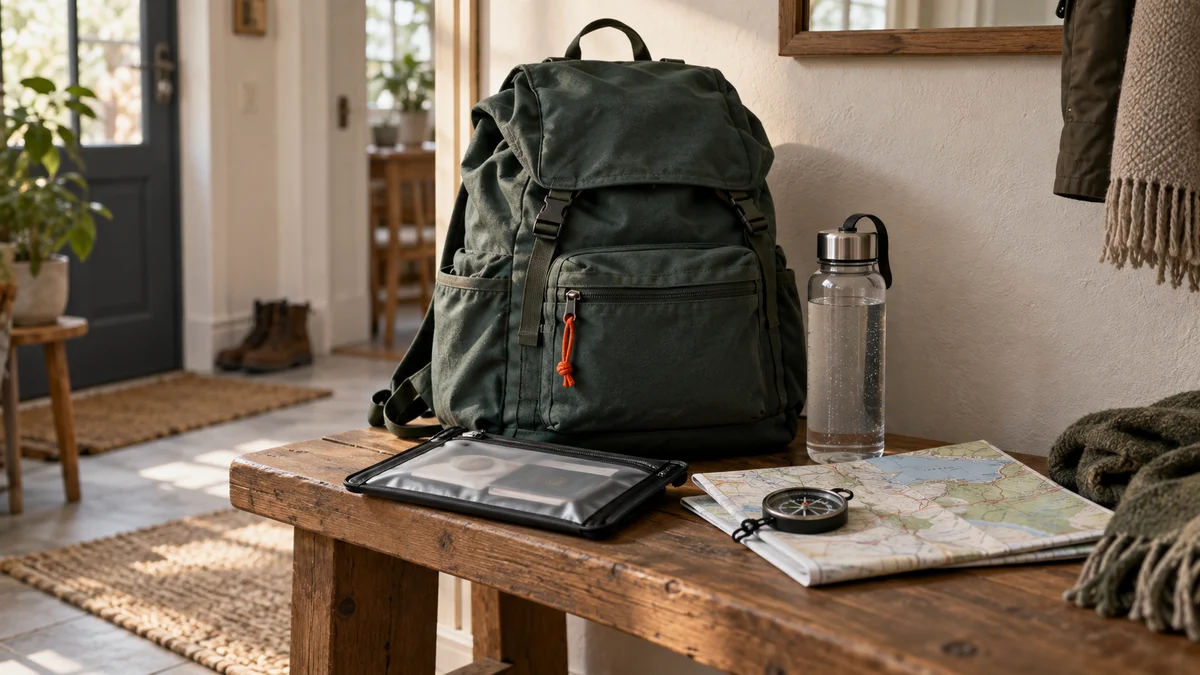
All of it lines up against the wall of the door you actually leave by, in one fixed place everyone in the household knows, including the house-sitter. Never the basement, never the underground garage, never the top of a pull-down ladder — those flood, fill with smoke, or cost four minutes you do not have. In an apartment the bags stay inside the apartment, not in a shared storage room that needs a key.
A pair of closed shoes sits on top of the largest bag, for everyone. A headlamp clips to the outside strap, because in an unlit hallway the first thing you need to see is the bag. And if the entryway has no floor to spare, a row of heavy-duty over-the-door hooksaff. turns two square feet of door into the staging area, which is the single cheapest fix in this article.
Then the repack, twice a year, on the two clock changes. Everything onto the kitchen table. Water and food into normal use and replaced. Power bank recharged, every lamp switched on, radio tuned. Document copies and medication lists updated. Clothes changed for the season and, for children, for size — kids outgrow a bag far faster than a bag wears out. Each one back on the bathroom scale before it goes back by the door.
Repack early after anything that changes the household: a birth, a new prescription, a new animal, a move. A move changes the most, because the hazard changes with the address — which is the first question of natural disaster preparedness, and a better place to start than any shopping list. What you carry on your body on an ordinary Tuesday is the layer underneath all of this, and it is the subject of everyday carry essentials. What stays home at the scale of two weeks and a month belongs to long-term emergency preparedness.
One last note on the Marshall Fire, and it is why I keep returning to it rather than to a wildfire in a forest. It burned through subdivisions with lawns and two-car garages, in the last week of December, in a state where people were thinking about snow. Nobody there had a bag by the door because of the grass. The checklist is not a prediction about where you live. It is ninety minutes on a Saturday, and then a row of bags that will very probably never be needed — the best possible outcome, and the only one worth packing for.
Frequently asked questions
- What is on a complete go bag checklist?
- Nine posts, split across two kinds of bag. The household bag holds what nobody should carry twice: a collapsible jug, a filter, a weather radio, the full first aid kit, the original documents in a waterproof pouch, cash in small bills, a power bank with a cable per phone, shared food, and the handwritten contact card. Each personal bag holds what belongs to one person: a quart of water, one change of clothes, a warm layer and a rain shell, a headlamp, copies of the paperwork, their own prescriptions, a snack, a hygiene kit. Then the inserts that depend on who lives with you — infant, animal, medical equipment. Nothing on the list is for living outdoors, because you are not going outdoors.
- What should a child's go bag contain?
- Their own bottle, one warm layer and a hat, their own flashlight, a snack they actually eat, the comfort object, something to do that needs no screen, and an identification card in the front pocket with their full name, their parents' names and numbers, and the out-of-area contact. Total weight under ten percent of the child's body weight, which for a fifty-pound kid is five pounds — roughly a school backpack with a water bottle in it. Let them pack it and let them carry it. A child who chose their own flashlight will keep track of it in a room full of strangers, which is more than can be said for one handed a bag at the door.
- What goes in a go bag for a baby?
- Ready-to-feed formula rather than powder, because powder needs safe water and safe water is the resource in question. Bottles. Three days of diapers and a pack of wipes. A changing pad that folds. Two changes of clothes plus one more warm layer than the weather seems to ask for, since small bodies lose heat fast in an unheated room. And a soft carrier rather than a stroller: a stroller does not climb gym stairs, cross gravel or fold into a packed car. All of it rides inside the household bag as an insert, not in a bag of its own, because the person carrying an infant is already carrying the heaviest thing in the house.
- How do you handle prescriptions in a go bag?
- The medications travel in the bag of the person who takes them, in their original labeled bottles, never decanted into a weekly organizer where nobody can read what they are. Alongside them goes a written list: what is taken, at what dose, how often, the diagnosis, the allergies, and the prescriber's name and number. Ready.gov's guidance for people with disabilities asks for exactly that list, and it also asks for a cooler and chemical ice packs for anything refrigerated. How many days of an advance supply you should hold, and whether your plan allows an early refill, is a conversation with your physician and pharmacist. No website should answer it, and this one does not.
- What do you leave out of a go bag?
- The tent, the sleeping bag, the hatchet, the stove, the fixed-blade knife, the rope, and the extra gallons of water. Together they are thirty pounds of equipment designed for a night in the backcountry, and you are going to a relative's spare room or a school gym with a floor and a coffee urn. Leave out the sealed pre-made kit as well, or rather open it the evening it arrives, weigh it and strip it. The one deletion that saves the most weight is water: a quart carried, a filter, and a collapsible jug you fill at the far end replaces eight pounds with half a pound.
- Should the go bag hold originals or copies of documents?
- Both, in different bags. The originals — IDs, passports, birth certificates, Social Security cards, the deed or the lease, the insurance declarations page including the separate flood policy — travel in one waterproof pouch inside the household bag. Copies go in each personal bag, so a household that gets split still has something to show at a shelter desk or an insurance table. Ready.gov's financial preparedness guidance adds the third layer that costs nothing: store the same documents on an external drive or in the cloud so they are reachable when the pouch is not. Photograph every room of the house while you are at it.
- How often should the bags be repacked?
- Twice a year, on the two clock changes, because those are dates nobody has to remember. Everything comes out onto the kitchen table. Water and food go into normal use and get replaced, the power bank is recharged, every lamp is switched on, the radio is tuned, document copies and medication lists are updated, clothes change season and, for children, size. Then each bag goes back on the scale. Repack early as well after anything that changes the household: a birth, a new prescription, a new animal, a move to a different address with a different hazard behind it.
Who wrote this
Baptiste S.
Founder and writer · bs-media
I am not a firefighter, a paramedic or a survival instructor. I am someone who read his government's household preparedness guide cover to cover, lives where winter storms knock the power out every year, and decided to do the work properly: read the official guidance, run the numbers, compare the spec sheets, and write down what I wish I had found. This site sells neither fear nor bunkers. It explains what an ordinary household can put together in a weekend, and in what order.
- I start from official guidance — FEMA, Ready.gov, the National Weather Service, the CDC, the American Red Cross — and I link to it. If I have not checked it, I do not write it.
- No guns, no bunkers, no doomsday: this site prepares an ordinary household for three days, two weeks, a month.
- I say what is not worth buying, including the things that sell best in survival stores.
- On health, medication and electrical work, I defer to your doctor, your pharmacist or a licensed electrician. That is not my job.
Read next
Backpacking Water Filter vs Purifier: What Each Removes
Backpacking water filter: what a 0.1-micron membrane stops, what slips straight through, and which of six technologies fits your trip. The sizes, from the CDC.
Everyday Carry Essentials: The Five That Matter
Everyday carry essentials: the five items worth adding to your phone, keys and wallet, what each one weighs, and why the rest of EDC is a hobby. Build yours.
Navigate Without GPS: Map, Compass, Declination
Navigate without GPS: read a USGS topo map, set the magnetic declination for your state, take a bearing and take it back, and fix the turnaround hour first.
72 Hour Kit Checklist: Every Line, Counted
The 72 hour kit checklist, counted for your own household: gallons, meals, lights, batteries, the seven lines people leave out, and where it all fits at home.