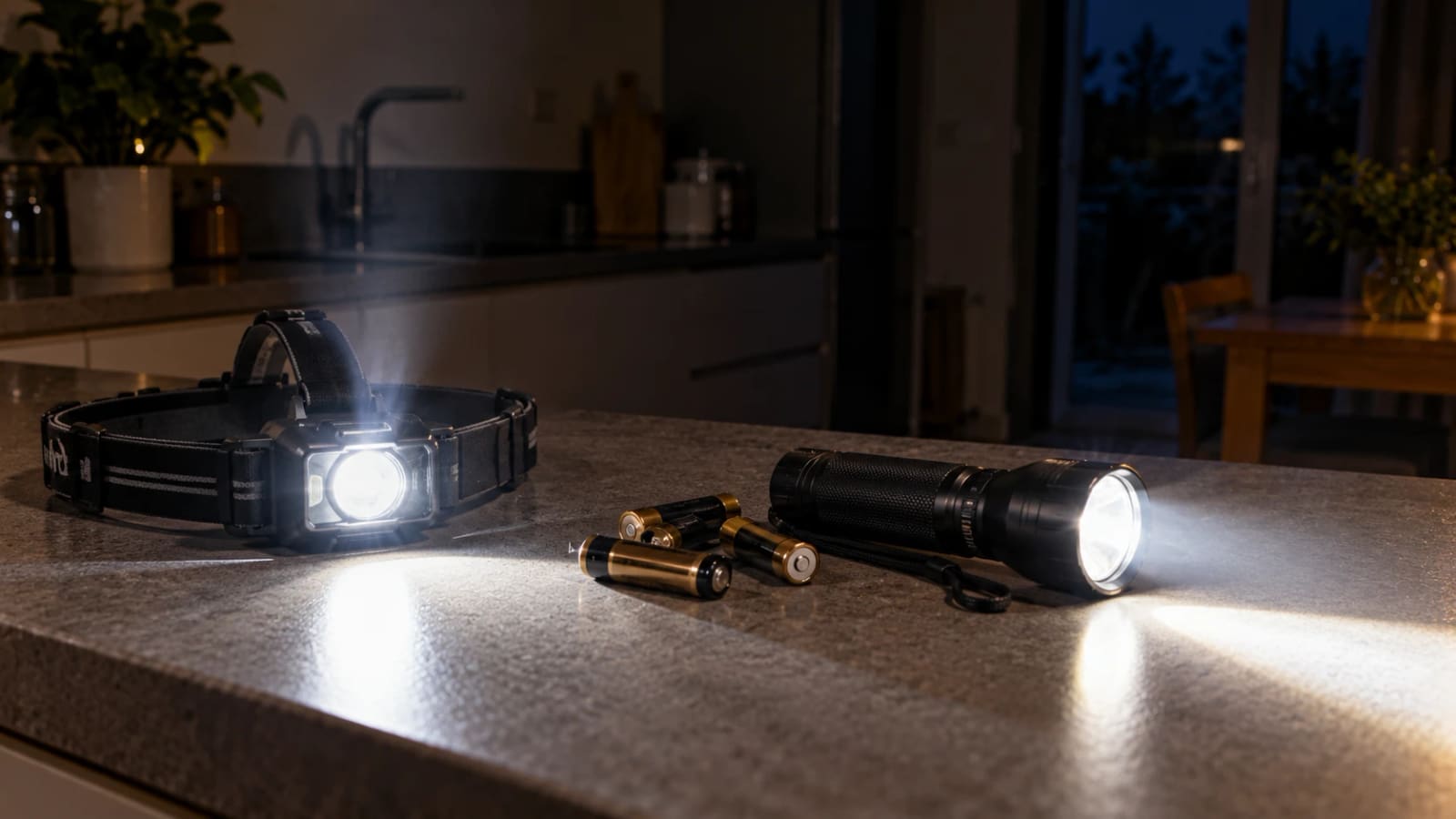
Ready.gov’s power outage page gives one instruction about light, and it is a count rather than a product: “Have flashlights for every household member.”
Not a headlamp. And yet, if I were keeping one light in the hallway closet, it would be the headlamp.
What an outage actually asks of you
A power cut gets described as a shortage of light. It is lived as a run of small jobs.
You have to find the panel and reset a breaker. Check the freezer is properly shut. Put a cold meal together. Swap the batteries in the radio, which are dead because the last check was a while ago. Settle a child who has never seen the house dark.
The problem is that these jobs share something a lamp comparison ignores: they take both hands.
Holding a flashlight in your teeth is the fix everyone eventually finds, and it tells you everything. If the object best suited to the situation forces you to improvise in the first five minutes, the choice was wrong.
There is a question of hour, too, that nobody asks. An outage at two in the afternoon in June needs no lamp at all. The same outage at five thirty on a December evening starts dark and ends dark, and it is the only one worth buying equipment for.
The hands-free test
How many of your chores need both hands?
Tick the chores an evening without power would actually force on you, in your home. The count takes care of itself.
The count is not a poll. Of the eight chores listed, six take both hands, and those six come first. The other two — stairs, a look down the driveway — come later, and they are exactly where the headlamp gives way.
Three ranges in one evening, and why no light wins them all
The debate uses the wrong unit. We compare lights when we should be comparing distances.
An evening without power imposes three, and they do not call for the same object.
Interactive diagram
The three ranges of an evening without power
Tap a zone in the cutaway: the card says what that range asks for, and which of the two lights answers it.
Swipe to see the whole cutaway
Range 1 — 16 to 24 in
Arm's length
Swapping batteries, opening a can, reading a label, cleaning a cut. Both hands are working, and the light has to follow your eyes without being held.
The headlamp wins, and not narrowly: a flashlight takes the hand that should be holding the thing. This is the one range where there is no argument.
For this range the article recommends a headlamp: it is the only one where it wins outright.
🛒 See headlamps with a washable bandLien affilié
Range 2 — 7 to 13 ft
The room you stay in
Eating, keeping children busy, finding your way around the kitchen. You do not want a beam, you want a light that sits there and does not aim at anyone.
A draw, and both lose: any beam lights one wall and leaves the room dark. A headlamp turned up at a pale ceiling does better; a lantern does far better.
Range 3 — 26 to 40 ft
The crossing, and what is at the end
Going down to the basement for the panel, crossing a windowless hallway, stepping out to the driveway. You need to see far, ahead, and know where your foot lands.
The flashlight takes it back: the beam carries, and a wrist aims faster than a neck. This is also the range FL 1 measures as “beam distance”.
For this range the article recommends a flashlight: the beam carries and the wrist aims it.
🛒 See flashlights with an adjustable beamLien affilié
Range 3 deserves to be taken seriously, because that is where people get hurt. Going down to the basement for the panel, on stairs with no handrail, with a light in one hand: the move is ordinary and it is the one that sends people to the emergency room every winter. A headlamp leaves both hands for the wall or the rail. But its beam follows your head, so your eyes, and not your feet — which is the case for a light that throws further and that a wrist can sweep across the bottom steps before you commit.
This is also the only range where I would carry both objects at once, one on the head and one in the hand. It sounds excessive until the first time you do it: the headlamp keeps your footing lit while your hands hold the rail, and the flashlight sweeps ahead of you. Two lights, two jobs, and neither replaces the other.
Range 2 is the one both lights lose. Any beam lights one wall and leaves the room dark. For four people around a table you do not want a beam, you want diffuse light: a headlamp aimed at a pale ceiling is an honest stopgap, and a battery lanternaff. is a great deal better. It is the one object in this article that neither lamp replaces.
What the headlamp adds, and the detail that changes the night
The band is not the point. The red mode is.
A headlamp sits at eye level. Every time you look at someone, you blind them — a child, an older parent, whoever is holding the ladder. Over three hours that is a real source of friction in a room that is already abnormal.
Red fixes it without switching the lamp off. It also protects your night vision, which takes around twenty minutes to settle and that one white flash wipes out instantly. Useful when you want to see what is going on outside, or watch a street without announcing yourself.
The second detail is more mundane: a band gets dirty and goes slack. A model whose band detaches and washes lasts ten years; the others end up at the back of a drawer, which amounts to not owning one.
Comparing two lights without believing the seller
Here the method matters more than the product, because product pages are written not to be comparable.
For a kit light, two quantities are enough: run time on the medium mode, and water resistance. Beam distance only matters for range 3, and an adjustable beamaff. answers it better than a high lumen number.
The allotment matters more than the model
This is where I change my mind about my own question. “Headlamp or flashlight” is badly posed, because it assumes you buy one.
Ready.gov does not assume that. It says one per household member, and it is right for a reason that has nothing to do with performance: a single light leaves with whoever holds it — and in a two-storey house, the person who stays is in the dark. It also fails, which during an outage is not a hypothesis but a statistic.
Your household light kit
How many lights, and which ones, for your home?
Three settings about your home. The output is not a model: it is who carries what, and what stays put where.
The basic disaster supplies kit is just as plain about the rest of the list. It asks for a “Flashlight” and “Extra batteries”, and for water at “one gallon per person per day for several days, for drinking and sanitation”. It also tells you where it all lives: items stored in airtight plastic bags inside easy-to-carry containers. That last line is the one most people skip, and it decides whether the lamp exists on the night you need it.
Battery size is the call almost nobody makes, and it is the most profitable one. With three lights in AAA and two in AA you need two stocks, two expiry dates, two lists. All in AA, a single pack of low-self-discharge batteriesaff. covers any of them. That is also what the basic kit asks for: “Extra batteries”, not an extra lamp.
What this is worth against a real outage
Which leaves the question of what you are preparing for. Ready.gov is specific about the clock, and the numbers are useful because they tell you how long light has to last.
A closed refrigerator “will keep food cold for about four hours”, and “a full freezer will keep the temperature for about 48 hours”. The page is blunt about the rest: “When in doubt, throw it out! Throw away any food that has been exposed to temperatures 40 degrees or higher for two hours or more.” And if the outage runs past a day, it says to discard refrigerated medication unless the label says otherwise.
Four hours is the number that sets the lighting problem, and it is also why the planning horizon is three days rather than one: the reasoning behind why 72 hours is that help is not instant, and light is the one supply you need on the very first evening. Beyond it, you are not managing a dark room any more, you are managing a household — which is what the article on an extended power outage covers hour by hour. The lamp is one item of the 72-hour emergency kit, alongside emergency water storage and an emergency weather radio, whose built-in light replaces none of the three ranges in the diagram. It also sits on the 72-hour kit checklist, where it comes after water and before food: you can go three days without eating comfortably, not three nights without seeing.
What does not work, and what I do not recommend
Three false good ideas, and I offer nothing on two of them.
Candles. They light range 2 and nothing else, they burn the oxygen of a closed room, and they set houses on fire during outages specifically. Ready.gov’s outage page does not mention them at all. I do not recommend them, and no link in this article points to one.
The phone light. It works, and it drains the one battery connecting you to help and to information. That is the trade not to make, and it is worked through in the article on a power station vs a generator.
The rechargeable lamp as a kit lamp, finally. It assumes an outlet, which is the thing that is missing. It belongs in your everyday carry essentials, recharged nightly, and nowhere in a closet where it sleeps eleven months.
The verdict, and the item I keep
If I keep one: the headlamp, for the six chores in eight that want two free hands, with a washable band and a red mode.
If I keep two: that headlamp and a flashlight with an adjustable beam, stored at the foot of the stairs rather than in a kitchen drawer.
If I keep three, and this is what I would do: both of those plus a set-down lantern, because range 2 is where the family spends its four hours, and it is the only one of the three ranges no beam covers.
Storage is part of the choice, which always surprises people. A lamp at the back of a kitchen drawer, under the tea towels, does not exist on the night you need it. A clear airtight binaff. always kept in the same place, visible and openable one-handed, beats a better lamp you hunt for twenty minutes.
There is one more habit worth building, and it costs nothing. Batteries do not announce their state: you cannot tell a dead AA from a fresh one by looking at it, which is why the radio is always flat when it matters. A cheap battery testeraff. turns the annual check into a two-minute job instead of a blind replacement of everything, and it pays for itself the first time it tells you a pack is still good.
The threshold I keep is not a lumen count. It is the battery size: one for the whole house, checked on a fixed date once a year along with the water and the important documents for an emergency. A perfect lamp with dead batteries lights exactly as much as a mediocre one.
One question I have not settled, and it applies to the whole kit: the lamp also has to work when you leave, and a go bag does not have the same weight constraints as a hallway closet. The headlamp wins there too, for a different reason — it weighs about two ounces.
Frequently asked questions
- Headlamp vs flashlight for a power outage: which one if I only keep one?
- The headlamp, if it is down to one. The reason is not output but hands: an outage is a run of chores — swapping batteries, opening a can, resetting a breaker, cleaning a cut — and each one takes two hands. A flashlight occupies the hand that should be holding the thing. The headlamp does lose on two counts: it lights a room poorly, and it sits at eye level, so you blind whoever you look at. That is what the red mode is for, and it is not a gimmick.
- What does Ready.gov recommend for lighting in an outage?
- Ready.gov's power outage page says plainly: "Have flashlights for every household member." The basic disaster supplies kit lists a "Flashlight" and "Extra batteries", and one gallon of water per person per day for several days. Note the count rather than the model: one per person. That is the part most households get wrong, and it matters more than choosing between a headlamp and a flashlight, because a single light leaves with whoever is holding it.
- How many lights should a household have?
- More than one, and that is the real subject. Ready.gov sets the floor at one per household member. The working rule that covers the ranges a single light cannot: a headlamp for each self-reliant adult, a flashlight per level you have to cross — basement, upstairs, landing — and at least one set-down light per living room. The configurator in this article builds the allotment for your home. The second call is the battery size: all AA or all AAA, so one spare set covers any of them.
- What is the red mode on a headlamp for?
- Two things, and both matter in an outage. First, not blinding people: a headlamp worn at eye level sends its beam into the eyes of whoever is talking to you, and red removes that without switching the lamp off. Second, keeping your night vision, which takes around twenty minutes to settle and that one white flash wipes out. That is useful when you want to see what is happening outside through a window without lighting yourself up.
- Batteries or rechargeable for an emergency light?
- Batteries, for a light that sleeps eleven months a year. A rechargeable lamp assumes a working outlet, which is precisely what is missing. It belongs in your everyday carry, not in the kit. Ready.gov lists "Extra batteries" for a reason: the consumable stores, electricity does not. If you do want a rechargeable light in the kit, plan how you will refill it without a wall socket — a power bank counts, a wish does not.
- How do I compare two lights without trusting the seller?
- By looking at the quantities the standard forces them to declare. ANSI/NEMA FL 1 defines and standardises six characteristics of a portable light: light output, beam distance, peak beam intensity, run time, impact resistance, and protection against water penetration. A product page that claims a lumen figure without saying on which mode or for how long says nothing. Two lights only compare quantity by quantity, on the mode you will actually use — which is never the boost mode.
Who wrote this
Baptiste S.
Founder and writer · bs-media
I am not a firefighter, a paramedic or a survival instructor. I am someone who read his government's household preparedness guide cover to cover, lives where winter storms knock the power out every year, and decided to do the work properly: read the official guidance, run the numbers, compare the spec sheets, and write down what I wish I had found. This site sells neither fear nor bunkers. It explains what an ordinary household can put together in a weekend, and in what order.
- I start from official guidance — FEMA, Ready.gov, the National Weather Service, the CDC, the American Red Cross — and I link to it. If I have not checked it, I do not write it.
- No guns, no bunkers, no doomsday: this site prepares an ordinary household for three days, two weeks, a month.
- I say what is not worth buying, including the things that sell best in survival stores.
- On health, medication and electrical work, I defer to your doctor, your pharmacist or a licensed electrician. That is not my job.
Read next
72 Hour Kit Checklist: Every Line, Counted
The 72 hour kit checklist, counted for your own household: gallons, meals, lights, batteries, the seven lines people leave out, and where it all fits at home.
Emergency Water Storage: How Much, Where, How Long
Emergency water storage, sized and drawn: gallons per person, which containers fit where, the six-month rule, and how to keep it drinkable. Start this weekend.
Emergency Weather Radio: How to Choose One That Wakes You
An emergency weather radio earns its shelf only if it wakes you at 2 a.m.: NOAA All Hazards, SAME coding, tone alert, battery backup. Compare before you buy.
Extended Power Outage: What to Do, Hour by Hour
An extended power outage fails in stages: hour 0, hour 4, hour 24, hour 72. What breaks at each one, what to do, what to keep or throw out. Start your clock.